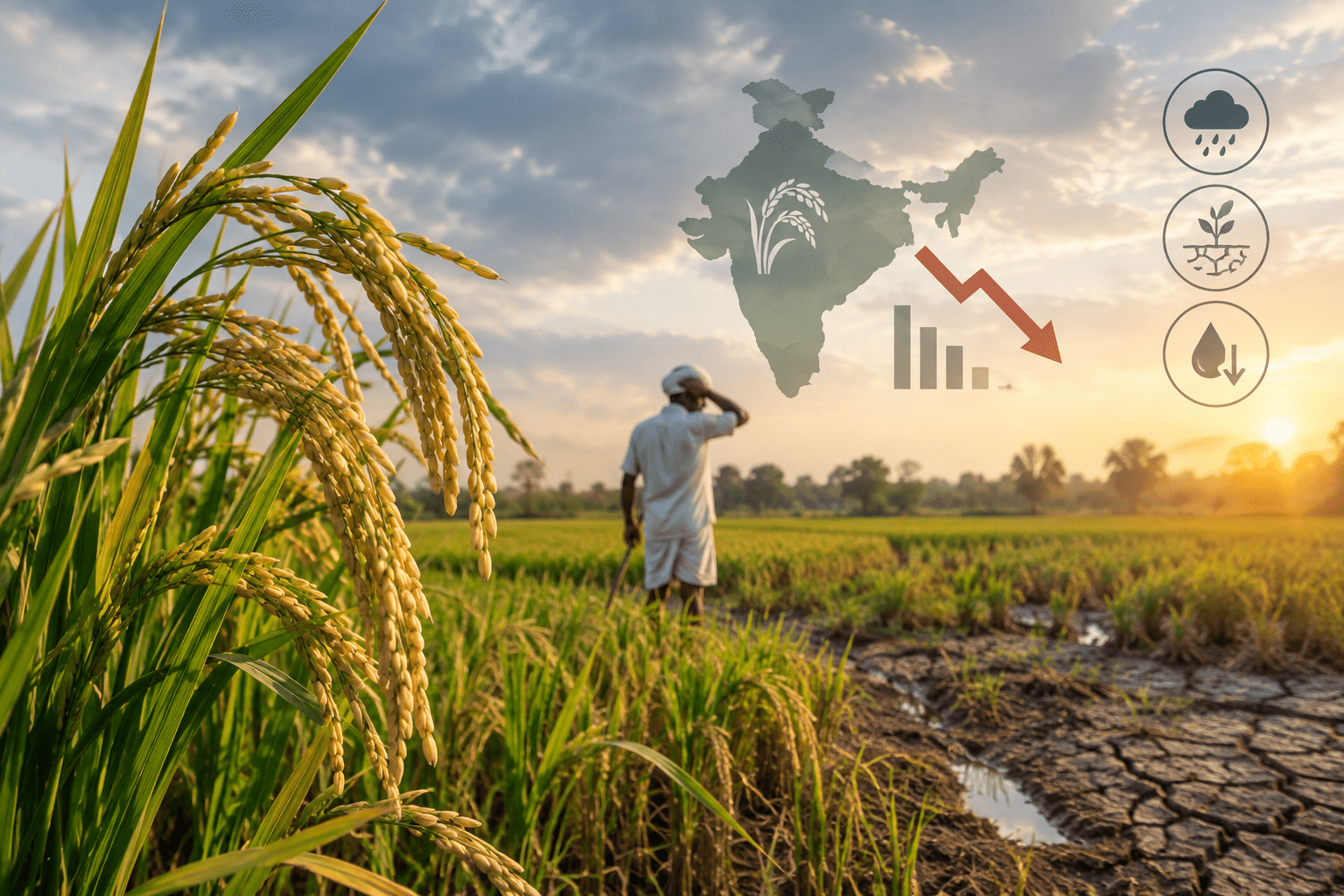
India’s rice production is expected to decline this year after below-normal rainfall affected crops during an important growth stage.
Industry estimates suggest that rice output could fall by around 10 million tonnes from last year’s record production.
That would represent a decline of about 6.5% from the previous year.
The expected fall could become India’s biggest rice production decline in nearly two decades.
Rice is one of India’s most important food crops.
However, rainfall shortages have affected several major rice-growing regions this year.
India received around 15% less rainfall than normal from the start of the monsoon season on June 1.
Some rice-growing states recorded much larger rainfall deficits.
The lower rainfall has reduced the yield potential of crops.
This is particularly important because the final stages of crop growth require adequate water.
The decline is not only linked to crop yields.
The area under summer-sown rice has also decreased.
Government data showed that rice was planted across around 42.68 million hectares as of September 11.
That was nearly 4% lower than the area recorded during the same period last year.
Earlier government data also showed lower rice coverage across several states.
As of September 4, rice had been planted across 421.82 lakh hectares.
The corresponding figure last year was 438.19 lakh hectares.
This represents a reduction of 16.37 lakh hectares.
The reduction in rice area has been reported across multiple states.
Government data showed notable declines in:
Karnataka recorded a decline of about 4.28 lakh hectares in rice area compared with the corresponding period last year.
Telangana recorded a reduction of about 3.61 lakh hectares.
These changes show how rainfall conditions can influence planting decisions across major agricultural regions.
The situation could also affect the next rice crop.
Winter-sown rice accounts for a smaller share of India’s total rice production.
However, lower reservoir levels could make planting more difficult in some areas.
Water availability will therefore remain an important factor for the upcoming crop season.
Despite the expected production decline, India has large rice reserves.
Government stocks, including unmilled paddy, stood at around 59.6 million tonnes on September 1.
This was significantly higher than the government’s target of 10.3 million tonnes for October 1.
Large reserves could help India maintain domestic supplies.
They may also allow the country to continue rice exports despite lower production.
Markets have already started responding to expectations of lower production.
Local rice prices have increased as traders assess the potential supply reduction.
Export prices have also moved higher.
The increase could affect buyers in international markets if global rice supplies become tighter.
India remains one of the world’s largest rice producers and exporters.
Not all rice farmers are expected to experience the same market conditions.
Farmers producing premium rice varieties could receive higher prices in open markets.
Higher market prices may also influence how much rice farmers sell to government procurement agencies.
This could change the flow of rice between government stocks and private markets.
The rice situation highlights the importance of rainfall for Indian agriculture.
Farmers depend on the monsoon for crop establishment and growth.
When rainfall becomes uneven, farmers may face difficult decisions about sowing, irrigation and crop selection.
Water availability also affects the cost of cultivation.
Better water management can therefore play an important role in protecting agricultural production.
The expected decline in rice production does not mean that India’s overall rice supply will fall by the same amount.
Large existing stocks provide a buffer.
However, lower production could still influence prices, farm incomes and export markets.
The final production figure will depend on crop yields, rainfall conditions and the performance of the remaining rice-growing season.
For farmers, access to water and timely weather information will remain important as the season progresses.
India’s rice sector is entering an important phase.
Lower rainfall and reduced planting have created pressure on production.
At the same time, strong rice reserves provide some support to domestic supplies.
The coming months will show how much the rainfall shortage affects final output.
For Indian agriculture, the development once again highlights the close connection between water availability, crop production and food markets.