Indian farms are facing a changing economic and climate landscape. Farmers must manage crop costs, water availability, weather risks and changing market conditions.
A new approach called agrivoltaic farming is gaining attention in India. It combines agriculture and solar power on the same land.
The idea is simple. Solar panels are installed above or alongside crops, allowing farmers to continue cultivation while also producing renewable electricity. The approach is being discussed as India looks for ways to improve farm income and land-use efficiency.
Agrivoltaic farming combines agricultural production with solar energy generation.
Instead of using farmland only for crops or converting it completely into a solar installation, agrivoltaic systems can allow both activities to take place on the same site.
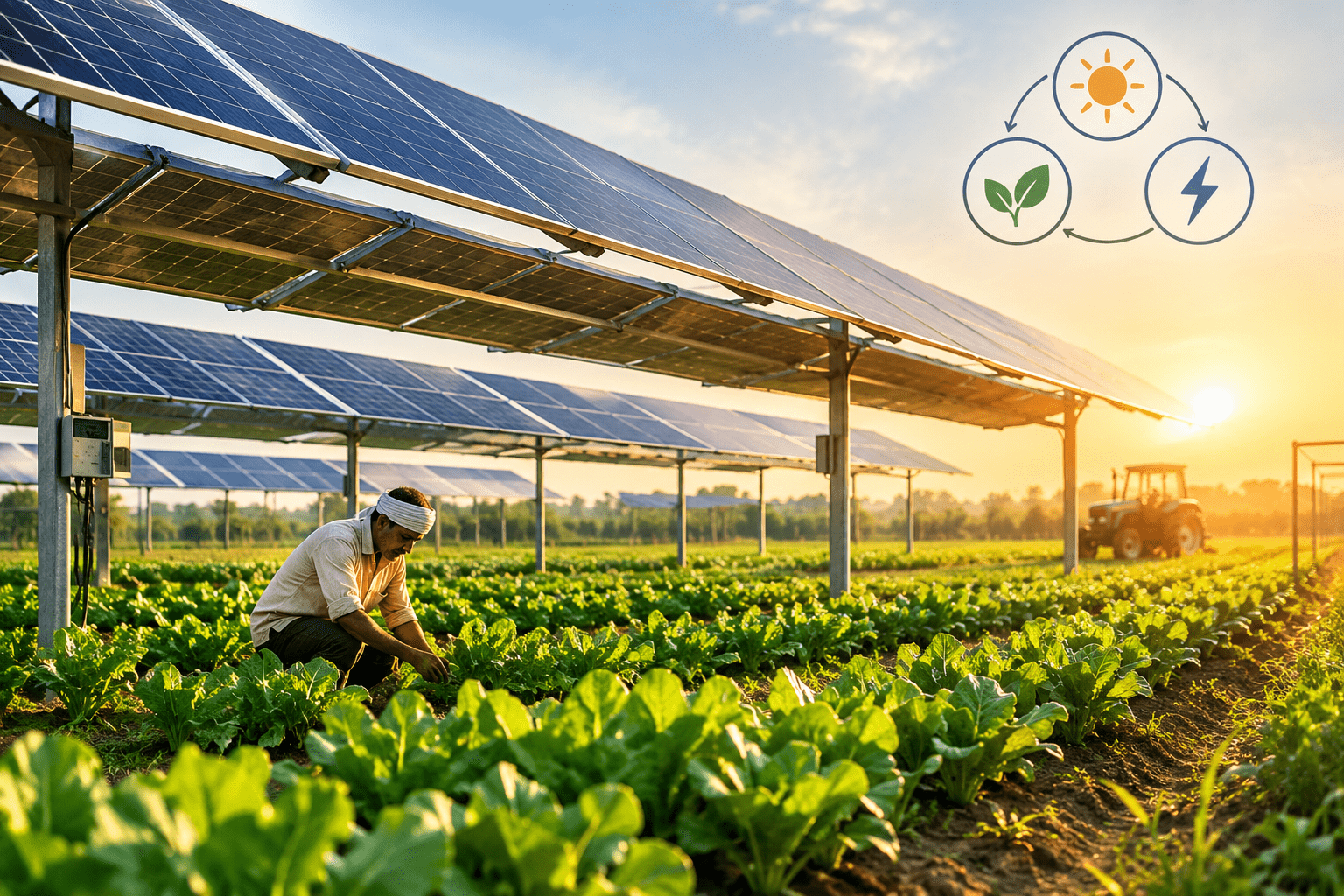
Solar panels can be installed at an elevated height. Crops can then grow below or between the panel structures, depending on the crop and design.
However, the system is not the same for every farm. Panel height, spacing, crop selection, sunlight levels and farm machinery access all need to be considered.
Research and field testing are therefore important before large-scale adoption.
In September 2026, Union Minister for New and Renewable Energy Pralhad Joshi highlighted agrivoltaics as an opportunity for Indian farmers.
Speaking at a curtain-raiser event for the 7th Agrivoltaics World Conference 2026, he said farmers could potentially earn from both agriculture and clean energy on the same land.
The proposed approach is aimed particularly at small and marginal farmers, Farmer Producer Organisations, cooperatives and panchayats. The minister also said that land ownership should remain with farmers.
This makes agrivoltaic farming an important topic for the future of agricultural land management.
A typical agrivoltaic farm uses elevated solar structures above cultivated areas.
The arrangement can provide space for crops underneath the panels while solar modules generate electricity above them.
The exact design depends on the farm.
For example, farmers need enough space for tractors and other equipment. They also need to consider how much sunlight different crops require.
Therefore, agrivoltaic farming in India is likely to require crop-specific and region-specific planning rather than a single model for every farm.
Agrivoltaics could create multiple economic streams from agricultural land.
Farmers can continue growing suitable crops under an appropriately designed solar structure.
The crop remains an important part of the farming system.
Electricity generated by solar panels can potentially create an additional revenue stream, depending on the project structure, power purchase arrangements and applicable regulations.
Solar power can also support farm operations.
It may help reduce dependence on diesel for certain agricultural activities when the system is designed for farm energy needs.
The Union Minister described these as three potential economic benefits from the same acre: crop income, electricity revenue and savings from solar-powered agricultural operations.
India has a large number of small and marginal farmers.
According to the figures cited by the Ministry of New and Renewable Energy, more than 85% of Indian farmers cultivate less than two hectares. The ministry has therefore highlighted agrivoltaics as one possible way to increase the economic value of limited land resources.
However, the financial outcome will depend on several factors.
These include installation costs, crop performance, electricity arrangements, maintenance, financing and local regulations.
Agrivoltaics should therefore be viewed as a developing farming model rather than a guaranteed income solution.
Agrivoltaic farming cannot be applied in exactly the same way everywhere.
Different crops need different levels of sunlight. Local weather conditions also affect the performance of both crops and solar equipment.
Researchers are already testing different combinations.
At BAIF’s Rural Innovation Centre in Pune, researchers are testing 17 solar configurations across 30 crops. The work is intended to study factors such as panel height, spacing, tracking systems, crop selection and business models.
This type of research can help identify which farming systems work best under specific conditions.
Modern farms depend on machinery for several operations.
Tractors, harvesters and other equipment need enough space to move through cultivated areas. Solar structures must therefore be designed around actual farm activities.
The Ministry has highlighted the need for solar structures that allow agricultural machinery to operate efficiently while also handling local weather conditions.
This is important because a solar installation should not make routine farm operations unnecessarily difficult.
Agrivoltaics was also highlighted ahead of the Punjab Agricultural University’s Kisan Mela, scheduled for September 18 and 19, 2026.
The event is focused on scientific farming, new crop varieties, agricultural technologies and improved farming practices.
PAU officials have described agrivoltaics as a way to improve land-use efficiency by allowing agriculture and solar power generation to share the same area.
The university is also promoting soil testing, careful use of fertilisers and water, crop-residue management and integrated farming systems.
The growth of agrivoltaics reflects a wider shift in how agricultural land can be managed.
Farms are no longer being discussed only in terms of crop production. Water management, renewable energy, technology and additional income opportunities are becoming part of the conversation.
Still, the success of agrivoltaic farming will depend on careful planning.
Farmers will need reliable technical advice, suitable crop choices and practical solar designs. Access to financing and clear power arrangements will also matter.
Most importantly, agricultural productivity must remain part of the planning process.
Agrivoltaic farming does not mean replacing agriculture with solar power.
Instead, the concept explores whether the same land can support food production and renewable energy when the system is designed correctly.
For India, where agricultural land is an important resource and renewable energy capacity is expanding, this approach could become an area of continued research and experimentation.
The coming years will show which crops, regions and farm models can benefit most from combining agriculture with solar energy.