Southern India’s digital transformation of land records is making agricultural land transactions more transparent and efficient. States such as Karnataka, Telangana, and Maharashtra have introduced digital land record platforms that simplify access to ownership records, mutation history, and land-related information. As a result, investors, managed farmland developers, and financial institutions can begin the due diligence process with greater clarity.
This shift comes at a time when managed farmland is attracting growing interest from high-net-worth individuals (HNWIs), NRIs, entrepreneurs, and institutional investors. While legal verification remains essential, digitized land records are helping reduce administrative complexity and encouraging greater confidence in India’s agricultural real estate market.
Buying agricultural land has traditionally involved extensive paperwork and multiple rounds of verification. In many cases, investors had to depend on physical records and local documentation, making the process both time-consuming and complex.
Today, digital platforms such as Bhoomi in Karnataka, Dharani in Telangana, and MahaBhulekh in Maharashtra allow users to access important land information online. Buyers can review ownership records, mutation history, and other essential details before proceeding with legal verification.
Although professional legal due diligence remains necessary, these digital systems make the initial stages of property evaluation much more efficient.
Transparency plays a significant role in every real estate investment.
With better access to verified land records, investors can evaluate opportunities with greater confidence. Managed farmland developers also benefit from improved documentation when planning new projects or expanding existing ones.
This increased transparency is particularly important for institutional investors and family offices that require structured documentation before making long-term investment decisions.
As digital governance continues to improve, agricultural land is becoming more accessible to a broader group of investors.
Digital land records are only one part of the transformation taking place across Indian agriculture.
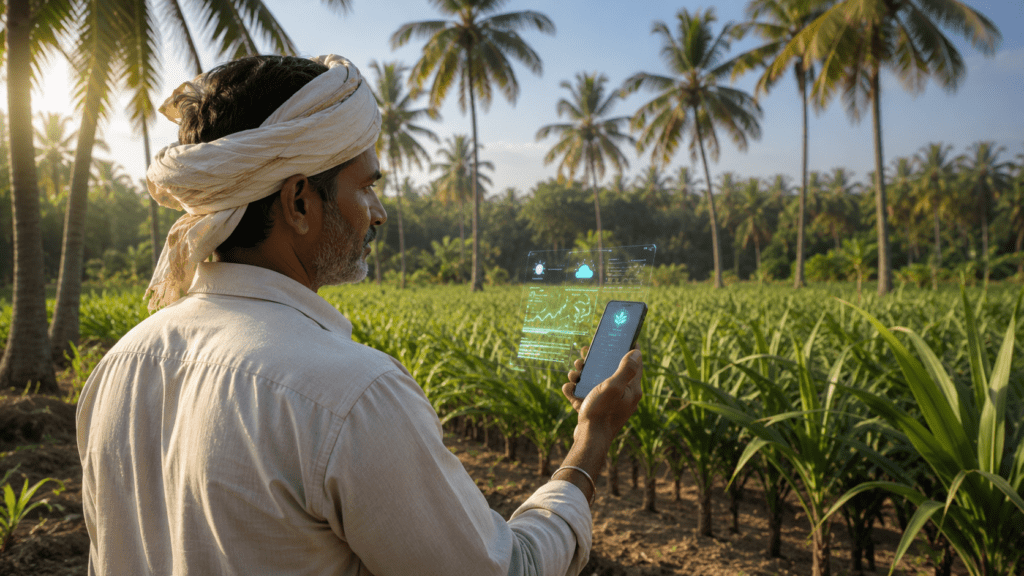
Professionally managed farmland projects are increasingly adopting modern technologies such as drip irrigation, automated fertigation systems, soil moisture sensors, satellite monitoring, and drone-assisted crop surveys.
These technologies help operators monitor crop health, improve irrigation efficiency, and optimize the use of water and fertilizers. They also support better planning throughout the growing season.
For investors, this means farmland is gradually becoming more professionally managed and operationally efficient.
Interest in managed farmland has increased steadily over the past few years.
Many buyers are looking beyond traditional residential and commercial real estate. Instead, they are exploring agricultural assets that combine professional management with long-term ownership.
Modern managed farmland developments often include planned infrastructure, internal roads, irrigation systems, security, landscaping, and ongoing farm maintenance. These features make farmland ownership more practical for professionals who may not have agricultural experience.
As a result, managed farmland continues to attract IT professionals, entrepreneurs, doctors, business owners, and NRIs seeking diversified investment opportunities.
Infrastructure development is also contributing to the sector’s growth.
Improved highways, industrial corridors, and expanding connectivity across Southern India have increased accessibility to many agricultural regions. Better transport networks make it easier for owners to visit their farmland while supporting efficient movement of agricultural produce.
Combined with digital governance and professional farm management, improved infrastructure is strengthening the overall appeal of managed farmland.
Technology is helping farmers make more informed decisions.
Modern irrigation systems, soil monitoring tools, and weather-based farm management solutions encourage more efficient use of natural resources. These practices support sustainable agriculture while improving operational planning.
Government initiatives promoting digital agriculture, micro-irrigation, and precision farming are further encouraging the adoption of modern farming techniques across the country.
Together, these developments are creating a stronger foundation for the future of Indian agriculture.
India’s agricultural real estate sector is undergoing a gradual transformation.
Digitized land records, improved infrastructure, and modern farming technologies are making managed farmland more transparent and professionally managed than ever before.
While every investment requires careful legal and financial evaluation, these developments are helping improve confidence across the sector.
As more states continue strengthening digital land administration, managed farmland is expected to remain an area of growing interest for investors seeking long-term ownership, operational efficiency, and exposure to India’s evolving rural economy.