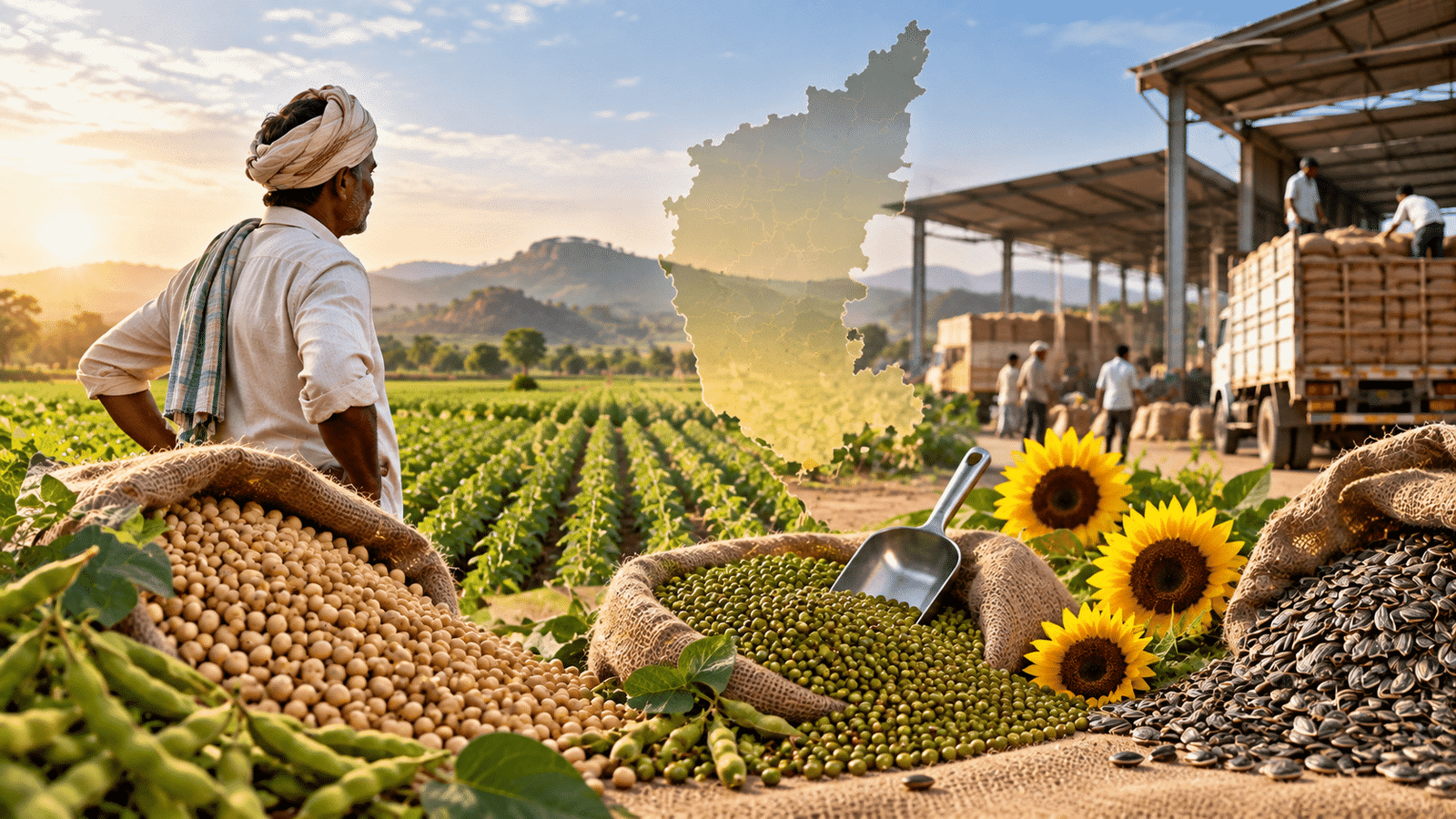
Farmers growing soybean, green gram and sunflower in Karnataka will have access to government procurement at the Minimum Support Price (MSP) for the Kharif 2026–27 season.
The Centre has approved procurement of 1,15,500 metric tonnes of soybean, 38,250 metric tonnes of green gram and 13,413 metric tonnes of sunflower from Karnataka under the Price Support Scheme (PSS).
The decision is particularly relevant to Karnataka’s farm sector because it provides an organised procurement mechanism for three important pulse and oilseed crops during the current marketing season.
The approved procurement quantities for Karnataka are:
The Karnataka procurement is part of a wider ₹5,547.99 crore MSP procurement approval covering Karnataka, Uttar Pradesh and Telangana.
For Karnataka alone, procurement worth approximately ₹1,107 crore has been approved under the Price Support Scheme.
Farmers often sell their produce through different channels after harvesting. Market prices can change because of supply, demand, quality, storage conditions and seasonal factors.
Government procurement at MSP provides an additional procurement channel for eligible quantities and farmers under the applicable scheme conditions.
The Centre said the latest approval is intended to provide greater economic security to pulse and oilseed growers and encourage domestic production.
However, MSP procurement does not mean that every quantity produced by every farmer will automatically be purchased. Procurement is subject to the approved quantities, designated agencies, eligibility requirements and operational guidelines.
Among the three crops approved for Karnataka, soybean accounts for the largest quantity.
The Centre has approved procurement of 1,15,500 metric tonnes of soybean, valued at about ₹659.27 crore according to the reported procurement allocation.
Soybean is an important oilseed crop in India. Its production contributes to the country’s edible oil supply chain and provides an important agricultural market for farmers in several states.
The approved procurement target for Karnataka includes 38,250 metric tonnes of green gram, also known as moong.
The reported value of this procurement allocation is approximately ₹335.83 crore.
Green gram is an important pulse crop and is widely used in Indian diets. Supporting domestic pulse production is also connected with India’s efforts to reduce dependence on imported pulses.
The Centre has approved procurement of 13,413 metric tonnes of sunflower from Karnataka.
The allocation is valued at approximately ₹111.90 crore under the approved procurement plan.
Sunflower is an important oilseed crop, and its production contributes to India’s broader edible oil supply chain.
The announcement is relevant not only to farmers but also to the wider agricultural ecosystem.
For farms producing soybean, green gram and sunflower, the procurement approval may influence decisions around:
Farmers still need to consider their production costs, crop quality, local market conditions and eligibility under the procurement programme.
Pulses and oilseeds occupy an important place in India’s agricultural economy.
Pulses contribute to domestic protein availability, while oilseeds are important for edible oil production.
India continues to import a significant share of its edible oil requirements. Increasing domestic oilseed production is therefore an important part of the country’s agricultural strategy.
Government procurement programmes are one of the mechanisms being used to support farmers producing selected crops.
For managed farmland businesses, developments in agricultural procurement provide useful insight into the changing farm economy.
A farm’s potential is influenced by more than the land itself. Crop selection, water availability, soil quality, farm management, input costs and market access all play a role in agricultural operations.
For managed farmland operators, understanding agricultural markets can help inform decisions about:
Different crops have different soil, water and climate requirements. Crop planning should therefore be based on the characteristics of the individual farm.
Water availability is especially important as Karnataka enters the transition from the kharif season to the rabi season. Recent reporting has highlighted concerns about rainfall deficits and reservoir levels in parts of the state.
Understanding procurement policies and prevailing market conditions can help farm managers make better-informed decisions about agricultural activities.
The latest procurement approval comes at an important point in the agricultural calendar.
Kharif crops are moving towards harvest and marketing, while farmers and farm managers are also beginning to prepare for the upcoming rabi season.
At the same time, Karnataka is dealing with uneven rainfall conditions. This makes water management, crop planning and market awareness important considerations for farms across the state.
The approved MSP procurement does not remove the wider challenges facing farmers, but it adds an organised procurement mechanism for the three specified crops.
The Centre has approved MSP procurement of 1,15,500 metric tonnes of soybean, 38,250 metric tonnes of green gram and 13,413 metric tonnes of sunflower from Karnataka for Kharif 2026–27.
The decision brings a government-backed procurement channel into focus for Karnataka’s pulse and oilseed farmers and highlights the growing importance of market access alongside effective farm management.