India’s agricultural land market is entering a more technology-driven phase.
Investors are paying greater attention to water security, soil health, farm productivity and environmental performance. At the same time, satellite imagery and digital monitoring are making it easier to track farming practices across large areas.
Punjab and Haryana offer an important example.
The two states are central to India’s rice-wheat production system. They are also at the centre of the country’s efforts to reduce crop-residue burning and encourage more sustainable farming practices.
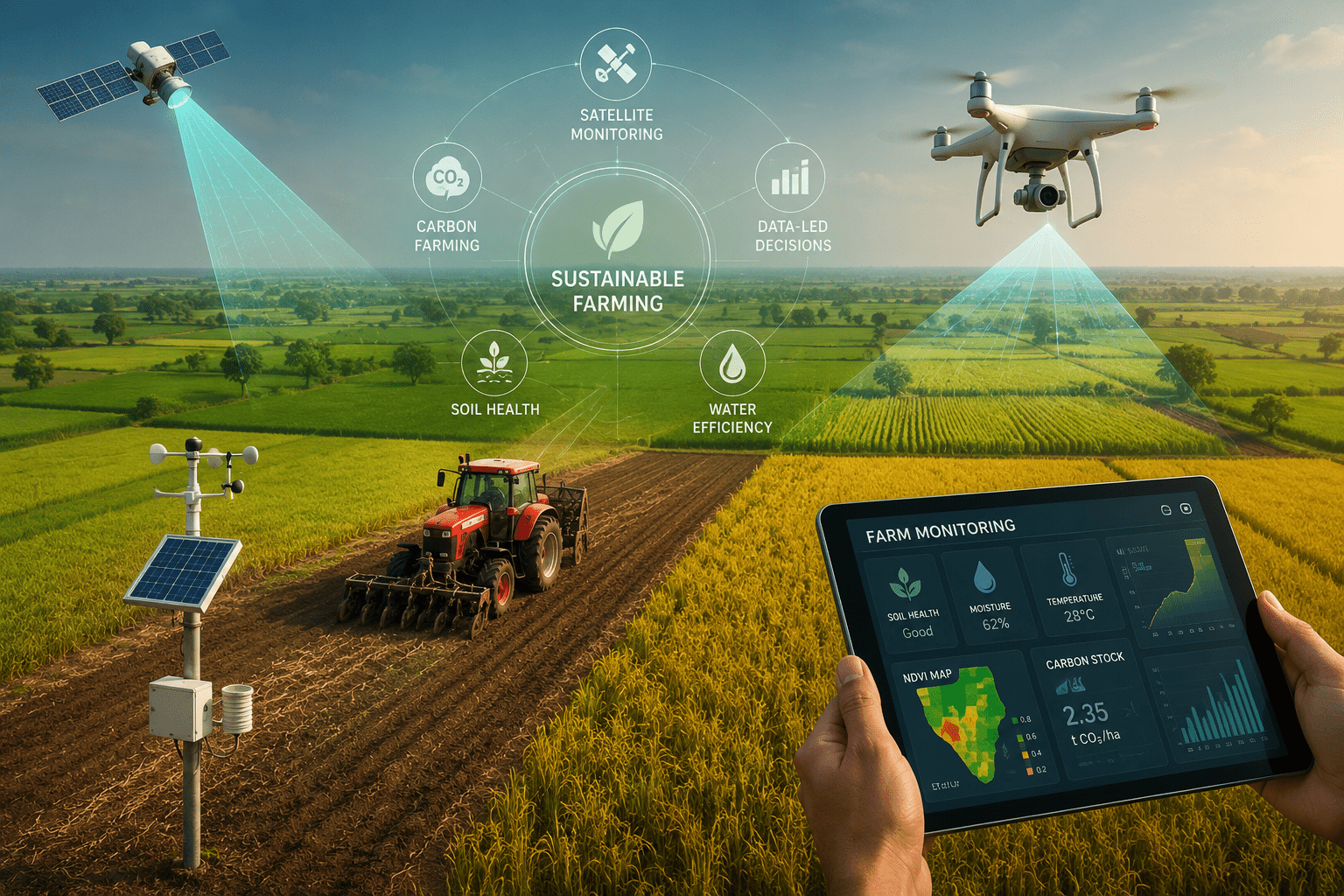
Recent research shows that satellite imagery can identify and monitor zero-tillage practices at scale. This creates new possibilities for agricultural monitoring, carbon farming and data-led land management.
For Indian farmland investors, however, the opportunity needs to be viewed carefully. Satellite monitoring does not automatically create carbon credits. Nor does sustainable farming guarantee higher financial returns.
The real opportunity lies in combining better data, responsible farm management and stronger agricultural fundamentals.
Traditional agricultural monitoring depends heavily on field visits and farmer records.
Satellite technology can provide another layer of information.
Researchers have used Sentinel-2 satellite imagery to identify zero-tillage practices in Punjab. One study developed a remote-sensing approach that achieved about 81% accuracy in mapping different tillage practices. Such technology can help researchers and farm managers understand how cultivation methods change across large agricultural areas.
This matters because farming practices can influence soil health, water use and greenhouse-gas emissions.
Zero tillage, for example, reduces soil disturbance. It can also reduce the time and fuel required for field preparation. When combined with residue management, crop diversification and efficient irrigation, conservation agriculture can support more resilient farming systems.
However, results vary by crop, soil, climate and farm-management method.
Carbon farming is attracting increasing attention in India.
Practices such as conservation tillage, residue management, improved fertiliser use and agroforestry can potentially reduce emissions or increase carbon stored in soil and vegetation.
Research on conservation agriculture in India has already examined the potential for carbon-credit generation. A study covering Punjab found that some zero-tillage and nitrogen-management practices could meet eligibility conditions under the voluntary Verra VM0042 methodology, although eligibility depends on additionality and other project requirements.
India is also developing its own regulated carbon-market framework.
Under the Carbon Credit Trading Scheme, eligible offset projects can generate Carbon Credit Certificates when they meet approved methodologies and verification requirements. BEE has adopted methodologies that include carbon-stock accounting and, in certain projects, soil organic carbon.
This distinction is important.
A farm using sustainable practices does not automatically qualify for carbon credits. Projects need to meet the applicable methodology, demonstrate additionality where required, maintain appropriate monitoring and undergo the required validation and verification process.
For investors, carbon revenue should therefore be treated as a potential additional value stream, not guaranteed farm income.
Punjab and Haryana have a unique position in India’s agricultural economy.
Their intensive rice-wheat systems have delivered high food production for decades. At the same time, the region faces challenges involving groundwater use, crop-residue management and soil health.
Research using satellite data has shown that remote sensing can help identify both crop-residue burning and zero-tillage practices. In Punjab, researchers found a relationship between greater zero-tillage adoption and lower residue burning.
This creates an important opportunity for better measurement.
Instead of relying only on self-reported farming practices, project developers and researchers can combine satellite imagery with field data, farm records and other measurement systems.
That could make future carbon-farming projects more transparent.
Satellite monitoring is only one part of the technology shift.
Modern farm operations can also use soil sensors, automated irrigation, weather data and agricultural drones.
Drones can support crop monitoring and precision spraying. Soil sensors can help track moisture and other farm conditions. Drip irrigation can improve the efficiency of water application.
But technology should be evaluated on actual farm performance.
A recent study by the University of Agricultural Sciences, Bengaluru, found that drone spraying reduced water used for agrochemical application by nearly 90% in its trials. The study also recorded yield increases of around 5% for ragi and 10% for pigeon pea.
These results demonstrate the potential of agricultural drones, but they should not be interpreted as a universal 20%–35% yield increase across Indian farms.
Crop, location and management quality all matter.
Technology is also changing agricultural land due diligence.
Karnataka’s Bhoomi system, Maharashtra’s MahaBhulekh and Telangana’s Bhu Bharati provide digital access to important land-record information.
Telangana’s Bhu Bharati is now the state’s integrated land-record management system. Its online services include land-detail searches, registered-document information and other land-related services.
These platforms can make preliminary verification faster.
However, digital records should not be treated as a complete substitute for legal due diligence.
Investors should still verify ownership, survey boundaries, encumbrances, land classification, mutation history, access rights and applicable state laws before purchasing agricultural land.
The original article also overstated the connection between digital title verification and priority-sector lending.
Agriculture is an important priority sector under India’s banking framework. Eligible agricultural credit includes farm loans, agricultural infrastructure and certain loans to corporate farmers, farmer producer organisations, partnerships and cooperatives engaged in eligible agricultural activities.
However, this does not mean that every agricultural land investor automatically qualifies for priority-sector financing.
Loan eligibility depends on the borrower, purpose of the loan, property, lender policy and applicable regulations.
For investors considering agricultural land investment, financing assumptions should therefore be based on the specific project rather than a general expectation of priority-sector benefits.
The biggest change may not be carbon credits themselves.
It may be the ability to measure farmland more accurately.
A professionally managed agricultural property can potentially combine several forms of value:
Each component has a different risk profile.
Crop income depends on weather and market prices. Land appreciation depends on location and demand. Environmental credits depend on methodology, verification and market conditions.
A strong investment model should keep these factors separate rather than treating them as guaranteed combined returns.
The next stage of India’s agricultural real estate market is likely to be more data-driven.
Satellite imagery can help monitor land use. IoT devices can generate farm-level data. Drones can support precision agriculture. Digital land records can make preliminary due diligence more accessible.
At the same time, India’s carbon-market framework is creating a formal pathway for eligible projects to participate in carbon markets.
This does not mean every farm will become a carbon asset.
Instead, it suggests that environmental performance may gradually become another factor considered alongside location, productivity, water security and land quality.
For Indian farmland investment, that could represent an important long-term shift.
The future of agricultural real estate in India may be shaped by more than land prices and crop yields.
Better measurement is becoming increasingly important.
Satellite technology can help identify farming practices. Agritech can improve resource efficiency. Digital land records can support due diligence. Carbon-market mechanisms may create additional opportunities for eligible agricultural and land-use projects.
Punjab and Haryana demonstrate why this transition matters. Their experience with zero tillage, crop-residue management and satellite monitoring shows how agriculture can become more measurable and data-driven.
For investors, the lesson is simple: technology and sustainability can strengthen farmland management, but neither should replace careful financial and legal due diligence.
The strongest agricultural land investments will continue to depend on fundamentals such as clear ownership, water availability, location, productive potential and professional management.
Carbon and environmental markets may add another layer of value in the future, but credible measurement and verification will be essential.