India’s renewable-energy transition is changing the way rural land is viewed.
Agricultural land has traditionally been valued for its farming potential, water availability and long-term appreciation. But in regions with strong renewable-energy resources, another factor is becoming relevant: the potential for land to support energy infrastructure alongside agriculture.
India’s wind sector has expanded significantly over the past decade. According to the Ministry of New and Renewable Energy, the country had about 57.44 GW of installed wind power capacity by June 30, 2026, compared with roughly 21 GW in 2014.
That expansion is creating a wider conversation around land.
For landowners and agricultural investors, the opportunity is not necessarily about turning farmland into a wind farm. In some locations, agricultural land can potentially participate in renewable-energy projects through leases, easements, access arrangements or other legally structured agreements.
The economics, however, depend heavily on location, project requirements and state regulations.
Wind energy is highly site-specific.
A suitable project needs strong wind resources, appropriate terrain, access to roads and transmission infrastructure. MNRE’s National Institute of Wind Energy has mapped wind potential across India’s major windy states, including Gujarat, Karnataka, Maharashtra, Rajasthan, Tamil Nadu and Telangana.
The scale of the opportunity is substantial.
MNRE estimates India’s gross wind potential at around 695.5 GW at 120 metres and 1,163.9 GW at 150 metres above ground level. Gujarat, Rajasthan, Karnataka and Maharashtra account for particularly large portions of that potential.
This does not mean every parcel within these states is suitable for a wind project.
Wind speed, turbine technology, land characteristics, grid connectivity, environmental considerations and project economics all have to be assessed before development.
A wind project can require land for turbine foundations, internal roads, electrical infrastructure, substations and transmission-related facilities.
In some cases, developers may work with landowners through long-term agreements.
The structure can vary. Depending on the project and contract, compensation may involve fixed payments, periodic rent, payments linked to project capacity or other negotiated arrangements.
There is therefore no universal “wind lease rate” that can be applied to farmland across India.
For an agricultural landowner, the important question is whether a proposed renewable-energy agreement provides a commercially attractive arrangement without undermining the productive use and legal status of the remaining land.
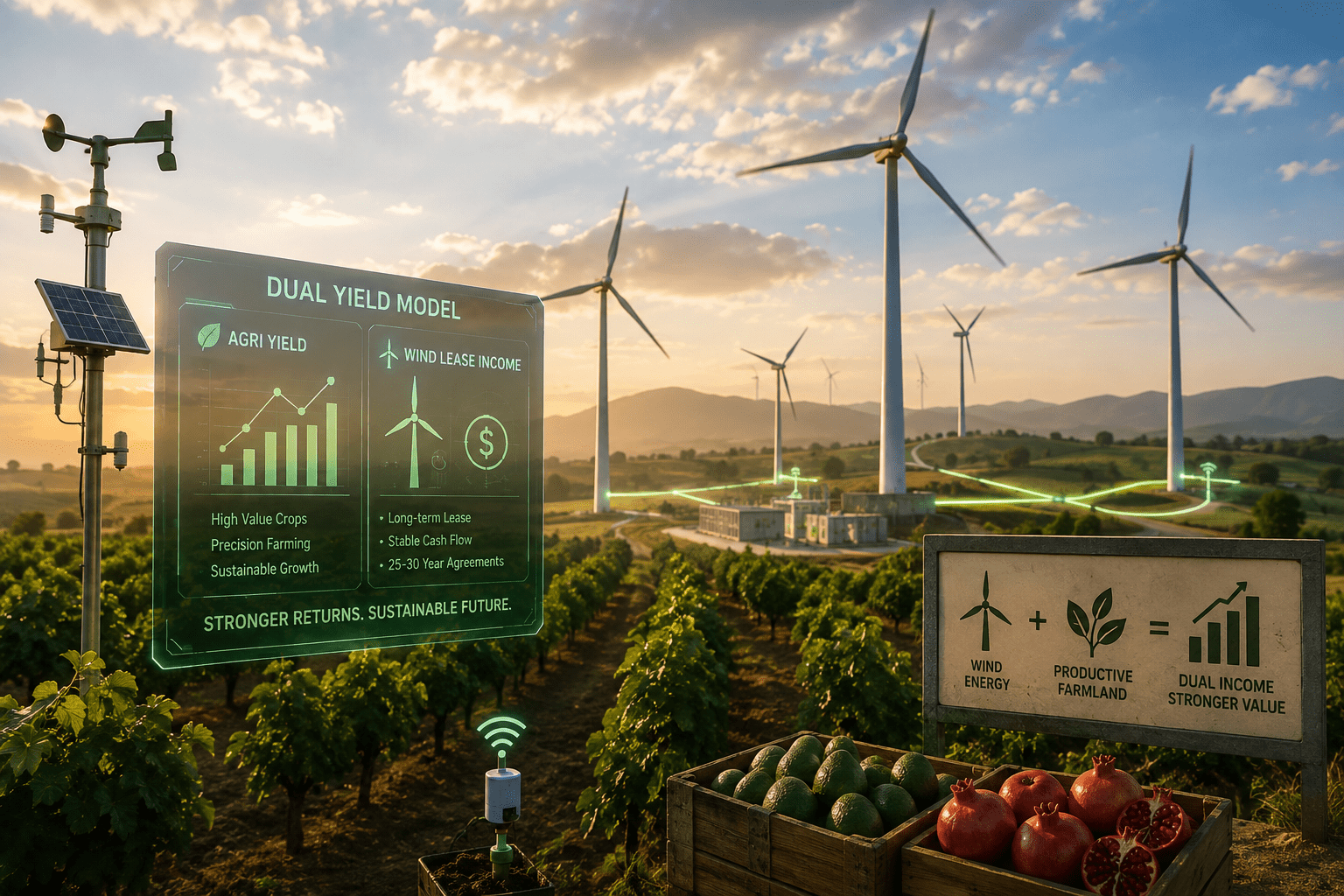
One of the more interesting developments in renewable-energy planning is the possibility of using land for more than one purpose.
A wind turbine does not occupy the entire area between turbines. However, that does not mean that 90% or more of a wind project’s land can automatically be farmed.
Wind projects require spacing between turbines, access roads, electrical infrastructure and other supporting facilities. The exact land requirement depends on turbine size, layout and site conditions. NIWE’s earlier technical material illustrates how turbine spacing can result in significant overall land requirements even when the physical foundation itself occupies a much smaller area.
Where agriculture can safely continue around project infrastructure, landowners may potentially retain some agricultural activity.
But that must be assessed on a site-by-site basis.
Modern wind projects are also becoming increasingly data-driven.
Wind-resource assessment, digital mapping, weather monitoring and grid analysis are used before developers commit significant capital.
NIWE operates a nationwide wind-resource assessment programme and has installed more than 900 wind-monitoring stations. It has also developed wind-potential maps at different hub heights.
This level of analysis is important because wind projects are long-term infrastructure investments.
A site that looks attractive from a simple land-price perspective may not be commercially viable if wind conditions are weak or grid connectivity is expensive.
For landowners, this means proximity to a proposed wind project alone should not be treated as proof of future income.
Energy cannot create value unless it can reach the grid or an approved power consumer.
This makes transmission infrastructure a major part of India’s renewable-energy expansion.
The Ministry of New and Renewable Energy’s Green Energy Corridor programme is supporting transmission infrastructure designed to integrate renewable-generation capacity into state and national power systems. Under the Intra-State Green Energy Corridor Phase-II programme, seven states — including Gujarat, Karnataka and Tamil Nadu — are implementing transmission projects designed to facilitate renewable-energy integration.
For rural land, this can create an important distinction.
A parcel with strong wind resources but poor grid access may be less attractive than a slightly less windy parcel with better transmission connectivity.
When agricultural land is connected to renewable-energy infrastructure, legal due diligence becomes more complicated.
Investors and landowners may need to examine:
Digital land-record platforms can help with preliminary verification, but they should not be treated as a substitute for professional legal review.
The regulatory position can also change over time.
For example, Karnataka introduced a 2026 system intended to simplify land-use procedures for renewable-energy projects, including wind, solar and hybrid projects.
This illustrates why investors should check the current rules applicable to the specific project and location, rather than relying on older assumptions about agricultural-land conversion.
Karnataka is already one of India’s important renewable-energy states.
MNRE estimates the state’s wind potential at around 124.15 GW at 120 metres and 169.3 GW at 150 metres.
The state has also set a target under its Renewable Energy Policy 2022–27 to add 10 GW of renewable-energy projects, including projects with energy-storage systems.
This combination of wind resources, renewable-energy policy and infrastructure development makes Karnataka an important market to watch.
However, renewable-energy potential should not be confused with guaranteed land appreciation.
A property’s value still depends on its individual characteristics and the actual development taking place around it.
The idea of combining agricultural activity with renewable-energy infrastructure is attractive because it potentially introduces another source of economic value.
But the financial outcome depends on the agreement and the project.
Agricultural income can fluctuate with weather, crop prices and input costs. Renewable-energy lease income can depend on contract terms, project commissioning and the developer’s obligations.
Land appreciation is also never guaranteed.
For this reason, investors should view renewable-energy integration as a potential diversification opportunity, rather than an automatic way to achieve double-digit annual returns.
The larger story is bigger than wind turbines.
India’s rural landscape is increasingly supporting multiple forms of infrastructure at the same time: agriculture, renewable energy, logistics, food processing, digital connectivity and water infrastructure.
This is changing the way productive rural land can be evaluated.
For managed farmland, the question may gradually move beyond:
“What can this land grow?”
to:
“What productive activities can this land sustainably support?”
That is a much broader investment question.
India’s wind industry is entering a period of continued expansion.
With more than 57 GW already installed and substantial identified wind potential across several states, the need for suitable sites and transmission infrastructure is likely to remain important.
For farmland owners, this could create selective opportunities where renewable-energy projects and agriculture can coexist within the applicable legal and operational framework.
But the opportunity will not be uniform.
The most attractive properties are likely to be those where land quality, wind resources, road access, grid connectivity, legal clarity and agricultural productivity come together.
For investors, that means the future of managed farmland may not be about choosing between agriculture and renewable energy.
In the right location, it could be about understanding how the two can responsibly coexist.
1. Check the wind resource first
Being located in a windy state does not mean every parcel is suitable for a wind project.
2. Examine grid connectivity
Transmission access can be just as important as wind conditions.
3. Never assume a standard lease income
Wind-energy agreements vary by project, location and negotiation.
4. Understand the full land requirement
Turbine foundations are only one part of a wind project. Roads, spacing, substations and electrical infrastructure also require consideration.
5. Conduct complete legal due diligence
Check title, land-use rules, access rights, easements and project-specific permissions.
6. Treat renewable-energy income as a potential additional value stream
It should not be presented as a guaranteed return or automatic appreciation driver.