For years, farmland in India has largely been viewed through two familiar lenses: agricultural income and land appreciation.
That view is beginning to change.
As climate risks, water security and sustainable agriculture become more important to investors, another layer of value is gaining attention the ecological value created by well-managed farmland.
Healthy agricultural land does more than produce crops. It can store carbon in soil and vegetation, improve water infiltration, support biodiversity and help maintain soil health. These benefits may not always appear on a conventional property valuation, but they can influence how productive and resilient a farm remains over time.
For high-net-worth individuals and long-term investors, this is creating a new way to think about farmland: not simply as agricultural real estate, but as an asset that can combine land ownership, agricultural productivity and environmental resilience.
Traditional farmland investment often focuses on location, acreage, irrigation and expected crop income.
These factors still matter. But the quality of the land itself is becoming increasingly important.
Practices such as agroforestry, crop diversification, cover cropping, reduced tillage and the use of organic amendments can improve soil structure, water retention and nutrient cycling. Research published by the Indian Council of Agricultural Research has highlighted the potential of regenerative agriculture to improve soil quality, water retention and the resilience of cropping systems.
This changes the investment conversation.
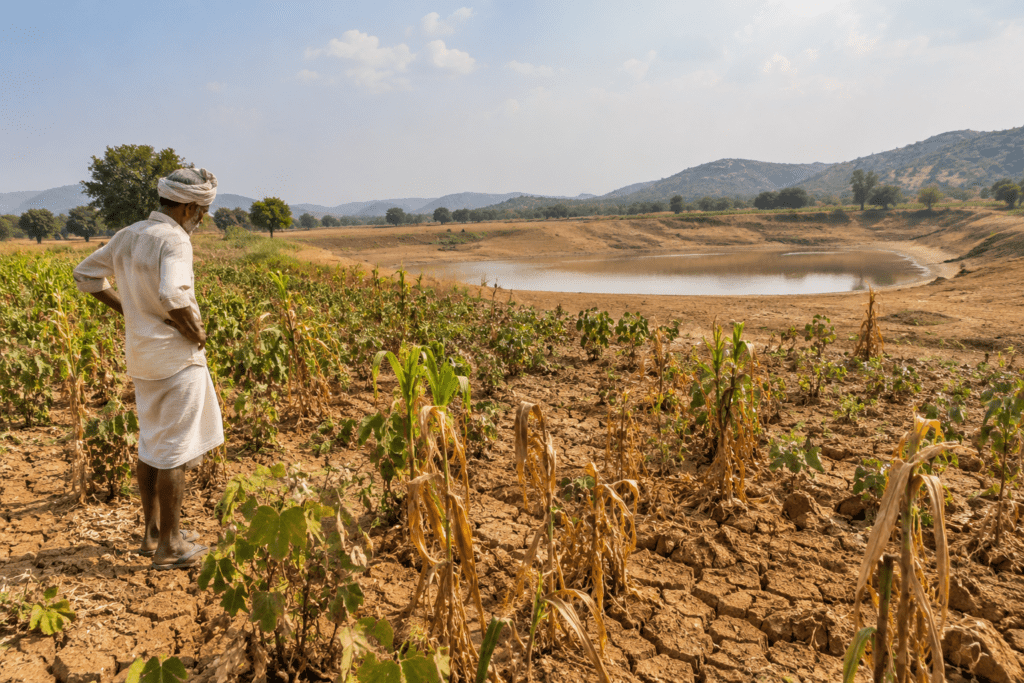
A farm with healthier soil and better water management may be better positioned to handle periods of drought, irregular rainfall or rising input costs than land that depends heavily on intensive inputs.
The benefit is not necessarily an immediate increase in revenue. It can be the preservation of productive capacity over a much longer period.
For agricultural land, water is one of the most important components of long-term value.
Efficient irrigation systems, rainwater management, soil organic matter and appropriate crop selection can all contribute to better water use.
NABARD supports financing and programmes connected with areas such as drip irrigation, water conservation, horticulture, agroforestry and precision farming. Its Micro Irrigation Fund has also been used to support the expansion of micro-irrigation across states, including Karnataka.
For investors, the significance is straightforward.
Better water management can help reduce wastage and improve farm resilience. Over time, that can make a managed agricultural asset more sustainable to operate than a comparable property with weaker infrastructure.
Carbon is another area attracting attention.
India has established the Carbon Credit Trading Scheme, which includes both a compliance mechanism and an offset mechanism. Under the offset mechanism, eligible projects can potentially receive carbon credit certificates for qualifying greenhouse-gas emission reductions, removals or avoidance, subject to the prescribed rules and procedures.
This creates an interesting possibility for agriculture and land management.
Activities that improve soil carbon, increase tree cover or reduce emissions could potentially become part of future carbon-related projects where they meet the required methodology and verification standards.
However, carbon credits should not be treated as guaranteed income from simply owning farmland.
A project needs a credible baseline, appropriate methodology, monitoring and verification. The economics also depend on the type of project, the quality of the credits and the market in which they are sold.
For serious investors, this makes carbon an emerging opportunity rather than a guaranteed return.
Technology is also changing how managed farmland is operated.
Soil sensors can monitor moisture levels. Drones can help survey crops and vegetation. Satellite imagery can track changes across large parcels of land. Digital farm-management systems can help operators make decisions about irrigation, crop health and resource use.
The importance of these tools goes beyond convenience.
Better data allows land managers to identify problems earlier and measure changes over time. For larger farmland portfolios, this can make farm operations more transparent and easier to monitor.
It can also create the records needed for sustainability reporting and, where applicable, environmental certification or carbon-project verification.
In other words, technology is helping turn some of the less visible characteristics of farmland into measurable information.
Technology is also improving the way investors examine land ownership and records.
In Maharashtra, the government’s Mahabhumi and MahaBhulekh platforms provide access to services including digitally signed 7/12 records, 8A records, property cards and mutation-related information.
These systems can make preliminary land-record checks more accessible.
But digital records should not replace professional legal due diligence.
An investor still needs to examine the title chain, encumbrances, land-use status, survey boundaries, access rights, applicable state regulations and other property-specific issues before making an investment decision.
For HNWIs, the process is therefore becoming broader. The question is no longer only, “Who owns this land?”
It is also, “What can legally and sustainably be done with it?”
Well-planned farmland can also generate value through crop diversification.
Horticulture, agroforestry and high-value crops can provide different income cycles from the same agricultural asset. The right combination depends heavily on soil conditions, climate, water availability, market demand and the time required for each crop to mature.
This is particularly important for long-term investors.
A farm does not need to depend on a single crop or a single source of value. Agricultural income, long-term land appreciation, timber or horticultural assets and potential environmental benefits can form different parts of the overall investment thesis.
However, none of these should be treated as fixed or guaranteed returns. Agriculture remains exposed to weather, disease, market prices, operating costs and regulatory changes.
The emerging opportunity is not simply about buying more land.
It is about buying and managing better land.
For high-net-worth investors, a professionally managed farmland asset can potentially bring together several elements: productive agriculture, land ownership, water management, technology, ecological restoration and long-term asset preservation.
That makes the management model increasingly important.
A parcel with good soil, reliable water, strong documentation and professional farm operations may have a very different long-term risk profile from an unmanaged agricultural parcel, even when both have similar acreage.
The difference lies in how the land is managed.
India’s farmland market is entering a period where ecological performance could become an increasingly important part of asset management.
The opportunity is still developing. Carbon markets are evolving. Agricultural technology is becoming more accessible. Digital land records are improving transparency. At the same time, investors are paying closer attention to climate resilience and the long-term productivity of natural assets.
This does not mean every farmland investment will deliver exceptional returns.
It means the definition of value is becoming broader.
The farmland of the future may be valued not only for what it produces today, but also for how well it preserves soil, manages water, supports biodiversity and remains productive in a changing climate.
For HNWI investors, that shift creates a compelling question: Could the next generation of farmland investments be built around natural capital as much as land capital?
The answer may increasingly depend on how effectively investors can measure, manage and preserve the ecological value already present in India’s agricultural landscapes.