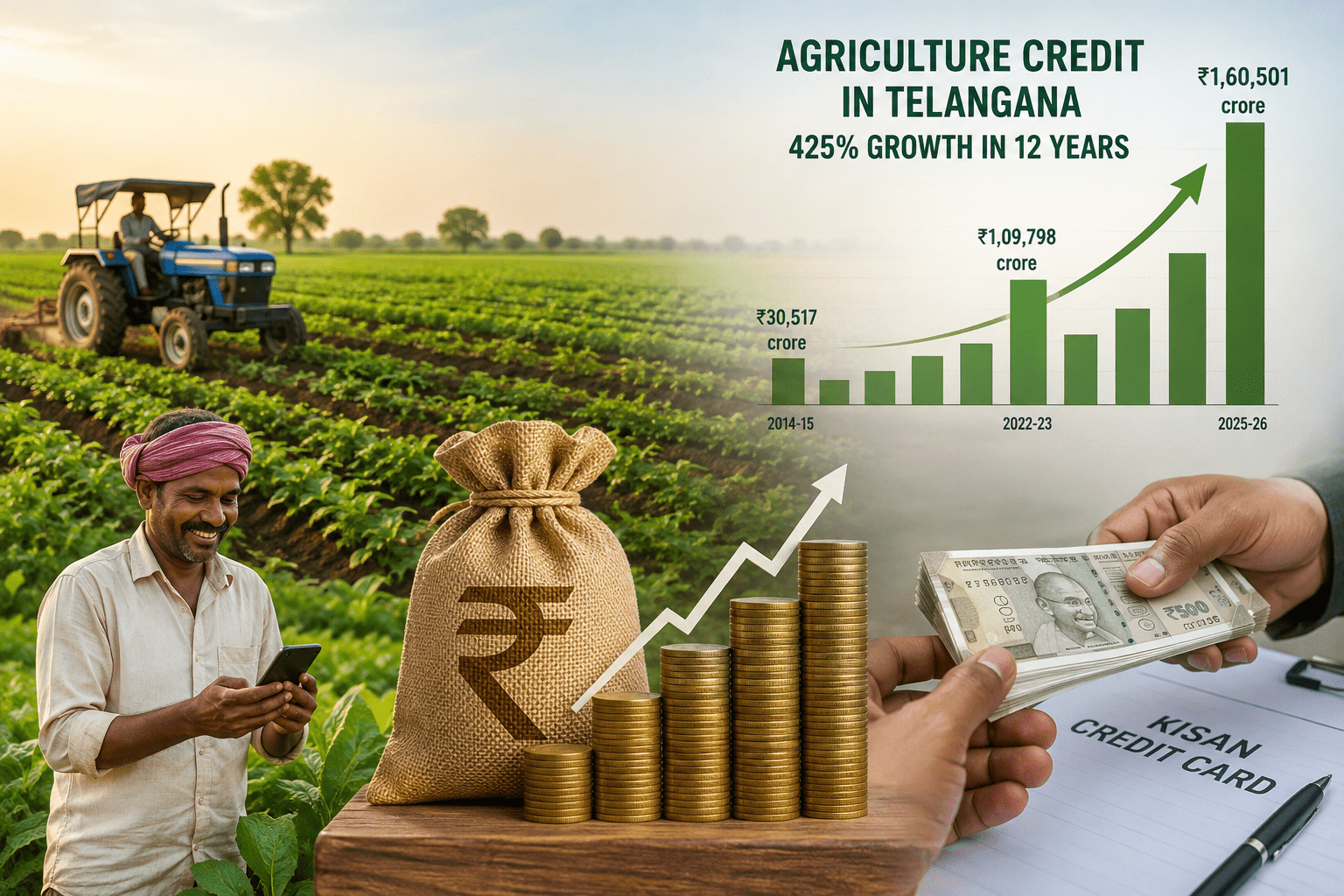
Agricultural credit disbursement in Telangana has increased by around 425% over the past 12 years, reflecting a sharp rise in the amount of formal financing flowing into the state’s farming sector.
According to information provided by the Ministry of Finance in Parliament, agriculture loans in Telangana increased from ₹30,517 crore in 2014–15 to ₹1,60,501 crore in 2025–26. The state recorded its highest annual agricultural credit disbursement of ₹1,64,908 crore in 2024–25.
Officials have linked the increase to higher farm investment, rising input costs, greater mechanisation and wider coverage of the Kisan Credit Card (KCC) system.
The development highlights a broader change taking place across Indian agriculture, where access to formal finance is becoming increasingly important for improving farm productivity and supporting modern agricultural operations.
Also Read AI in Farm Lending: SBI Sees New Credit Opportunity for Farmers
Agricultural Credit Has Expanded Rapidly
The growth in agriculture credit in Telangana has been particularly notable over the past decade.
Data cited by The New Indian Express shows that agricultural credit more than doubled in 2016–17, reaching ₹67,739 crore from ₹33,326 crore the previous year.
The ₹1 lakh crore mark was crossed for the first time in 2022–23, when agricultural credit disbursement reached ₹1,09,798 crore.
The latest figure of ₹1,60,501 crore for 2025–26 therefore represents a significant expansion in the scale of formal lending available to the state’s agricultural sector.
The increase is not being driven by a single factor.
Farmers are facing higher costs for seeds, fertilisers, labour, machinery and other inputs.
At the same time, more farmers are investing in mechanisation and other farm improvements.
Rising Input Costs Are Increasing the Need for Credit
Agriculture requires substantial expenditure before a farmer earns revenue from a crop.
Seeds and other inputs need to be purchased before sowing.
Machinery and labour are required during cultivation.
Irrigation and electricity can add further costs.
Farmers also need working capital to manage expenses between one harvest and the next.
As these costs increase, access to affordable agricultural credit becomes more important.
Officials cited by The New Indian Express said rising input costs, farm mechanisation and wider KCC coverage were among the major reasons behind the growth in agricultural credit.
This means the increase in lending is not simply a financial-sector development.
It is also a reflection of how the economics of farming are changing.
Mechanisation Is Changing Farm Investment
Farm mechanisation is another important factor behind the increase in agricultural borrowing.
Modern equipment can help farmers complete labour-intensive activities more efficiently.
Tractors, harvesters, irrigation equipment and other machinery can reduce dependence on manual labour and improve the speed of farm operations.
However, machinery also requires significant upfront investment.
For individual farmers, financing can make such purchases more manageable.
The growing availability of agricultural credit can therefore support the gradual transition from traditional farming methods towards more mechanised agricultural operations.
This trend could become increasingly important as rural labour availability and agricultural input costs continue to change.
Kisan Credit Cards Are Expanding Access
The Kisan Credit Card has become an important part of India’s agricultural credit system.
KCC-based lending is designed to provide farmers with timely access to short-term credit for agricultural activities.
Greater KCC coverage can make it easier for farmers to access formal finance instead of relying entirely on informal sources.
The expansion of formal banking networks in rural areas has also contributed to the increase in agricultural lending, according to officials cited in the recent report.
For farmers, formal credit can provide a more structured source of working capital.
For banks, the expansion represents a growing connection between India’s financial system and its agricultural economy.
Government Policies Are Supporting Agricultural Lending
Policy measures have also played a role in increasing agricultural credit.
Under the Reserve Bank of India’s Priority Sector Lending framework, banks are required to allocate at least 18% of their credit to agriculture, including a sub-target of 10% for small and marginal farmers.
The government has also expanded the limit for collateral-free short-term agricultural loans from ₹1.6 lakh to ₹2 lakh, while interest subvention is available for certain categories of agricultural lending.
These measures are intended to make formal agricultural finance more accessible.
The objective is not only to increase the volume of lending but also to ensure that farmers can obtain credit when they need it.
More Credit Does Not Automatically Mean Higher Farm Income
The rapid increase in agricultural credit is significant, but it needs to be viewed carefully.
Higher loan disbursement does not automatically mean that farmers are earning more.
A farmer may borrow more because input costs have increased.
Another farmer may take a loan to purchase machinery.
Someone else may borrow because of crop losses or unexpected expenses.
Therefore, the quality and purpose of agricultural borrowing are just as important as the overall amount of credit.
The real measure of success will be whether access to finance helps farmers improve productivity, manage risk and generate stronger and more sustainable incomes.
What This Means for Agricultural Land
The expansion of farm credit also has implications for the way agricultural land is used.
Land itself is only one part of a productive farming operation.
Farm productivity can depend on water availability, soil health, crop selection, machinery, infrastructure and working capital.
When farmers have access to financing, they may have greater capacity to invest in some of these areas.
Irrigation equipment can improve water management.
Farm machinery can improve operational efficiency.
Storage facilities can help with post-harvest handling.
Better inputs can support productivity.
Together, these investments can improve the productive use of agricultural land.
A More Investment-Oriented Agricultural Economy
India’s agricultural economy is gradually becoming more capital intensive.
Farmers are investing in machinery and infrastructure.
Agribusinesses are investing in processing and supply chains.
Banks are increasing their exposure to agricultural lending.
Technology companies are developing tools for farming and rural finance.
This creates a more interconnected agricultural ecosystem.
The trend is particularly relevant for people who view farmland investment as a long-term asset class.
However, access to agricultural credit should not be interpreted as a guarantee of land appreciation.
The value and productivity of farmland still depend on fundamentals such as location, water resources, soil quality, connectivity, land regulations and market demand.
Managed Farmland and the Importance of Farm Operations
The changing credit environment also highlights the importance of effective farm management.
For managed farmland, investment in irrigation, plantation maintenance, soil improvement, crop planning and agricultural infrastructure can determine how effectively the land is used.
A professionally managed farm can bring together several of these elements under one operating system.
The availability of financial infrastructure can support the wider agricultural ecosystem, but actual farm performance will still depend on how capital and resources are deployed.
This distinction is important.
Borrowing money does not create value by itself.
Productive investment is what can create value.
Telangana Offers a Larger Picture
The growth in agricultural credit in Telangana reflects a broader national trend.
Indian agriculture is moving towards greater formalisation.
Farmers are increasingly connected to banks, digital payment systems, government databases and formal credit programmes.
At the same time, agricultural operations are becoming more mechanised and technology-driven.
The result is an agricultural economy that requires more capital than traditional farming models.
This creates opportunities, but it also increases the importance of responsible borrowing.
Farmers need credit that matches their agricultural cash flows and repayment capacity.
What the Credit Growth Could Mean for the Future
The expansion of agricultural credit is likely to remain an important part of India’s rural economy.
As input costs rise and farmers invest in machinery, irrigation and improved farming systems, demand for formal agricultural finance could continue.
For banks, this represents an expanding rural lending opportunity.
For farmers, it can provide access to capital for productive activities.
For agricultural businesses, stronger rural finance can support investment across the farm-to-market chain.
And for landowners and people evaluating farmland as an investment, the development highlights an important point:
The economic potential of agricultural land is increasingly connected to the resources available to make that land productive.
Land, capital, water, infrastructure and farm management are becoming increasingly interconnected.
The Bigger Picture
The 425% increase in agricultural credit in Telangana is more than a banking statistic.
It reflects the changing economics of farming.
Farmers are spending more on inputs.
Mechanisation is increasing.
Formal financial access is expanding.
Government lending targets are supporting agricultural credit.
And agricultural operations are becoming more capital intensive.
The next challenge will be ensuring that this growing flow of credit translates into stronger farm productivity, sustainable incomes and productive agricultural investment.
For India’s agricultural sector, the direction is becoming clear: farming is no longer only about cultivating land.
It is increasingly about how effectively land, capital, technology and resources can work together.