India’s agriculture sector is increasingly becoming an important part of the country’s broader investment story. New government data released in June 2026 shows that public spending, farm infrastructure and private participation are helping agriculture move beyond traditional crop production.
According to the Press Information Bureau (PIB), the budget allocation for the Department of Agriculture and Farmers Welfare has increased to ₹1,40,528.78 crore for 2026–27, compared with ₹27,663 crore in 2013–14. The government says the higher allocation reflects continued investment in agricultural infrastructure and rural development.
At the same time, the Agriculture Infrastructure Fund (AIF) has attracted significant investment into projects connected with storage, logistics and post-harvest management.
One of the most notable developments is the expansion of the Agriculture Infrastructure Fund.
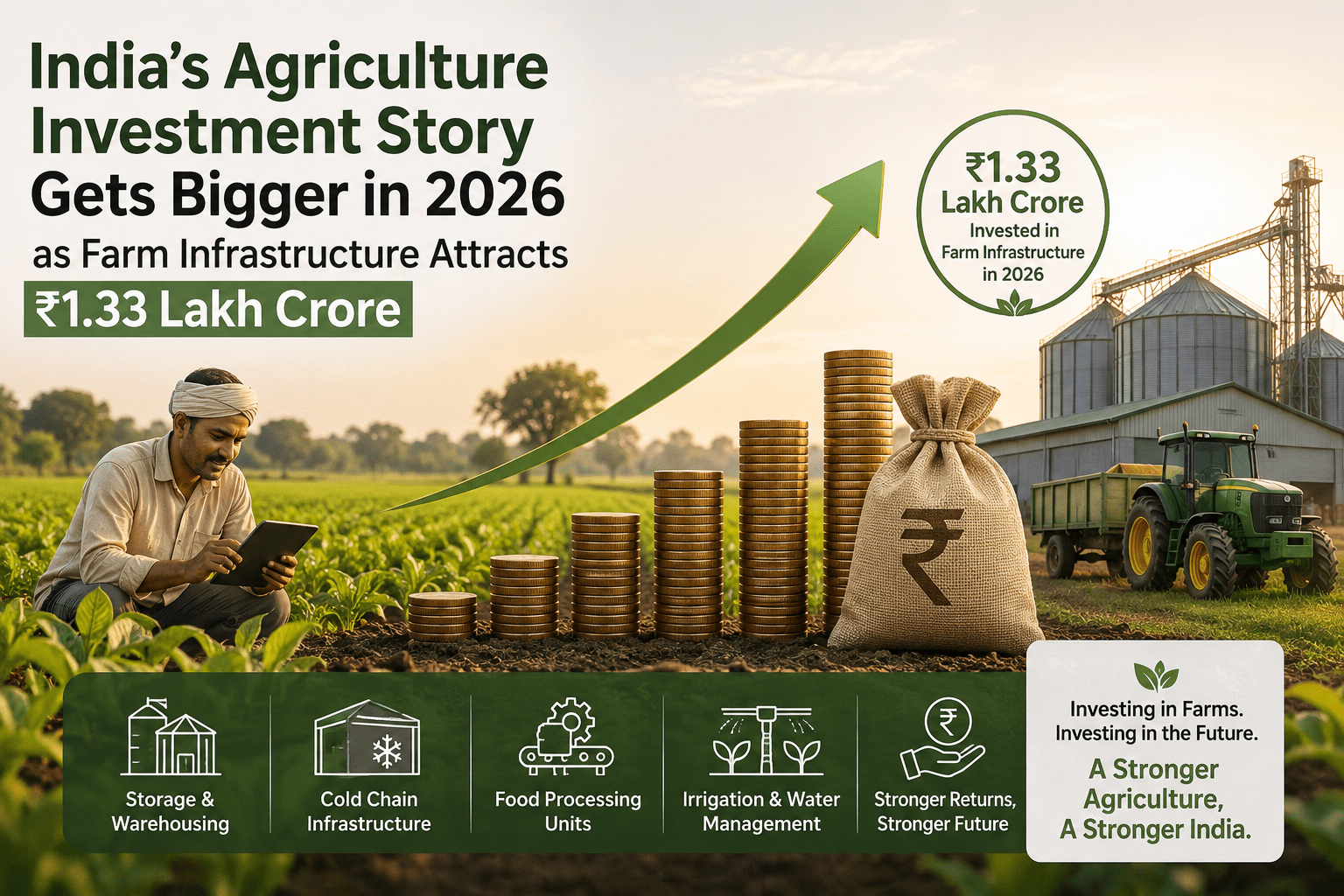
According to the government’s June 2026 update, loans worth ₹84,202 crore had been sanctioned for 1.68 lakh projects as of March 2026. The scheme has mobilised around ₹1.33 lakh crore in investment.
The projects cover areas such as warehouses, processing facilities, cold storage and other post-harvest infrastructure.
This is important for agriculture because investment does not stop at the farm gate. Better infrastructure can help farmers store produce, reduce post-harvest losses and connect more efficiently with markets.
It also creates opportunities for businesses involved in food processing, logistics, warehousing and agricultural services.
The latest numbers point to a broader change in the Indian agricultural economy.
Agriculture and allied activities accounted for about 18% of India’s Gross Value Added (GVA), according to the PIB backgrounder. The sector’s GVA increased from ₹20.9 lakh crore in 2014–15 to ₹48.7 lakh crore in 2023–24 at current prices.
The growth is not limited to traditional farming.
Horticulture, dairy, fisheries, food processing and agricultural technology are becoming increasingly important parts of the rural economy.
Horticulture production, for example, increased from 280.70 million tonnes in 2013–14 to 369.05 million tonnes in 2024–25. The sector now accounts for nearly 37% of the Gross Value Output within the crop sector.
For investors, this diversification matters because agriculture is increasingly connected to several industries rather than operating as an isolated farming activity.
Investment is also moving further along the agricultural value chain.
The government reported that the Gross Value Added of the food-processing sector increased from ₹1.34 lakh crore in 2014–15 to ₹2.24 lakh crore in 2023–24.
Under the Production Linked Incentive Scheme for the Food Processing Industry, approved beneficiaries reported investments of ₹9,207 crore as of February 2026.
This reflects a growing focus on value addition.
Instead of selling agricultural produce only as raw commodities, businesses can create additional value through processing, packaging, storage and distribution.
That shift can make agricultural supply chains more efficient while creating new opportunities for rural businesses and investors.
The changing investment landscape also brings attention to the role of productive land.
Farmland is different from financial assets such as stocks or bonds. Its value is influenced by factors such as location, soil quality, water availability, agricultural productivity, infrastructure and access to markets.
As agricultural infrastructure improves, well-connected rural areas can become increasingly relevant to the wider agricultural economy.
However, investors should distinguish between owning agricultural land and investing in agriculture-related businesses or infrastructure. Land ownership comes with its own legal, regulatory, operational and management considerations.
For anyone evaluating farmland as an asset, factors such as land title, permitted land use, water resources, road access, farm management and long-term maintenance should be assessed carefully.
Investment in agriculture is also becoming more technology-driven.
The government’s June 2026 update said that more than 7.63 crore Farmer IDs had been created by February 2026, while approximately 23.5 crore crop plots had been digitised under the Digital Agriculture Mission.
Digital agriculture can improve access to information and help create better visibility across farming operations.
Technology is also being used for crop monitoring, weather information, precision farming, irrigation management and agricultural supply chains.
This could make professional farm management increasingly important as agricultural assets become more connected to technology and data.
The latest figures suggest that India’s agriculture investment story is becoming broader than simply owning farmland.
Capital is entering multiple layers of the agricultural ecosystem — from land and farm operations to storage, food processing, logistics, technology and allied activities.
This creates a more connected rural economy.
For investors, the important question may therefore not simply be “Is agriculture growing?” but rather “Which part of the agricultural value chain is positioned for long-term growth?”
As India continues investing in farm infrastructure and rural connectivity, agriculture could increasingly be viewed as a long-term economic ecosystem rather than only a primary production sector.
The latest government figures provide a clear indication that agriculture remains a major area of public investment and economic activity in India.
With ₹1.33 lakh crore mobilised through Agriculture Infrastructure Fund-supported investment, rising agricultural allocations, expanding food processing and rapid digitisation, the sector is undergoing a significant structural shift.
For investors and businesses, the opportunity may lie in understanding this transformation early.
Agriculture is no longer only about what happens on the farm.
It is increasingly about the entire journey — from soil to storage, from cultivation to processing, and from farmland to the final market.