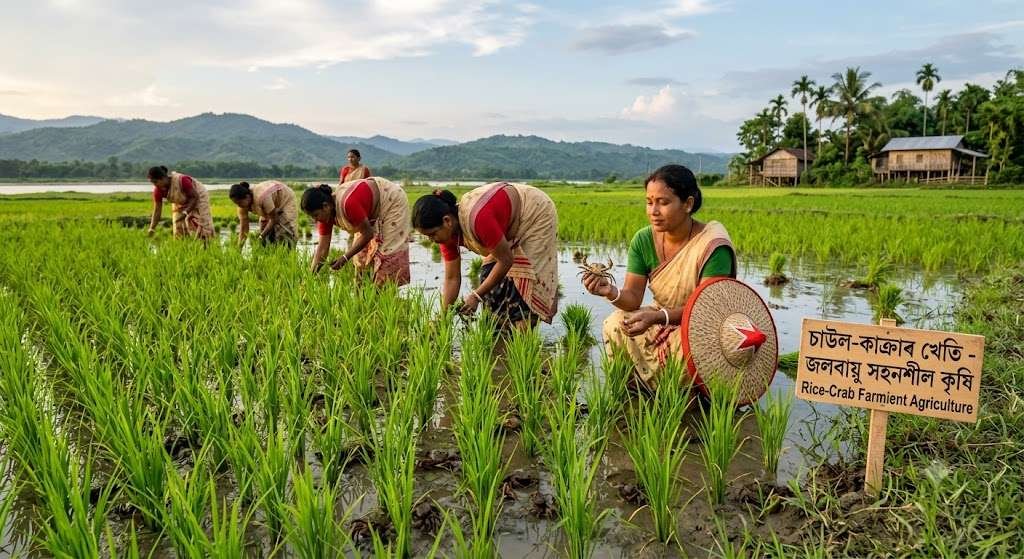
Farmers in Assam are adopting an unusual but promising approach to deal with unpredictable weather: growing indigenous rice and freshwater crabs together in the same farmland.
The women-led farming model, being promoted with support from the Assam State Rural Livelihood Mission (ASRLM), combines traditional rice cultivation with crab farming to provide farmers with an additional source of income while reducing dependence on chemical inputs. The initiative is being expanded across 219 blocks in the state.
In Dibrugarh and Lakhimpur districts, farmers are cultivating Betguti, an indigenous rice variety known for its ability to withstand longer dry periods and unpredictable rainfall.
Once the rice is established, freshwater mud crabs are introduced into sections of the paddy fields. Instead of treating the two as separate farming activities, the system allows them to develop together.
The approach is particularly relevant for Assam, where farmers are experiencing increasingly unpredictable patterns of heavy rainfall followed by prolonged dry spells. Traditional fish-paddy systems have become more difficult in some areas because fish require adequate water throughout the growing period.
The integrated system offers environmental benefits alongside its economic potential.
Farmers involved in the initiative have observed that crabs help aerate the soil as they move through the fields. They can also feed on certain crop pests, potentially reducing farmers’ dependence on pesticides.
Research cited in the report indicates that rice-crab farming can contribute to improvements in soil nutrients, soil fertility, biodiversity and efficient use of available land and water resources.
This makes integrated farming an increasingly interesting option for agricultural landscapes where farmers are looking for ways to maintain productivity while reducing chemical inputs.
The model also provides farmers with an additional source of revenue.
Nikumoni Bora, one of the farmers involved in the initiative, cultivated Betguti rice on one bigha of land and introduced crabs into the field. From approximately 8 kg of seed, she harvested nearly two quintals of rice.
The crabs grew substantially over three months and were sold in local markets for around ₹300–₹400 per kg. Bora also earned income by selling rice seeds. According to the report, her total earnings over the previous year reached around ₹1.35 lakh, supplementing her family income.
The initiative is also creating opportunities for women farmers to experiment with alternative agricultural systems.
Alongside Bora, dozens of other women have started cultivating indigenous rice varieties and exploring integrated rice-crab farming. A group of women farmers has also leased around 20 bighas of land to grow indigenous rice, with plans to introduce crabs on portions of the farmland.
The programme is now being expanded through training and community-level support, with ASRLM planning to promote integrated natural farming across 219 blocks.
Beyond climate adaptation, the initiative is helping preserve traditional rice varieties.
Farmers involved in the programme are cultivating Betguti along with other indigenous varieties, giving traditional crops an opportunity to remain part of Assam’s agricultural landscape.
The wider programme has already involved around 25 indigenous rice varieties, according to ASRLM officials cited in the report.
Preserving these varieties can be important because traditional crops may carry characteristics that are useful under specific local environmental conditions.
The rice-crab model demonstrates how agricultural innovation does not always require completely new technology.
In some cases, the answer can come from combining traditional knowledge with new approaches to climate adaptation.
By using the same farmland to produce rice and crabs, farmers can diversify their income while potentially improving soil health and reducing chemical use.
As climate uncertainty continues to challenge conventional farming systems, such integrated approaches could offer valuable lessons for other agricultural regions looking to make farmland more resilient.
Source: Mongabay-India, August 18, 2026.