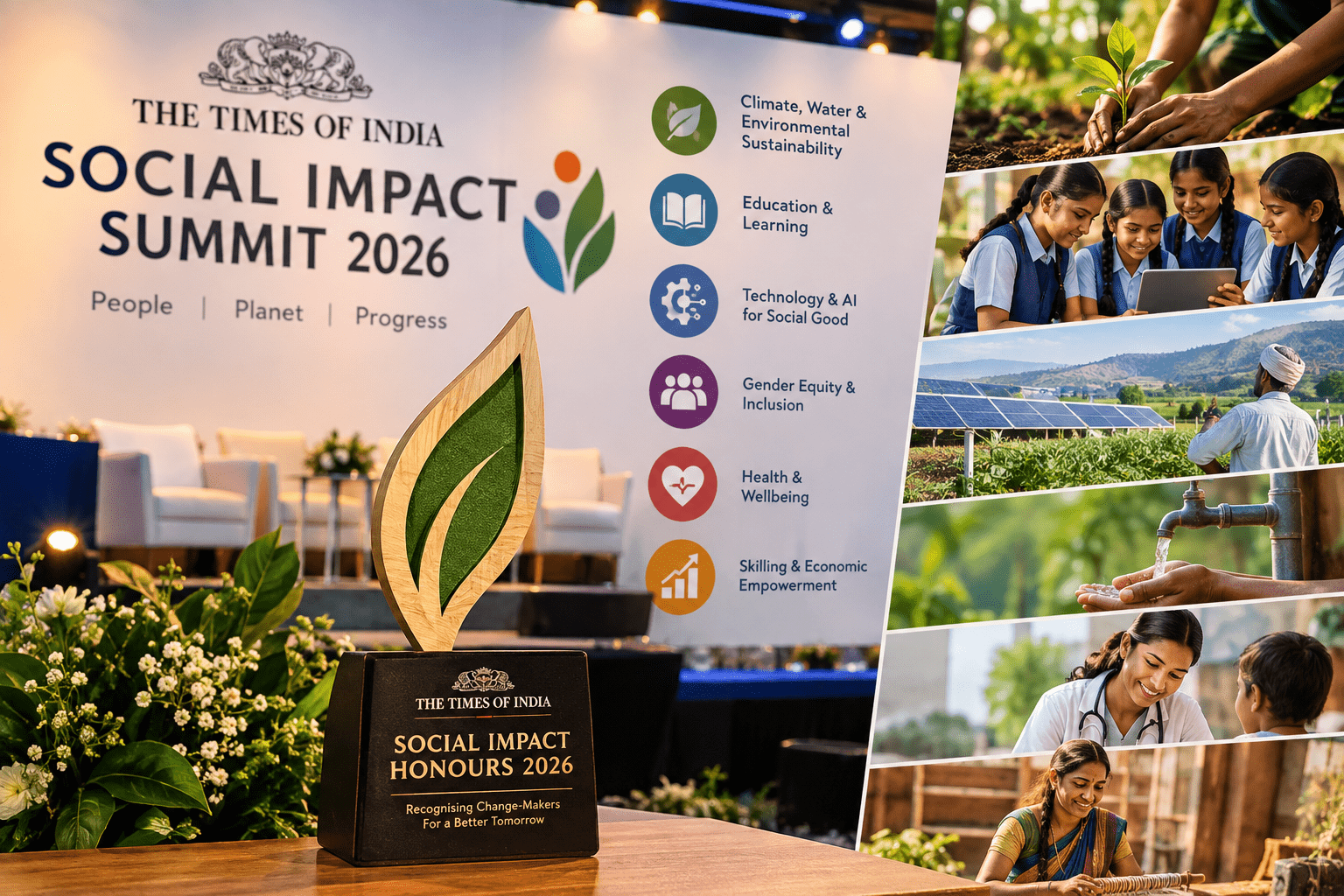
The Social Impact Honours 2026 have recognised 18 initiatives working to create positive change across India.
The honours were part of the Times of India Social Impact Summit 2026 in Mumbai.
This year’s recognised initiatives cover several important areas. These include health, education, technology, sustainability, inclusion and employment.
The awards also highlight a growing focus on practical solutions.
Many of the recognised programmes work directly with communities. Their efforts address issues such as water scarcity, waste, sanitation and rural livelihoods.
The honours cover six broad categories.
These include:
The environmental category is particularly important for communities facing climate and resource challenges.
It also shows how sustainability can create social benefits at the same time.
Three initiatives were recognised in the Climate, Water & Environmental Sustainability category.
They are:
Each organisation focuses on a different environmental challenge.
Saahas works on waste management and resource recovery.
PRADAN focuses on water access and ecosystem restoration.
Hindustan Unilever’s Suvidha programme combines sanitation with water and energy efficiency.
Together, these initiatives show how local action can support a more sustainable future.
Saahas was recognised for its work in solid waste management.
The organisation promotes better waste segregation and resource recovery.
Its approach follows circular economy principles. This means treating waste as a resource wherever possible.
The organisation has worked across three gram panchayats in peri-urban Bengaluru.
According to the award profile, its work has achieved 90% source segregation and 94% collection efficiency.
It has also diverted more than 1,450 metric tonnes of waste.
The initiative reported a reduction of around 1,111 tonnes of carbon dioxide equivalent emissions.
These results show the link between waste management and climate action.
PRADAN received recognition for its Water Access Through Ecosystem Restoration, or WATER, initiative.
The programme works across seven drought-prone states.
Its goal is to improve water availability while strengthening rural livelihoods.
The programme has supported:
The initiative has also helped bring together public funds for local water projects.
Water security is especially important for rural communities.
Farmers depend on reliable water for crops, livestock and household needs.
Therefore, restoring local water systems can also strengthen rural economies.
Hindustan Unilever’s Suvidha initiative was also recognised.
The programme works with the Brihanmumbai Municipal Corporation.
It focuses on community sanitation and hygiene infrastructure.
The centres use several sustainability measures.
These include solar energy, greywater recycling and decentralised wastewater treatment.
According to the award profile, 25 centres serve more than 600,000 users every year.
The centres also recycle more than 300 million litres of wastewater.
The programme reports avoiding around 4 million kilograms of CO₂ equivalent emissions each year.
This demonstrates how sanitation infrastructure can also support environmental goals.
Environmental work is also becoming more technology-driven.
One example is Solinas Integrity.
The IIT Madras-incubated company was recognised in the Technology & AI for Social Good category.
It uses robotics and artificial intelligence to inspect water pipelines and sanitation infrastructure.
The technology can help identify leaks and defects in underground systems.
In one Lucknow project, the company inspected 5.1 kilometres of pipeline.
The inspection identified 34 critical defects. The award profile states that 28 of them were repaired.
The work is estimated to save around 0.9 million litres of water each day for about 1,750 households.
This shows how technology can support environmental conservation.
The recognised projects have another common feature.
They connect environmental protection with people’s everyday needs.
Water restoration can support farmers.
Better waste management can create cleaner communities.
Wastewater recycling can reduce pressure on freshwater resources.
Efficient infrastructure can also reduce resource losses.
This makes sustainability more practical.
It is not only about protecting nature. It is also about improving how communities use natural resources.
Water remains one of the most important resources for Indian agriculture.
Changes in rainfall can create pressure on farming communities.
Drought-prone regions face even greater challenges.
Projects that restore ponds, wells and local water systems can therefore have a wider impact.
PRADAN’s WATER initiative is one example.
Its work combines ecosystem restoration with community participation.
Women are also involved in managing local water assets.
This approach can make water conservation more closely connected with rural development.
Waste is another growing environmental concern.
Poorly managed waste can affect land and water.
It can also increase pressure on landfills.
Better segregation allows more materials to be recovered and reused.
Saahas’s work demonstrates how local waste systems can follow circular economy principles.
Its results in peri-urban Bengaluru show the potential of community-level waste management.
The approach can also reduce the amount of waste reaching landfills.
Recognition can help successful initiatives reach a wider audience.
Many environmental projects begin at the local level.
They may work with villages, neighbourhoods or small communities.
Awards can bring these models into a larger national conversation.
This can encourage other organisations to study and adapt similar approaches.
It can also help businesses and policymakers understand the value of measurable environmental action.
The environmental winners also show the importance of measurable results.
For example, organisations can track:
These numbers help demonstrate the impact of sustainability programmes.
They also make it easier to compare progress over time.
As climate action grows, such measurements are likely to become increasingly important.
The Social Impact Honours 2026 show that environmental work does not happen separately from social development.
The two areas often support each other.
A restored pond can help a farming community.
A better waste system can improve neighbourhood conditions.
A water-saving sanitation centre can benefit both people and the environment.
This connection is becoming increasingly important as India works toward more resilient communities.
Large environmental programmes often receive attention.
However, smaller community projects can also create significant results.
They can respond to local needs.
They can involve residents directly.
They can also adapt their methods to local conditions.
The initiatives recognised this year demonstrate the value of such approaches.
Their work covers different regions and different environmental challenges.
Yet the overall goal remains similar.
It is to use resources more responsibly while improving people’s lives.
The Social Impact Honours 2026 recognise organisations that are working beyond traditional development models.
Their projects combine environmental responsibility with community needs.
Saahas shows how waste can become part of a circular economy.
PRADAN demonstrates how water restoration can strengthen rural communities.
HUL’s Suvidha initiative shows how sanitation can include climate-resilient practices.
Together, these examples highlight the growing importance of practical sustainability.
The Social Impact Honours 2026 provide a snapshot of India’s changing sustainability landscape.
The recognition of environmental initiatives is particularly relevant as communities face growing pressure on water, land and natural resources.
The message is clear.
Environmental progress can begin with simple but measurable actions.
Better waste management.
Stronger water systems.
Smarter infrastructure.
Greater community participation.
When these efforts come together, they can help create healthier communities and a more resilient future.