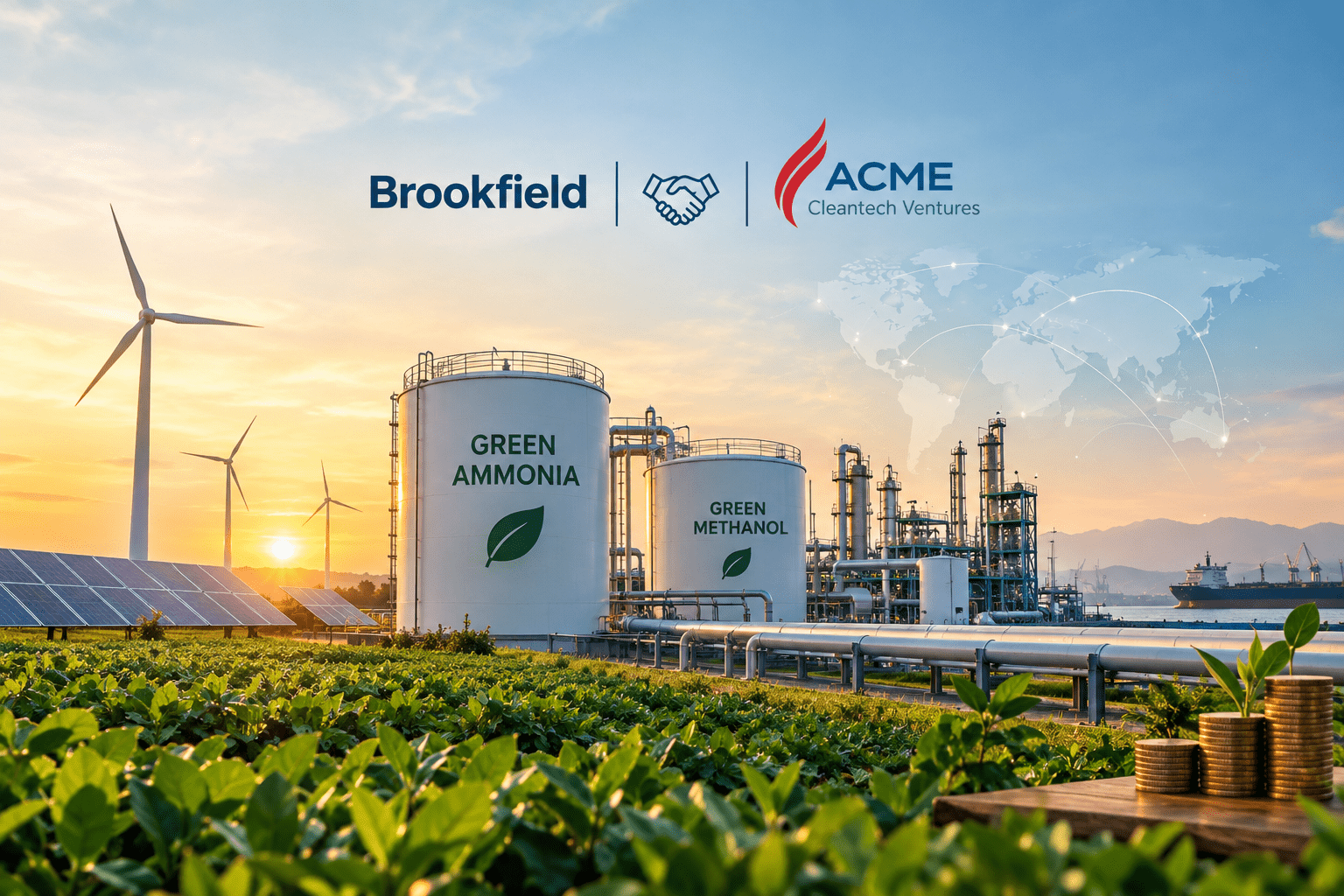
Global investment firm Brookfield plans to invest up to $600 million in ACME Cleantech Ventures.
The Brookfield investment in India will support green molecule projects in India and the Middle East. These projects include green ammonia and green methanol facilities.
The investment will be made through Brookfield’s Global Transition Fund strategy. The fund focuses on investments that support the transition to a lower-carbon economy.
ACME Cleantech Ventures is a UK-based entity within the ACME Group. It focuses on the group’s green molecules business.
Brookfield’s investment will help ACME develop and build its project pipeline.
The projects are planned across India and the Middle East. They aim to supply green fuels and industrial feedstocks to domestic and international markets.
Green molecules are fuels and industrial products made using low-carbon energy.
Green ammonia and green methanol are two examples.
These products can support industries that are difficult to electrify directly. They include fertilisers, shipping, chemicals, refineries and heavy industries.
As a result, green molecules are becoming an important part of the global energy transition.
ACME already operates a green ammonia facility in Bikaner, Rajasthan.
The company is also developing a green ammonia project in Duqm, Oman.
In Odisha, ACME is establishing new facilities under a green ammonia purchase agreement with the Solar Energy Corporation of India.
The company also has a strategic joint venture with Japan’s IHI Corporation.
ACME has secured agreements with several international and Indian companies.
Its partners include Yara International, IHI Corporation and Mitsubishi Gas Chemicals.
Indian companies such as IFFCO, Paradeep Phosphates, Coromandel International and Indorama India are also linked to the projects through agreements.
These arrangements provide potential markets for future green molecule production.
Green ammonia has a direct connection with agriculture.
Ammonia is widely used in fertiliser production. Green ammonia can be produced using renewable electricity and hydrogen instead of conventional fossil-based processes.
This creates a potential link between clean energy investment and the agricultural sector.
For India, the development of domestic green ammonia projects could also support the growth of lower-carbon fertiliser supply chains.
However, the wider impact will depend on production costs, infrastructure and market demand.
The Brookfield investment in India also expands the firm’s exposure to clean energy.
Brookfield said its Indian energy portfolio includes about 50 GW of wind and solar assets in operation and under development.
The new investment takes its involvement into green molecules.
This includes clean fuels and industrial products that can complement renewable electricity.
Large industrial sectors need reliable sources of energy and raw materials.
Some of these sectors cannot switch completely to electricity in the short term.
Green ammonia and green methanol are being developed as alternatives for some of these applications.
This is creating new investment opportunities in clean energy infrastructure.
For investors, such projects also involve long development periods and significant capital requirements.
Their success will depend on technology, project costs, infrastructure and long-term demand.
India has attracted major investments in renewable power over the past several years.
Solar and wind projects remain important parts of this market.
New investment is now also reaching areas such as green hydrogen, green ammonia and green methanol.
The latest Brookfield investment in India shows how the country’s clean energy market is expanding beyond renewable electricity.
It also connects energy investment with industries such as agriculture, shipping, chemicals and manufacturing.
The $600 million commitment will support ACME’s plans to develop green molecule projects.
The projects could help build new clean fuel supply chains in India and the Middle East.
They may also create stronger links between renewable energy, industrial production and agriculture.
However, the projects will take time to develop. Their eventual impact will depend on construction, financing, technology and demand from buyers.
The investment is therefore part of a longer-term shift towards new forms of clean energy and industrial infrastructure.