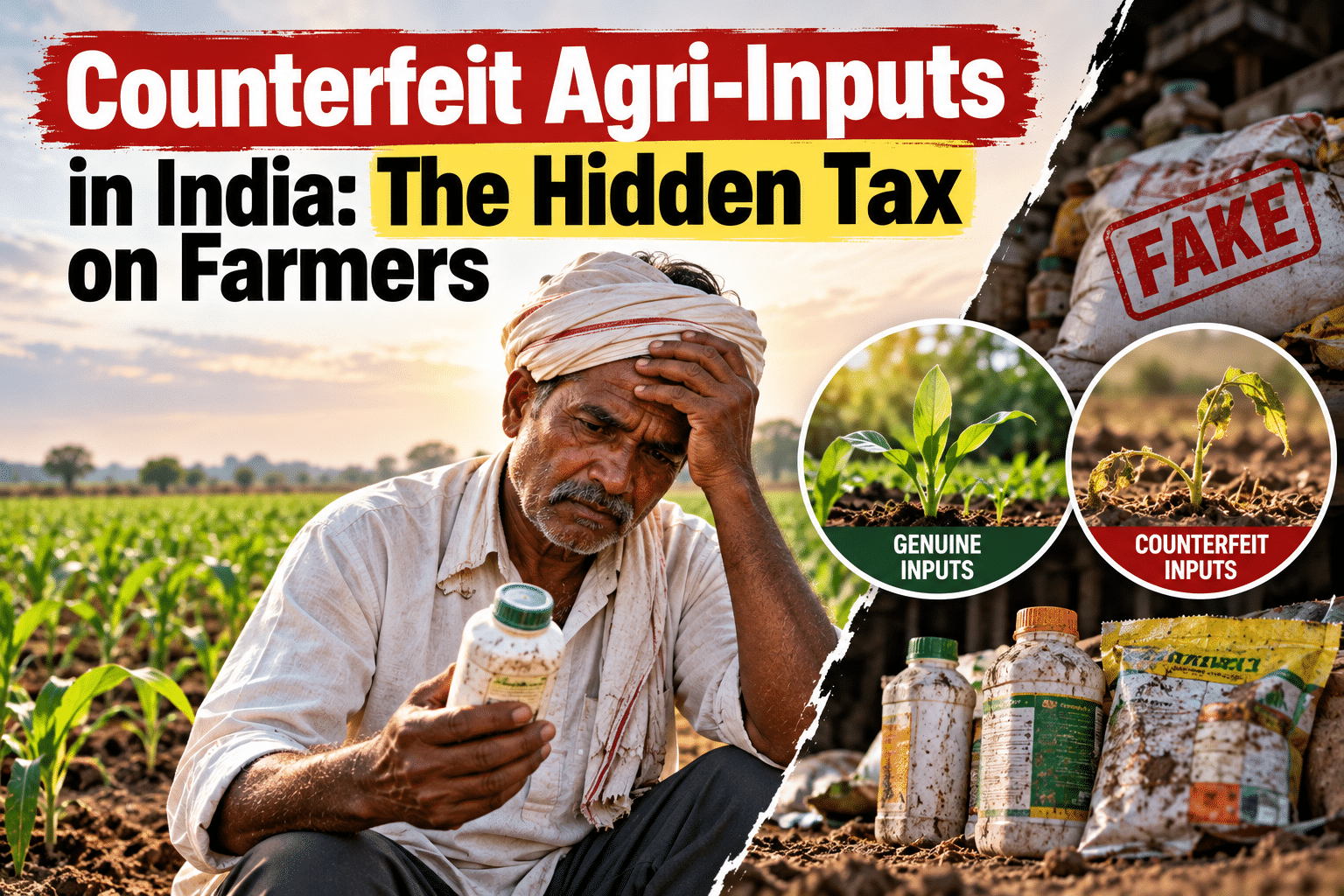
Every year, Indian farmers lose money to a cost that does not appear in any government budget or official record. Counterfeit agri-inputs, including fake pesticides, adulterated fertilisers and spurious seeds, drain resources from the farm sector and put the country’s food security at risk.
Counterfeit agri-inputs are fake or substandard products sold under the names of genuine brands. They include pesticides with the wrong active ingredients or diluted strength, fertilisers mixed with cheap fillers, and seeds that fail to germinate or perform as promised. Many of these products look almost identical to the real thing, so farmers often cannot tell the difference at the point of sale.
The deception usually comes to light only after the crop has failed. By then, the farmer has already spent money on seed, land preparation, labour, and inputs. A failed crop can leave a family with debt and no income for the season. Because the loss arrives weeks or months after the purchase, it is difficult for farmers to trace the product back to the seller or to seek compensation.
An industry analysis cited by the author estimates that 25 to 33 per cent of pesticides sold in India may be counterfeit. The same estimate puts annual food losses at around 10 million tonnes. These figures come from industry estimates rather than official government data, so they should be read as indicative of the scale of the problem rather than as precise measurements.
Even so, the impact is significant. Food lost to crop failure reduces supply, and farmers who lose money struggle to invest in the next season. Over time, this weakens the productivity of the farm sector.
The author argues that counterfeiting is more than a regulatory matter. It erodes trust between farmers, dealers and companies, and trust is essential to how agriculture works. When farmers cannot rely on the products they buy, they may hesitate to adopt improved inputs, even when those inputs are genuine and beneficial.
Smallholder farmers have the least room to absorb losses. A single failed crop can wipe out their savings, push them further into debt, and make them vulnerable to unfair lending. Larger farms may be able to recover from a bad season. Small farms often cannot.
Addressing counterfeit inputs requires coordinated action. Experts commonly point to several measures:
Counterfeit agri-inputs are a hidden tax on Indian agriculture, paid by the farmers who can least afford it. Protecting them means protecting the trust that the farm sector depends on, and that trust is essential to ensuring the country’s food security.