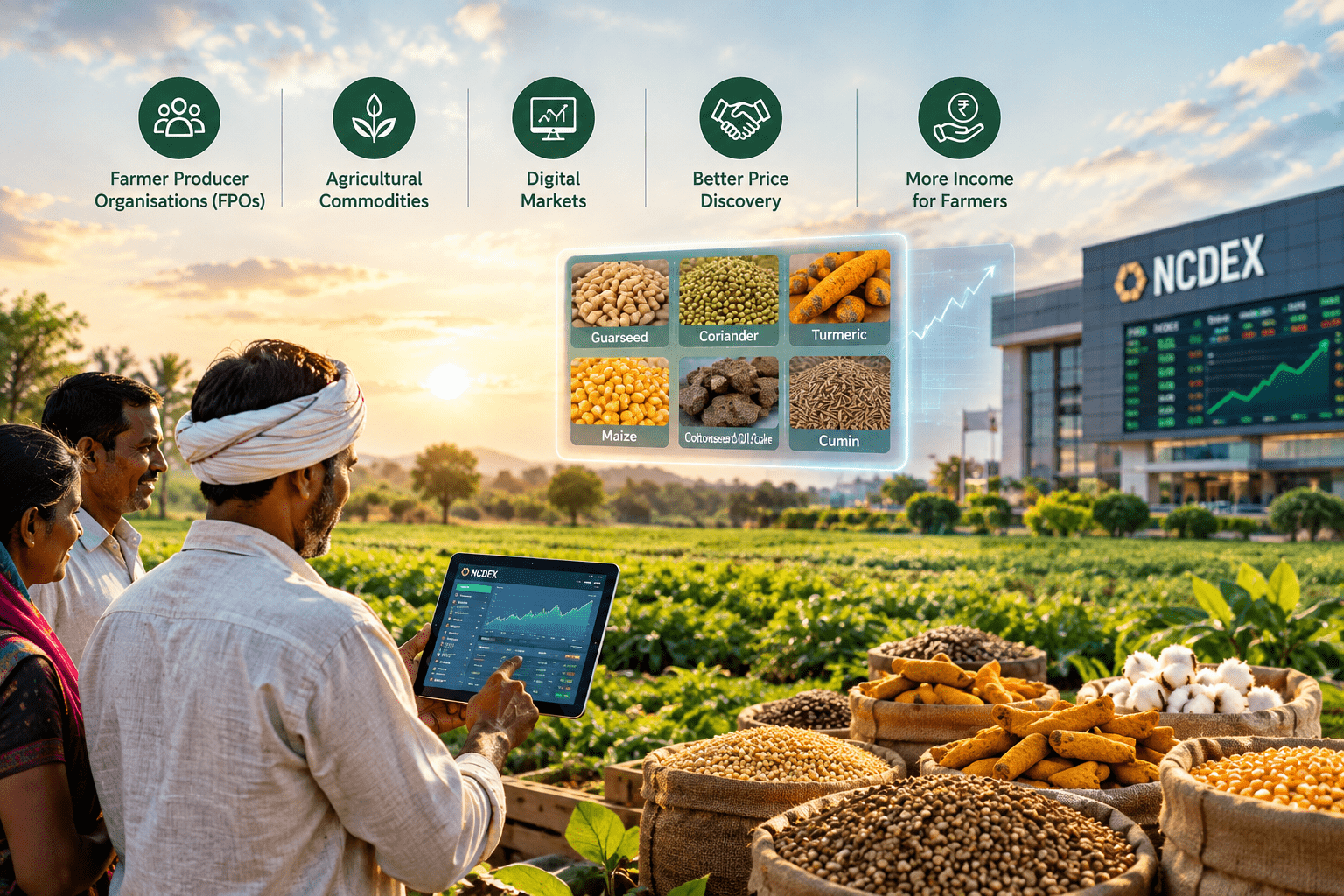
Farmer Producer Organisations are becoming more active in India’s organised agricultural markets.
During the first five months of the 2026–27 financial year, 75 FPOs traded around 0.15 million tonnes of agricultural commodities on NCDEX.
The total value of these trades reached about ₹57 crore between April and August 2026.
The growth shows how farmer collectives are exploring digital commodity markets to sell agricultural produce and access new marketing options.
The development could strengthen the connection between farmers, commodity markets and organised agricultural trade.
The growth is not limited to a few large farmer groups.
According to the report, 16 FPOs crossed ₹1 crore in cumulative trade on NCDEX during April to August.
The agricultural commodities traded include:
Many of these commodities are important crops for India’s agricultural economy.
The increase in FPO participation could also push agricultural commodity sales on the exchange above the ₹700 crore recorded in FY26, according to sources cited by Financial Express.
A Farmer Producer Organisation brings farmers together as a collective.
Instead of selling individually, farmers can pool their produce through the organisation.
This can help them improve procurement, storage and marketing.
FPOs can also connect farmers with organised markets and digital platforms.
The model is becoming increasingly important as India looks for better ways to connect agricultural producers with buyers.
NCDEX is a commodity exchange where agricultural commodities can be traded through organised market mechanisms.
For FPOs, such platforms provide another option beyond conventional mandi-based trading.
According to an agriculture ministry official quoted by Financial Express, commodity exchanges can help formalise agricultural trade while allowing FPOs to receive payments directly into bank accounts.
This can improve transparency in transactions.
It can also give farmer groups greater flexibility in how they market their produce.
One of the major advantages of organised commodity markets is price discovery.
Farmers and FPOs can use market information to understand prevailing prices and make better selling decisions.
FPO representatives quoted in the report said commodity futures provide alternative marketing tools and can support better prices and prompt payment settlements.
However, commodity markets do not guarantee higher prices.
Prices can move up or down based on supply, demand, weather, global markets and other factors.
Therefore, FPOs need strong market knowledge before using futures and other commodity-market tools.
Some farmer groups are also looking beyond immediate sales.
Ranmal Farmer Producer Company from Gujarat said it plans to procure agricultural commodities from farmers in advance and store them in NCDEX warehouses.
The objective is to have produce ready for future trades when market conditions are favourable.
This highlights another important part of organised agricultural markets.
Storage can give farmers more flexibility over when to sell their produce.
The rise of FPO trading is happening alongside wider digitalisation in agriculture.
Thousands of farmer organisations are now using online platforms to reach buyers.
The Financial Express report notes that more than 9,450 FPOs are onboarded on the government’s ONDC platform.
More than 200 collectives are also selling products through the Government e-Marketplace, while agricultural sales are expanding through private e-commerce platforms.
This creates more options for farmer groups.
Instead of depending on a single sales channel, FPOs can explore multiple organised markets.
Despite the growth, FPOs want wider access to agricultural futures markets.
They have requested that more commodities be allowed for futures trading.
This comes as the Securities and Exchange Board of India has extended the suspension of derivative contracts for several agricultural commodities until March 31, 2027.
The affected commodities include paddy, wheat, chana, mustard seed and derivatives, soybean and derivatives, crude palm oil and moong.
This limits the number of agricultural products available for futures trading.
Greater FPO participation can have an impact beyond individual farmers.
When farmers organise into larger groups, they can potentially improve procurement and marketing efficiency.
They can also aggregate larger quantities of produce.
This makes it easier for organised markets and institutional buyers to engage with farming communities.
Over time, stronger FPOs could therefore become an important link between India’s farms and its formal agricultural markets.
The shift is not only about commodity exchanges.
Digital platforms are changing how agricultural produce is marketed, tracked and sold.
Online marketplaces can help FPOs reach buyers outside their traditional trading areas.
Digital payments can also make settlements faster and more transparent.
Combined with organised commodity markets, these tools can give farmer groups more control over their marketing decisions.
The growing FPO agri trade on NCDEX reflects a wider change in India’s agricultural economy.
Farmers are increasingly becoming part of organised digital markets rather than depending only on traditional channels.
For FPOs, this can mean better access to market information, organised buyers, storage facilities and alternative trading mechanisms.
The next challenge will be improving awareness and ensuring that smaller farmer organisations can use these systems effectively.
The rise in FPO trading shows that India’s agricultural market is becoming more connected.
Farmers produce the crops.
FPOs aggregate them.
Digital platforms connect them with buyers.
Commodity exchanges provide another organised route for trading and price discovery.
Together, these systems can create a more structured agricultural marketplace.
The growth recorded during the first five months of FY27 suggests that farmer collectives are increasingly willing to explore these opportunities.
The latest NCDEX data points to a changing agricultural landscape.
FPOs are no longer focused only on production.
They are also becoming more active in marketing, storage, price discovery and organised commodity trading.
As digital agricultural markets continue to expand, stronger farmer collectives could play a bigger role in connecting India’s farms with the wider economy.