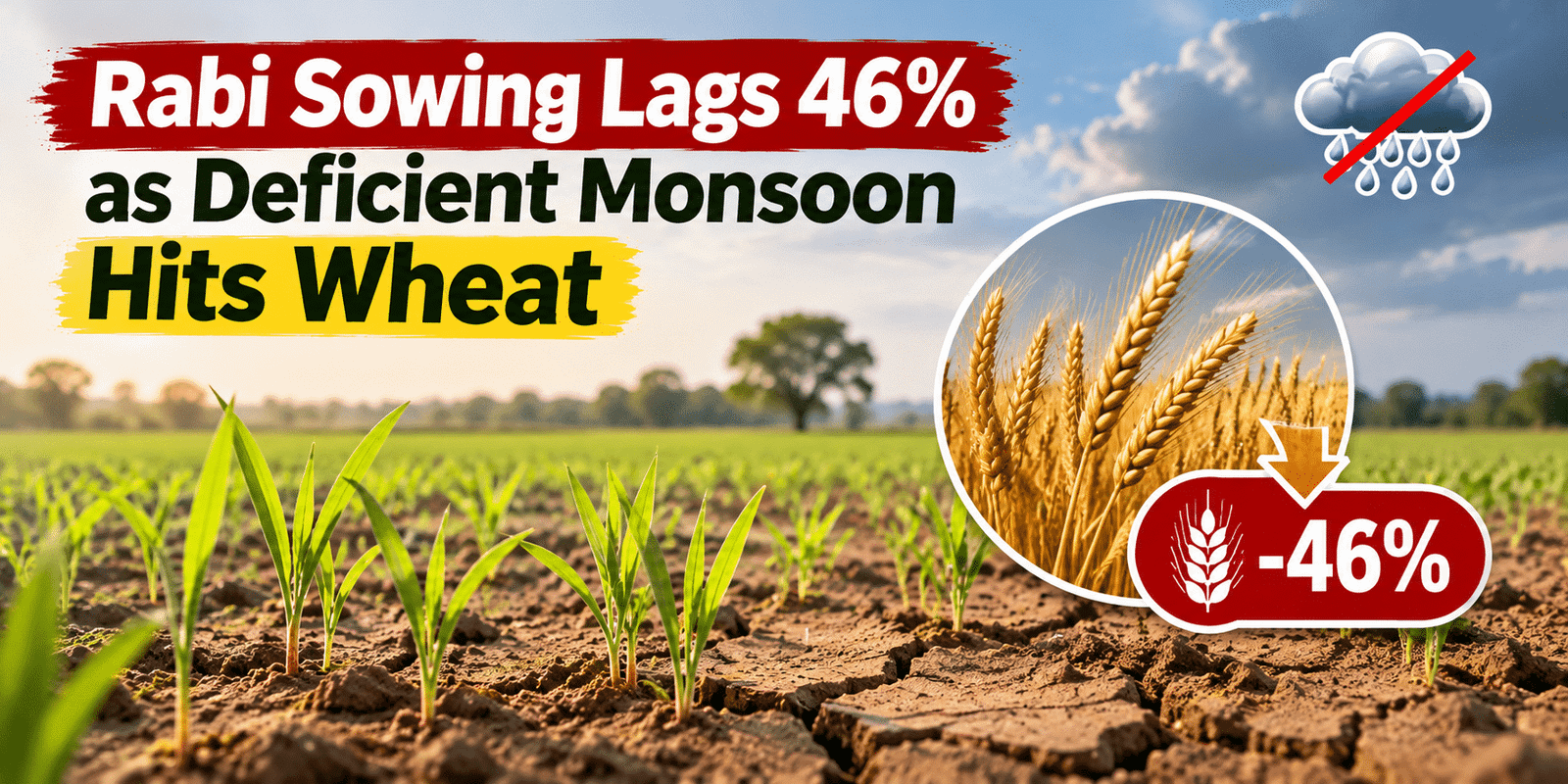
India’s rabi sowing season has fallen far behind last year. As of October 30, farmers had planted rabi crops on 37.56 lakh hectares, down 46% from 69.02 lakh hectares in the same period a year earlier, according to data from the Union Agriculture Ministry. A weak monsoon and low soil moisture are the main reasons for the slowdown.
Wheat is the main rabi crop, normally sown in October and November and harvested in March and April. This year, only about 19,000 hectares had been sown, compared with 3.34 lakh hectares a year earlier. Experts say insufficient soil moisture is the main reason, since the land needs enough moisture before farmers can plant. Lower water levels in reservoirs and canals in key wheat-growing states add to the problem, because wheat needs several rounds of irrigation after sowing.
The slowdown extends beyond wheat. Pulse acreage stood at 9.45 lakh hectares, down from 19.56 lakh hectares. Gram alone fell to 5.90 lakh hectares from 14.35 lakh hectares. Oilseed sowing covered 20.97 lakh hectares, compared with 38.62 lakh hectares last year. Rapeseed and mustard, a major oilseed, accounted for 20.50 lakh hectares against 38.07 lakh hectares.
Coarse cereals and winter-sown paddy showed smaller declines, with coarse cereals at 3.78 lakh hectares and paddy at 3.16 lakh hectares.
The June to September monsoon was 13% below normal. This reduced the moisture left in the soil after the kharif harvest, which is the window farmers rely on to sow rabi crops. With less residual moisture, many farmers are waiting for conditions to improve before planting.
Union Agriculture Minister Shivraj Singh Chouhan reviewed the situation at a meeting on Monday. He directed officials to speed up rabi sowing immediately after the kharif harvest and make full use of the remaining soil moisture.
For farmers in areas with limited irrigation, Chouhan recommended crops that need less water and cost less to grow. These include chana (chickpea), mustard, masoor (lentil), and millets. He also asked that climate-resilient, heat-tolerant seeds developed by agricultural scientists be made available to farmers, given the unpredictable temperature changes this season.
The ministry said there are adequate stocks of urea, DAP, MOP, and NPK fertilisers, along with certified seed for the rabi season. Supply chains are being coordinated with states down to the district level. Mandi data also show that prices for major crops, including paddy, wheat, maize, gram, lentil, arhar, soybean, and mustard, are running well above their minimum support prices. This gives farmers who do sell a better return.
Sowing will pick up only if rainfall improves and irrigation supplies recover. Farmers and policymakers will be watching the weekly sowing data closely in the coming weeks, especially for wheat and pulses.