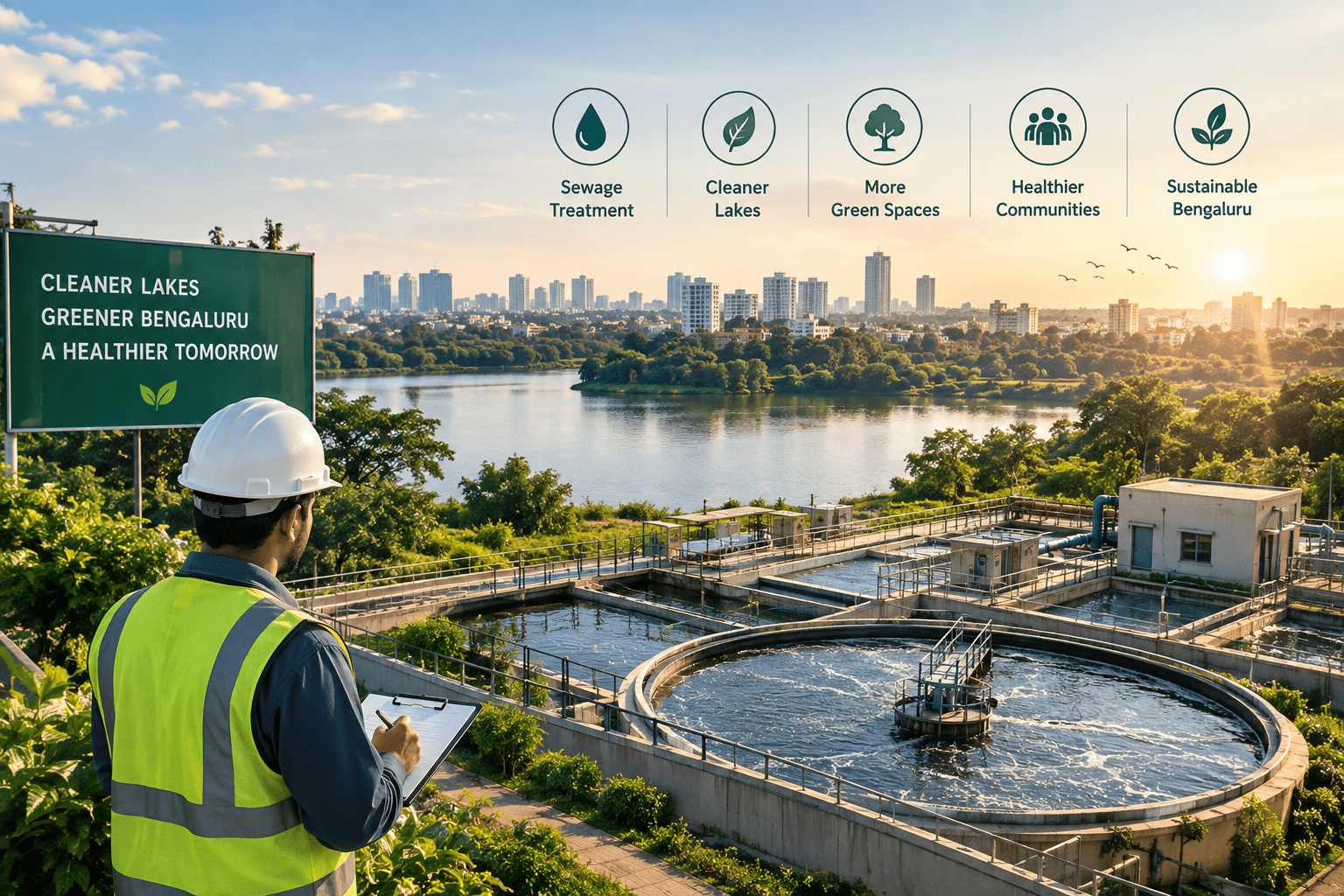
Bengaluru is strengthening its focus on sewage management as concerns over water pollution continue to grow.
Karnataka’s Forest, Environment and Ecology Minister Ramalinga Reddy has directed officials to carry out stricter inspections of sewage treatment plants (STPs) across the city.
The Bangalore Water Supply and Sewerage Board (BWSSB) and Karnataka State Pollution Control Board (KSPCB) have been asked to ensure that STPs follow prescribed environmental standards.
The move comes as the city continues to balance rapid development with the need to protect its lakes, groundwater and other natural resources.
Bengaluru depends heavily on its network of lakes and interconnected water systems.
Poorly treated sewage can affect these water bodies and surrounding ecosystems. It can also create wider concerns for water quality and urban health.
The latest inspections are therefore more than a compliance exercise.
They are part of a larger effort to improve how the city manages wastewater as its population and built-up areas continue to expand.
Recent discussions between the government and citizen groups have also highlighted concerns about pollution affecting Bengaluru’s lakes and other natural areas.
The state government has asked BWSSB and KSPCB to step up inspections.
The agencies will check whether sewage treatment facilities are operating according to required standards.
The directive is aimed at identifying gaps and ensuring that treatment systems work as intended.
The government has also set a compliance timeline for STPs to meet the required environmental norms.
This could bring greater attention to wastewater management in apartment communities, commercial developments and other large establishments.
Bengaluru has seen rapid growth in apartment communities and large residential developments.
Many of these developments operate their own sewage treatment plants.
During a recent public consultation, environmental groups called for better monitoring of sewage treatment systems in apartment complexes.
They also sought real-time publication of pollution data from BWSSB, apartment STPs and other agencies.
Better monitoring could help identify problems before untreated or poorly treated wastewater reaches nearby water bodies.
It could also encourage residential communities to treat wastewater as an important part of responsible urban living.
Bengaluru’s lakes are closely connected to the city’s environmental health.
They support aquatic ecosystems, provide open spaces and form part of the city’s drainage network.
However, pollution and development pressures continue to create challenges.
At the September 9 public consultation, citizens and environmental groups raised concerns about the condition of lakes, parks, pollution and the impact of large infrastructure projects on Karnataka’s ecology.
The Forest Minister said issues under the forest department would be addressed, while other concerns would be taken up at the government level.
Bengaluru’s environmental concerns are not limited to sewage.
The city is also debating how infrastructure projects should use public and green spaces.
A recent Geological Survey of India report warned that the proposed Hebbal underground tunnel could affect the ancient rock formation at Lalbagh.
The report also raised concerns about possible changes to groundwater flow and potential effects on Lalbagh Lake and local aquifers.
These developments highlight a larger question for Bengaluru.
How can the city continue to grow while protecting the natural systems that support urban life?
Good sewage management has a direct connection with everyday life.
Cleaner lakes can improve the quality of public spaces.
Better wastewater treatment can reduce pressure on natural water systems.
It can also support healthier surroundings for communities living near lakes, streams and other water bodies.
This makes wastewater management an important part of sustainable urban development.
The latest government action could therefore have an impact beyond sewage treatment plants.
It could influence how residential communities, businesses and civic agencies approach water management.
Regular inspections are important, but technology can make monitoring more effective.
Digital systems can help authorities track treatment performance and identify facilities that need attention.
Real-time data can also make environmental compliance easier to monitor.
Citizen groups have already asked for greater transparency around pollution data in Bengaluru.
Public access to reliable information could encourage stronger accountability.
It could also help residents understand the environmental performance of the communities and facilities around them.
Bengaluru has experienced major changes in its urban landscape over the past few decades.
New residential areas, offices, roads and infrastructure have expanded across the city.
At the same time, natural lakes, groundwater systems and green spaces remain important to the city’s environmental balance.
The government’s latest sewage inspection drive shows that wastewater management is becoming an important part of this conversation.
Protecting water resources will require action from government agencies as well as private communities and businesses.
Environmental protection is often associated with forests, parks and large conservation projects.
But sustainable living also depends on less visible systems.
Sewage treatment is one of them.
When wastewater is treated properly, pressure on natural water bodies can be reduced.
When communities monitor their STPs and follow environmental standards, they become part of the city’s wider sustainability effort.
For a growing city like Bengaluru, these everyday systems can have a significant long-term impact.
The new inspection drive puts Bengaluru sewage treatment plants under greater environmental scrutiny.
It also reflects a broader shift in the city’s approach to sustainability.
Lakes, groundwater, parks and wastewater systems cannot be viewed separately.
They are part of the same urban ecosystem.
As Bengaluru continues to grow, protecting these natural resources will be important for creating healthier and more sustainable neighbourhoods.
The challenge now is to ensure that environmental standards are not only written into regulations but also followed consistently on the ground.