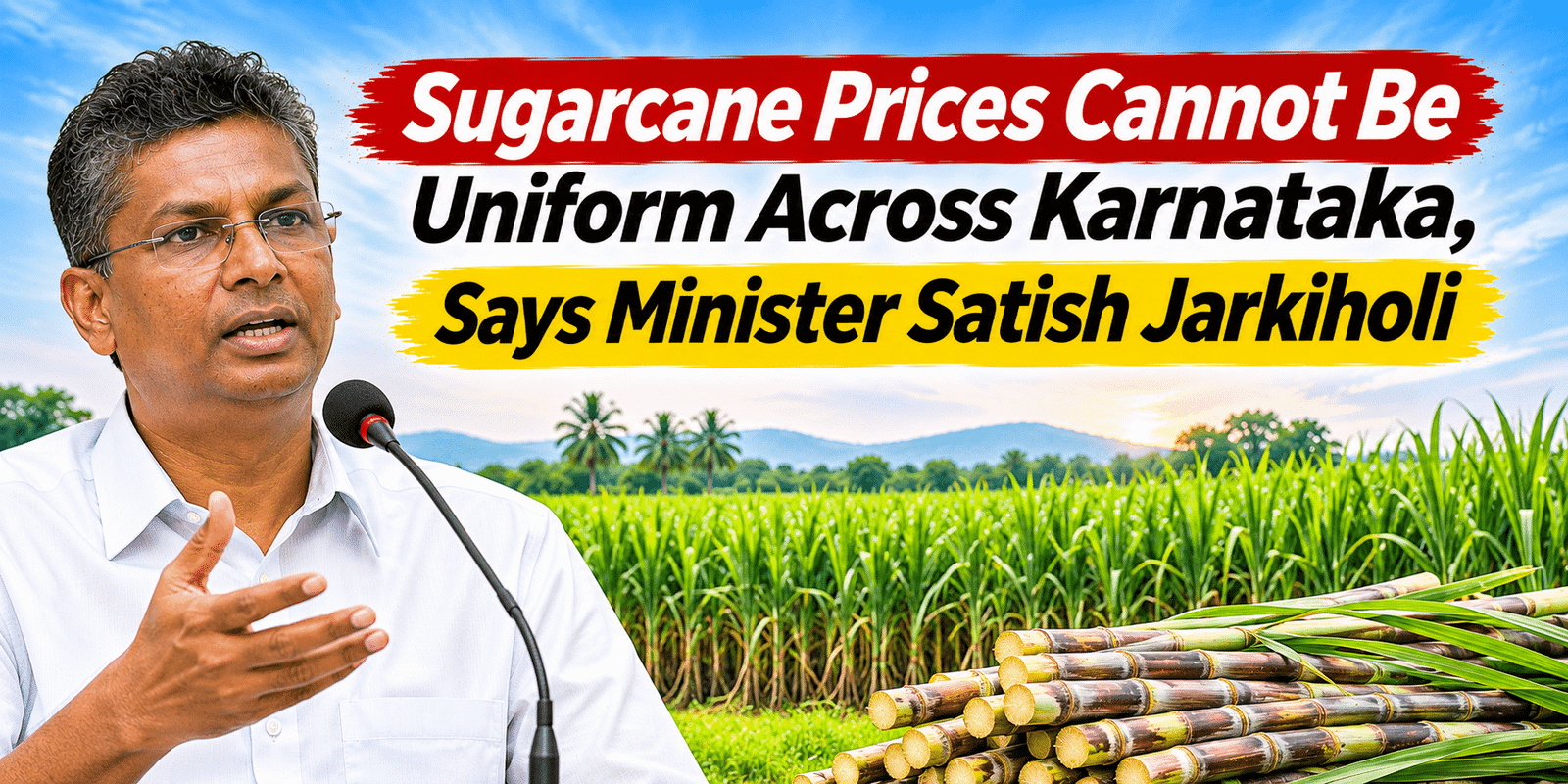
Karnataka sugarcane price levels will vary from factory to factory, according to Minister Satish Jarkiholi. He said each mill’s ability to pay depends on its financial health, sugar recovery, and market conditions. His remarks in Belagavi on Saturday, November 14, 2026, reflect the state’s position on the cane price dispute.
Jarkiholi said price differences between factories and districts are natural, especially in a year of poor yields caused by dry weather. Financially strong mills can afford to pay more, while mills running at a loss or carrying heavy debt face tighter limits. He acknowledged that farmers’ demand for a uniform Karnataka sugarcane price is understandable, but said enforcing one would be impractical.
According to the minister, several rounds of talks between farmers and factory owners produced a base price of Rs 3,600 per tonne. Growers will also share in extra income if sugar prices improve. Some factories have announced higher rates to stay competitive and secure enough cane, which is why prices differ across Belagavi, Kalaburagi and Haveri districts.
Farmers are also comparing the Karnataka sugarcane price with Maharashtra, where mills have traditionally paid more. Jarkiholi said this comparison is shaping farmers’ expectations.
Jarkiholi identified low sugar prices as the industry’s main financial challenge. Weak sugar realisations limit mills’ ability to pay farmers more for cane. He urged the Union government to revise the Minimum Selling Price (MSP) of sugar, arguing that higher realisations would strengthen factory finances and support a better Karnataka sugarcane price.
The minister said the Centre has formed a committee to examine the MSP revision and asked it to consider farmers’ concerns. He stressed that the final decision on raising the minimum selling price rests with the Union government. Until then, the Karnataka sugarcane price will remain a point of negotiation between farmers, mills, and the state.