📍 Bengaluru ENG
Mogg's News
Farmland · Land & Investment · Bengaluru
Advertisement
Latest
Grow your wealth with secure, managed farmland●Unlock High Returns with Premium Farmland Investment●Subscribe now to catch every update!●Grow your wealth with secure, managed farmland●Unlock High Returns with Premium Farmland Investment●Subscribe now to catch every update!●
← Home
Home › Agriculture
Agriculture

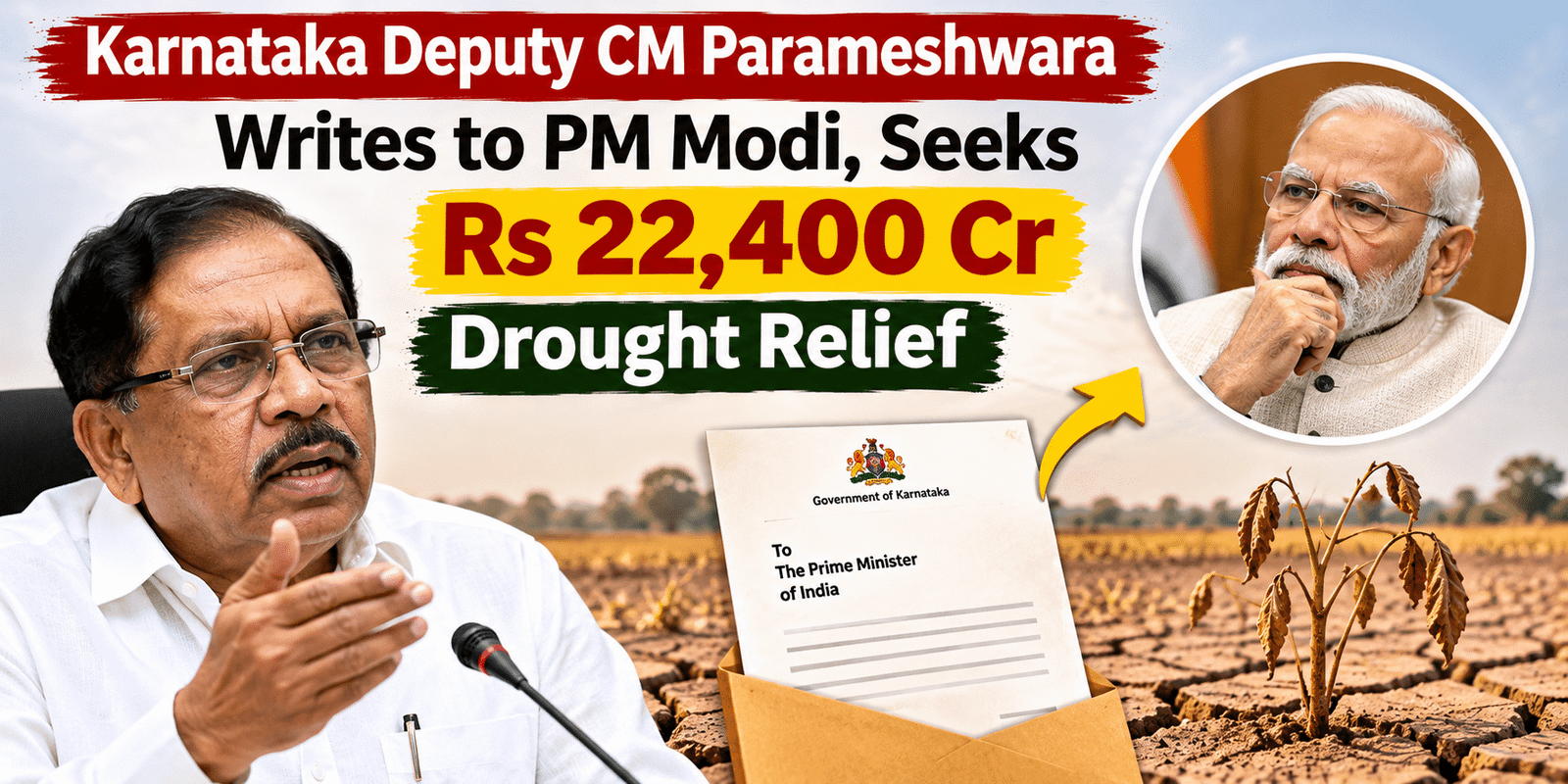
Karnataka Seeks Rs 22,400 Crore Drought Relief from Centre as 226 Taluks Are Hit

Karnataka has asked the Centre for Rs 22,400.58 crore in drought relief after declaring 226 taluks drought-affected, with crops damaged across 57.93 lakh hectares. The state estimates economic losses at Rs 62,481.88 crore. Revenue Minister G. Parameshwara has written to PM Modi

A
By Abdulrazak
Published: November 4, 2026, 09:15 IST · Updated: November 4, 2026, 14:32 IST · 3 min

Karnataka has asked the Centre for Rs 22,400.58 crore in drought relief after declaring 226 taluks drought-affected. Crops have been damaged across 57.93 lakh hectares, and the state estimates economic losses at Rs 62,481.88 crore.

Revenue Minister and Deputy Chief Minister G. Parameshwara wrote to Prime Minister Narendra Modi, Union Home Minister Amit Shah, and Union Agriculture Minister Shivraj Singh Chouhan in separate letters dated November 2. He asked for urgent appointments to present the state’s revised memorandum and explain the extent of drought-related losses.

The state’s cumulative drought relief requirement has risen from Rs 20,585.73 crore to Rs 22,400.58 crore. The increase follows the Centre’s revision of assistance norms under the State Disaster Response Fund (SDRF) and the National Disaster Response Fund (NDRF) for 2026-27 to 2030-31. The Union Home Ministry notified the revised norms on October 26.

Under the new norms, Karnataka’s crop-loss input subsidy requirement has risen from Rs 6,128.70 crore to Rs 7,943.55 crore.

The revised rates are Rs 11,000 per hectare for rainfed crops, Rs 22,000 per hectare for irrigated crops, and Rs 30,000 per hectare for perennial crops.

Parameshwara acknowledged the revised norms but said the higher rates still fall short of what farmers spend to cultivate their land. “Our farmers cannot be expected to confront the economic realities of 2026 with a relief framework that does not adequately recognise the true cost of cultivation,” he said.

He added that drought-affected farmers need timely financial help and a relief mechanism that reflects both the size of their losses and their economic situation.

The state is waiting for the Centre to schedule meetings and decide on the revised memorandum. Farmers and rural communities will be watching for any change in the rates and the timing of payments.
#Agriculture #ManagedFarmland #MoggsEstates
Advertisement · 728 x 120

Related Stories

Agriculture

Agriculture Infrastructure Fund Expands Subsidized Financing for On-Farm Cold Chains and Processing Assets

Under the Central Government’s ₹1 lakh crore Agriculture Infrastructure Fund (AIF), individual landholders, agri-entrepreneurs, and Farmer Producer Organizations (FPOs) are accelerating investments in farm-gate infrastructure.

August 11, 2026 · 5 min
Farms

Institutionalizing Farmland: How NABARD’s ₹25,000 Crore Refinance Fund Unlocks High-Yield Managed Acreage in South India

The landscape of Indian agricultural real estate is undergoing a structural shift. The National Bank for Agriculture and Rural Development (NABARD) has unveiled a ₹25,000 crore refinance facility targeted at institutional managed farmland and smart cold-chain corridors.

August 4, 2026 · 10 min
Investment

India’s Wind Energy Expansion Could Create a New Opportunity for Managed Farmland

India's renewable-energy transition is changing the way rural land is viewed. Agricultural land has traditionally been valued for its farming potential, water availability and long-term appreciation. But in regions with strong renewable-energy resources, another factor is becoming relevant: the potential for land to support energy infrastructure alongside agriculture. India's wind sector has expanded significantly over the past decade. According to the Ministry of New and Renewable Energy, the country had about 57.44 GW of installed wind power capacity by June 30, 2026, compared with roughly 21 GW in 2014.

August 16, 2026 · 10 minutes
" in single-news.php (uses $post_id which is already set inside your while(have_posts()) loop — if your loop has closed by this point, move this snippet inside the loop instead) -->