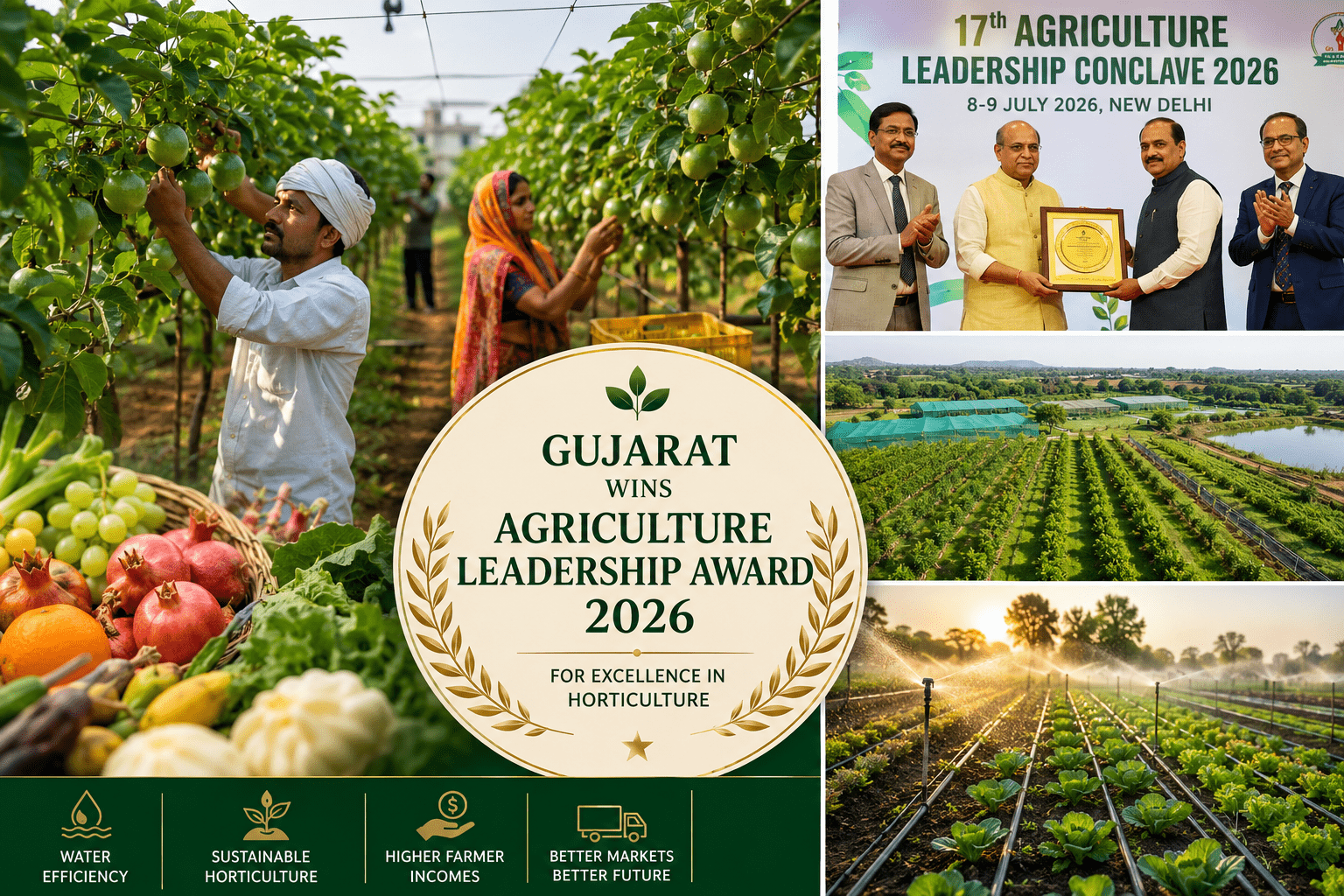
Gujarat has received the Agriculture Leadership Award 2026 for its performance in the horticulture sector, placing the state’s agricultural development back in the national spotlight.
The recognition was presented at the 17th Agriculture Leadership Conclave 2026, held in New Delhi on July 8–9. Union Defence Minister Rajnath Singh presented the award, which was received on behalf of the Gujarat government by Agriculture Minister Jitu Vaghani.
The award is significant because it recognises horticulture at a time when Indian agriculture is gradually moving beyond a purely crop-production model. Fruits, vegetables, protected cultivation, efficient irrigation and higher-value agricultural activities are becoming increasingly important to farm incomes and rural economies.
Horticulture has a different economic profile from traditional field crops.
Fruit and vegetable cultivation can create opportunities for higher-value production, but it also requires stronger management of water, post-harvest handling, storage, transportation and markets.
Gujarat’s latest recognition therefore points to a broader question for Indian agriculture:
Can farmers earn more from every acre while using natural resources more efficiently?
The answer will depend on more than simply increasing production.
Farmers need access to suitable planting material, irrigation, technology, market information, storage facilities and reliable buyers. Without these supporting systems, higher production does not automatically translate into higher farm income.
That makes horticultural development a question of the entire agricultural value chain.
One of the biggest changes taking place in Indian agriculture is the growing emphasis on value creation.
A traditional agricultural model often focuses on producing a crop and selling it immediately after harvest.
Horticulture creates a wider set of possibilities.
A farmer can potentially diversify into fruits, vegetables, spices, flowers, medicinal plants or other high-value crops depending on local conditions and market demand.
This diversification can reduce dependence on a single crop.
However, diversification also brings new risks. Perishable crops can suffer major losses when transportation, cold storage or market access is inadequate.
Therefore, the next phase of agricultural growth cannot focus only on what farmers grow.
It must also focus on what happens after the crop leaves the farm.
According to reporting on the award, Gujarat was recognised for its initiatives and innovations in horticulture. The state has also received Agriculture Leadership Awards in previous years, including recognition as the Best Agriculture State in 2009, 2014 and 2018, and for animal husbandry in 2019.
The 2026 recognition is therefore not an isolated event.
It adds another chapter to Gujarat’s long-running agricultural development story.
The state’s earlier agricultural initiatives have included programmes associated with soil health and micro-irrigation. These areas remain relevant because horticulture can be particularly sensitive to water availability and soil conditions.
Water is one of the most important issues facing Indian agriculture.
Horticultural crops can require careful irrigation management, particularly in regions facing water stress.
Technologies such as drip irrigation can help deliver water directly to the root zone and reduce unnecessary water application when properly designed and managed.
But technology alone cannot solve the water challenge.
Farmers also need crop choices that match local water availability, soil characteristics and climatic conditions.
This is where climate-smart agriculture becomes increasingly important.
Future agricultural success may depend not simply on producing more, but on producing more efficiently with limited water, healthier soil and better resource management.
Agricultural awards often focus on productivity, innovation and farmer welfare.
But the environmental dimension deserves equal attention.
Horticulture can contribute to agricultural diversification and landscape diversity, particularly when integrated with appropriate soil and water management.
At the same time, intensive cultivation can create environmental pressure if soil nutrients, pesticides and water are not managed responsibly.
The lesson from Gujarat’s recognition should therefore not be interpreted as “more production is always better.”
The more useful question is:
What kind of agricultural growth can remain productive over the long term?
That distinction matters for farmers, policymakers and anyone interested in sustainable land management.
The changing agricultural economy also has implications for how farmland is viewed.
Farmland is no longer only about traditional crop cultivation.
Depending on location, soil, water availability, connectivity and legal conditions, agricultural land can support different types of productive and lifestyle uses.
This is particularly relevant to the growing interest in managed farmland, where professional land management and agricultural planning can become part of the ownership experience.
For prospective farmland owners, however, agricultural potential should be evaluated carefully.
Factors such as water access, soil quality, road connectivity, land title, permitted land use, crop suitability and long-term maintenance can matter considerably more than simply the size of a plot.
Awards provide recognition, but they also create expectations.
Gujarat’s Agriculture Leadership Award 2026 highlights progress in horticulture. The next challenge is to determine whether that progress can translate into stronger farm incomes, more efficient resource use and greater resilience for farmers.
That requires continued investment in research, irrigation efficiency, post-harvest infrastructure and farmer training.
It also requires better connections between farms and markets.
If horticulture is to become a larger part of India’s agricultural economy, farmers need to capture more value from what they produce rather than remaining exposed to price fluctuations immediately after harvest.
The Gujarat award arrives at an interesting point for Indian agriculture.
The sector is gradually moving towards a more diversified model involving horticulture, livestock, agroforestry, technology, water-efficient cultivation and other forms of value-added farming.
This does not mean traditional agriculture is disappearing.
Instead, India’s agricultural future is likely to become more diverse.
Different regions will need different solutions based on their climate, soils, water resources and markets.
Gujarat’s 2026 Agriculture Leadership Award is therefore best understood not simply as a trophy for one state.
It is a reminder that the future of farming will increasingly be measured by productivity, profitability, resource efficiency and resilience together.
For farmers, the opportunity lies in finding better ways to create value from every acre.
For policymakers, the challenge is building the infrastructure and knowledge systems that make those opportunities practical.
And for the wider land market, the shift reinforces an important idea: productive farmland is becoming increasingly connected to how intelligently it is managed.