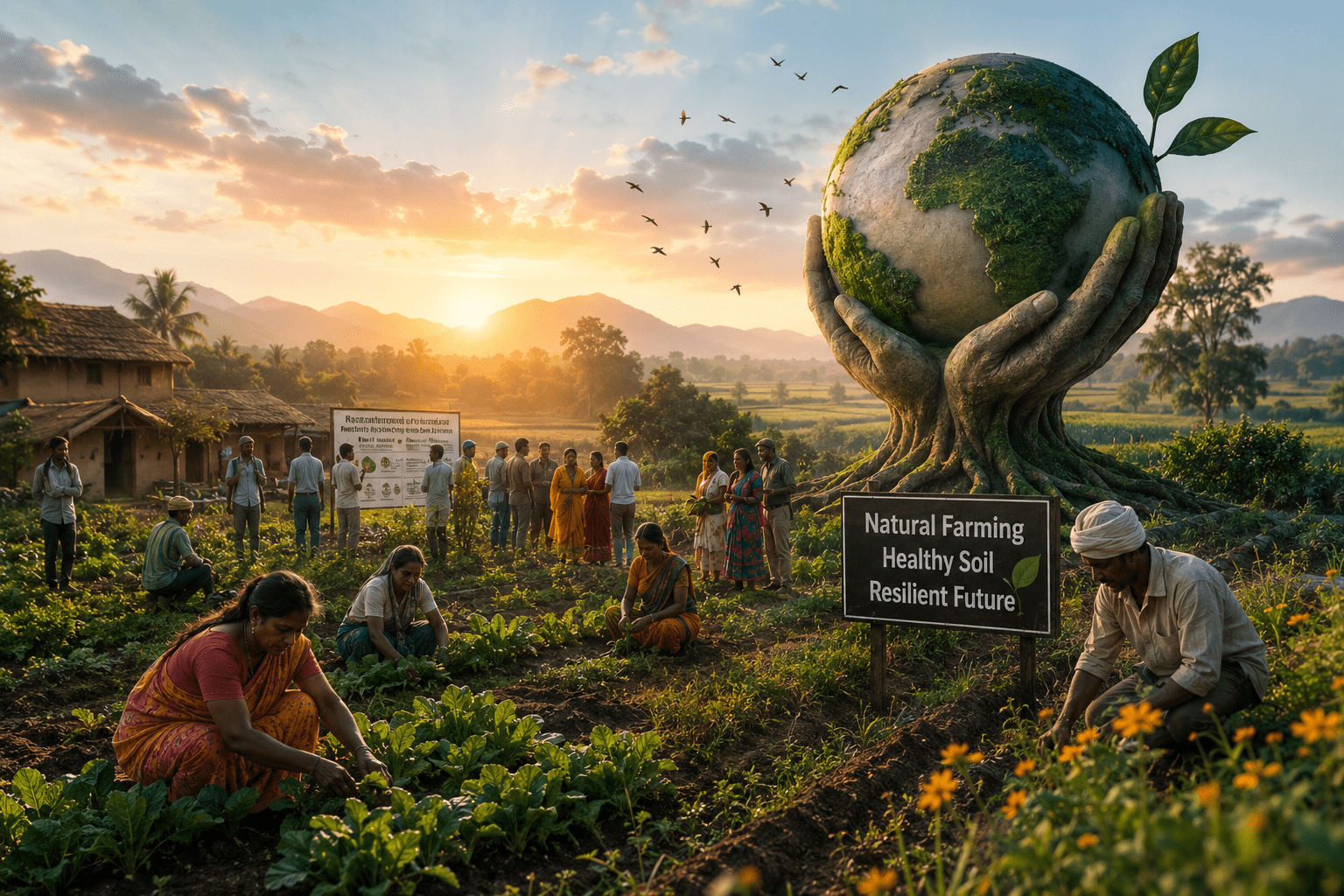
A large-scale farming movement in Andhra Pradesh has gained international recognition after the Andhra Pradesh Community Managed Natural Farming (APCNF) was named the winner of the 2026 Food Planet Prize, one of the world’s major environmental awards.
The recognition places India’s natural farming movement at the centre of an increasingly important global conversation: how can agriculture produce enough food while reducing pressure on soil, water and ecosystems?
APCNF was recognised for its efforts to help farmers move towards natural farming practices while strengthening resilience to climate shocks and improving rural livelihoods. According to the Food Planet Prize, the programme now involves around 1.8 million farmers, more than 8,000 villages and a network of over 10,000 farmer trainers.
The award carries a prize of $1.5 million, making the recognition significant not only for Andhra Pradesh but also for India’s wider agricultural transition.
For years, conversations around Indian agriculture have often focused on productivity, irrigation, fertiliser use and food security.
The APCNF recognition adds another dimension: how agriculture can work with natural ecosystems rather than continuously increasing dependence on external inputs.
The programme promotes practices such as year-round soil cover and pre-monsoon dry sowing. These approaches are intended to improve soil conditions, reduce dependence on synthetic agricultural inputs and help farms withstand climate-related stresses such as drought and erratic weather.
This matters at a time when farmers across different regions are dealing with changing rainfall patterns, rising input costs and increasingly unpredictable growing conditions.
The award therefore represents more than an achievement for one agricultural programme. It highlights a wider shift in the way sustainable farming is being discussed.
One of the most distinctive aspects of APCNF is its community-based approach.
Instead of treating natural farming as a practice adopted by isolated farmers, the programme has built networks of farmer trainers, village communities and women’s groups.
The Food Planet Prize says the movement is supported by more than 340,000 women’s self-help groups, demonstrating how agricultural transformation can also become connected with rural community organisation and women’s participation.
This model is important because agricultural change does not happen simply by introducing a new technique.
Farmers need knowledge, demonstrations, peer learning and confidence before changing practices that directly affect their income.
Community-based farming networks can make that transition easier by allowing farmers to learn from other farmers working under similar local conditions.
Soil is one of the most important assets in agriculture, but it is often discussed only when productivity begins to decline.
Natural farming brings soil health back into the centre of the agricultural conversation.
Practices that maintain ground cover and reduce dependence on synthetic inputs can contribute to healthier agricultural ecosystems when appropriately adapted to local conditions.
The Food Planet Prize says APCNF has demonstrated measurable reductions in dependence on synthetic agricultural inputs while improving resilience to drought, climate shocks and economic volatility.
However, the larger lesson is not that one farming method can work identically everywhere.
India has extremely diverse soils, climates, crops and farming systems. What works in one district may need to be adapted elsewhere.
That makes farmer-led experimentation and scientific evaluation particularly important.
Climate change is making agricultural planning more complicated.
Rainfall can become less predictable. Heat stress can affect crops and livestock. Longer dry periods can place additional pressure on irrigation. At the same time, sudden heavy rainfall can damage fields and wash away valuable soil.
This is why climate-resilient agriculture is becoming an increasingly important part of the environmental discussion.
APCNF’s recognition suggests that resilience should not be viewed only through the lens of technology and infrastructure.
The way farmland itself is managed can also influence resilience.
Healthy soils, diversified farming systems, efficient water management and locally appropriate agricultural practices can all form part of a broader climate adaptation strategy.
The Food Planet Prize says the award will help APCNF expand demonstration sites, develop implementation toolkits, build research partnerships and establish a natural farming leadership course. It also plans to strengthen the role of “farmer scientists” who can conduct and document experiments on their own farms.
That last element could be particularly significant.
Farmers are often treated as recipients of agricultural knowledge. A farmer-scientist approach instead recognises that farmers also generate valuable knowledge through years of observing their soil, crops, weather and local ecosystems.
Combining that practical knowledge with scientific research could create stronger models for sustainable agriculture.
The APCNF award also offers a broader perspective on how farmland is viewed.
Agricultural land is not simply a space where crops are produced. It is also connected to soil, water, biodiversity, carbon cycles and rural communities.
For people interested in farmland investment, this changing understanding is worth watching.
Land that is managed with long-term soil health, water conservation and ecological resilience in mind can have a very different future from land managed purely for short-term production.
This is one reason concepts such as managed farmland, regenerative agriculture and sustainable land management are increasingly entering conversations around rural development.
The investment perspective should not, however, be confused with a guarantee of financial returns. Land value depends on location, legal status, infrastructure, water availability, agricultural productivity and wider market conditions.
The 2026 Food Planet Prize has given Andhra Pradesh’s natural farming movement a global platform.
More importantly, it demonstrates that some of the most interesting agricultural innovations are not necessarily based on a new machine or a new chemical input.
Sometimes, the innovation lies in changing how farmers organise, share knowledge and work with the resources already present around them.
For Indian agriculture, the challenge now is to determine how such approaches can be scientifically evaluated, locally adapted and responsibly scaled.
The future of farming may not be about choosing between productivity and environmental protection.
It may increasingly be about finding ways to achieve both.