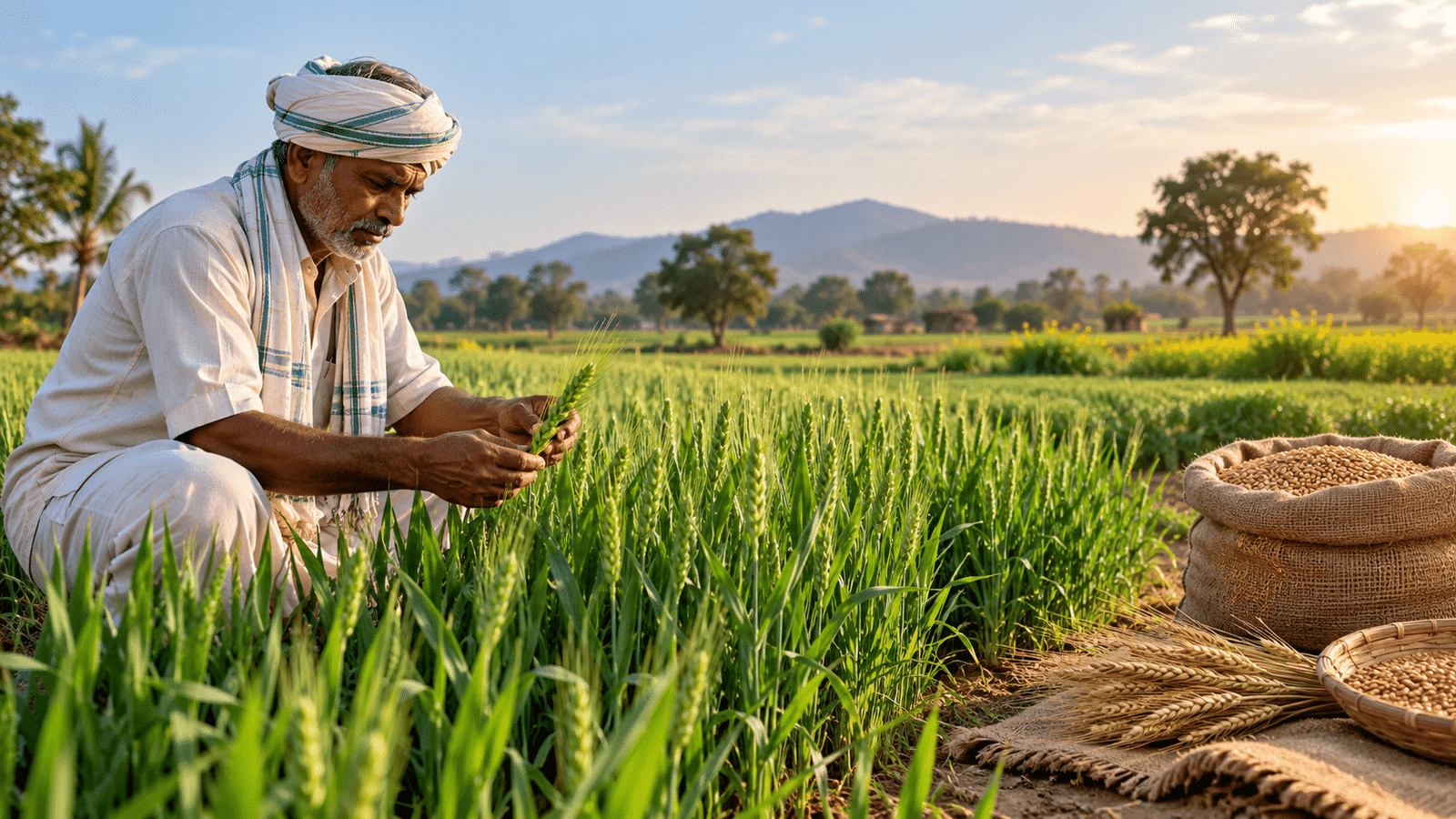
The Indian government has announced higher Minimum Support Prices (MSP) for six major rabi crops for the 2027–28 marketing season.
The Cabinet Committee on Economic Affairs approved the revised prices on September 30, 2026. The decision covers wheat, barley, gram, lentil (masur), rapeseed and mustard, and safflower.
Among these crops, safflower received the largest increase at ₹675 per quintal, while rapeseed and mustard received an increase of ₹413 per quintal.
The announcement is significant for India’s agricultural markets because MSP can influence procurement, farm-level price expectations and crop planning ahead of the rabi sowing season.
Minimum Support Price, or MSP, is a government-announced price for specified agricultural crops.
It is intended to provide a price-support mechanism for farmers. However, the announced MSP does not mean that every farmer automatically sells their entire crop at that price. Actual procurement depends on the applicable government procurement arrangements, crop, location and other conditions.
For agricultural markets, MSP announcements are closely watched because they provide a reference point for the upcoming marketing season.
The revised MSPs for the 2027–28 marketing season are:
The figures were reported following the Cabinet decision on September 30.
The MSP for wheat has increased from ₹2,585 to ₹2,610 per quintal.
The ₹25 increase is smaller in absolute terms than the increases announced for several other rabi crops. Wheat remains one of India’s most important food crops and a major part of the country’s agricultural procurement system.
Safflower has received the largest absolute MSP increase among the six crops.
Its MSP has increased by ₹675 per quintal, from ₹6,540 in the previous marketing season to ₹7,215 per quintal for 2027–28.
Rapeseed and mustard follow with an increase of ₹413 per quintal.
The new MSP rates provide an important reference for farmers and other participants in the agricultural supply chain.
MSP announcements come ahead of the rabi sowing period. Farmers may consider the announced support prices along with factors such as water availability, soil conditions, input costs and local market conditions when planning their crops.
Higher MSPs can influence expectations around government procurement for eligible crops.
The government has estimated an ₹90,962 crore financial payout under the Rabi Price Policy for the six crops covered by the latest decision.
MSP is one of several factors that influence agricultural commodity markets.
Actual market prices can also be affected by production levels, demand, weather, storage, imports, exports and international commodity prices.
Therefore, an increase in MSP does not necessarily mean that retail or wholesale prices will rise by the same amount.
The MSP decision comes as India moves from the kharif season towards the rabi agricultural cycle.
This year’s agricultural conditions have already attracted attention because India’s southwest monsoon ended with rainfall 12% below normal, according to reporting published on September 30.
Uneven rainfall has affected agricultural regions, while concerns about soil moisture and water availability have increased ahead of the rabi season.
This makes the interaction between crop prices, farm production and water availability particularly important for India’s agricultural markets in the months ahead.
The revised MSPs give farmers another price-related factor to consider when planning rabi cultivation.
However, crop economics involve much more than the announced support price.
Farmers also need to consider:
A higher MSP can change the price-support environment, but the final profitability of a crop depends on the complete cost and market structure.
For managed farmland businesses, agricultural market developments are useful indicators of the broader farming environment.
Market prices can influence which crops farmers consider, while water availability, soil health and local climate conditions determine what can realistically be cultivated.
For farmland managers, this reinforces the importance of taking a long-term approach to agricultural planning.
Good farm management should consider the complete picture: land quality, water resources, crop suitability, maintenance costs and market conditions.
The latest MSP announcement comes at a time when India’s agricultural markets are responding to several factors at once.
Weather conditions are influencing crop expectations. Water availability is an important consideration for the upcoming rabi season. At the same time, government price-support policies are providing new reference prices for six major rabi crops.
Together, these factors will shape agricultural decisions during the next marketing cycle.
The actual impact on commodity prices and farm income will depend on production, procurement, demand and market conditions as the season progresses.
India has increased MSPs for all six mandated rabi crops for the 2027–28 marketing season, with safflower receiving the largest increase of ₹675 per quintal.
For agricultural markets, the announcement provides a new price benchmark ahead of the rabi season, while farmers will continue to weigh MSP against production costs, water availability, crop yields and prevailing market prices.