📍 Bengaluru ENG
Mogg's News
Farmland · Land & Investment · Bengaluru
Advertisement
Latest
Grow your wealth with secure, managed farmland●Unlock High Returns with Premium Farmland Investment●Subscribe now to catch every update!●Grow your wealth with secure, managed farmland●Unlock High Returns with Premium Farmland Investment●Subscribe now to catch every update!●
← Home
Home › Agriculture
Agriculture

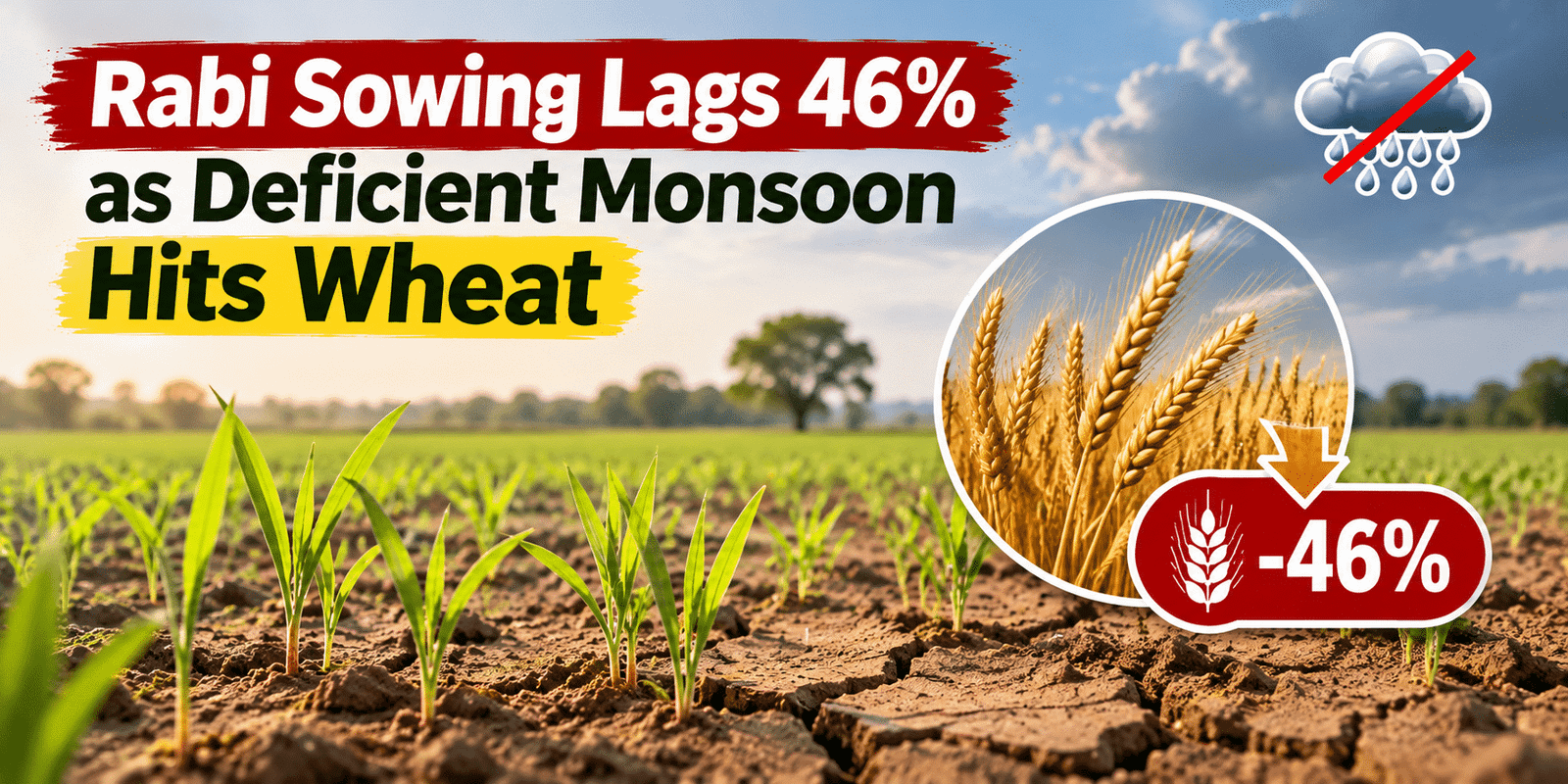
Rabi Sowing Lags 46% as Deficient Monsoon Hits Wheat

Rabi sowing across India has fallen 46% behind last year, with 37.56 lakh hectares planted as of October 30 against 69.02 lakh hectares a year earlier. Wheat is the hardest hit, with only about 19,000 hectares sown compared with 3.34 lakh hectares last year. Experts blame a 13% monsoon deficit that left too little soil moisture and low reservoir levels. The government has urged farmers in dry areas to shift to water-saving crops such as chana, mustard, masoor, and millets.

MN
By Mogg's News Desk
Published: November 3, 2026, 09:15 IST · Updated: November 3, 2026, 14:32 IST

India’s rabi sowing season has fallen far behind last year. As of October 30, farmers had planted rabi crops on 37.56 lakh hectares, down 46% from 69.02 lakh hectares in the same period a year earlier, according to data from the Union Agriculture Ministry. A weak monsoon and low soil moisture are the main reasons for the slowdown.

Wheat is the main rabi crop, normally sown in October and November and harvested in March and April. This year, only about 19,000 hectares had been sown, compared with 3.34 lakh hectares a year earlier. Experts say insufficient soil moisture is the main reason, since the land needs enough moisture before farmers can plant. Lower water levels in reservoirs and canals in key wheat-growing states add to the problem, because wheat needs several rounds of irrigation after sowing.

The slowdown extends beyond wheat. Pulse acreage stood at 9.45 lakh hectares, down from 19.56 lakh hectares. Gram alone fell to 5.90 lakh hectares from 14.35 lakh hectares. Oilseed sowing covered 20.97 lakh hectares, compared with 38.62 lakh hectares last year. Rapeseed and mustard, a major oilseed, accounted for 20.50 lakh hectares against 38.07 lakh hectares.

Coarse cereals and winter-sown paddy showed smaller declines, with coarse cereals at 3.78 lakh hectares and paddy at 3.16 lakh hectares.

The June to September monsoon was 13% below normal. This reduced the moisture left in the soil after the kharif harvest, which is the window farmers rely on to sow rabi crops. With less residual moisture, many farmers are waiting for conditions to improve before planting.

Union Agriculture Minister Shivraj Singh Chouhan reviewed the situation at a meeting on Monday. He directed officials to speed up rabi sowing immediately after the kharif harvest and make full use of the remaining soil moisture.

For farmers in areas with limited irrigation, Chouhan recommended crops that need less water and cost less to grow. These include chana (chickpea), mustard, masoor (lentil), and millets. He also asked that climate-resilient, heat-tolerant seeds developed by agricultural scientists be made available to farmers, given the unpredictable temperature changes this season.

The ministry said there are adequate stocks of urea, DAP, MOP, and NPK fertilisers, along with certified seed for the rabi season. Supply chains are being coordinated with states down to the district level. Mandi data also show that prices for major crops, including paddy, wheat, maize, gram, lentil, arhar, soybean, and mustard, are running well above their minimum support prices. This gives farmers who do sell a better return.

Sowing will pick up only if rainfall improves and irrigation supplies recover. Farmers and policymakers will be watching the weekly sowing data closely in the coming weeks, especially for wheat and pulses.

#Agriculture #ManagedFarmland #MoggsEstates
Advertisement · 728 x 120

Related Stories

Lifestyle

India Hosts World Circular Economy Forum 2026 as Sustainable Living Takes Centre Stage

The World Circular Economy Forum 2026 has begun in Gandhinagar, Gujarat. The global event is being held from September 15 to 18. This is the first time the forum is being hosted in South Asia. More than 2,000 participants from over 65 countries are attending the event. The forum focuses on recycling, reuse, resource efficiency and sustainable living. It also looks at how businesses, governments and communities can reduce waste.

September 15, 2026 · 10 minutes
Farms

Soil Health Engineering as an Asset Value Multiplier: Capitalizing on Regenerative AgTech and Managed Farmland Yields in India

India’s institutional agricultural sector is undergoing a profound structural shift where soil health is no longer viewed merely as an ecological metric, but as a critical lever for underlying real estate asset valuation and long-term risk management.

August 5, 2026 · 10 min
Agriculture

India Calls for Stronger Global Investment in Land Restoration and Drought Resilience

India has called for stronger and more predictable international financing for land restoration and drought resilience, highlighting the growing need to protect agricultural land, water resources and ecosystems from environmental stress. Speaking at a ministerial dialogue on innovative financial mechanisms for healthy land and drought resilience during the 17th Conference of Parties (COP17) of the UN Convention to Combat Desertification in Ulaanbaatar, Mongolia, Union Environment Minister Bhupender Yadav said land restoration should be viewed as an investment rather than simply a cost.

August 25, 2026 · 10 minutes
" in single-news.php (uses $post_id which is already set inside your while(have_posts()) loop — if your loop has closed by this point, move this snippet inside the loop instead) -->