Indian farming is entering a new phase.
Farmers across the country are increasingly adopting methods that focus not only on crop production, but also on the health of the soil, water and wider farm ecosystem.
This shift towards regenerative agriculture has gained fresh attention after the Government of India highlighted its growing role in building stronger and more resilient farms. The development was reported by the Press Information Bureau on August 23, 2026.
Regenerative agriculture focuses on improving the natural health of farmland.
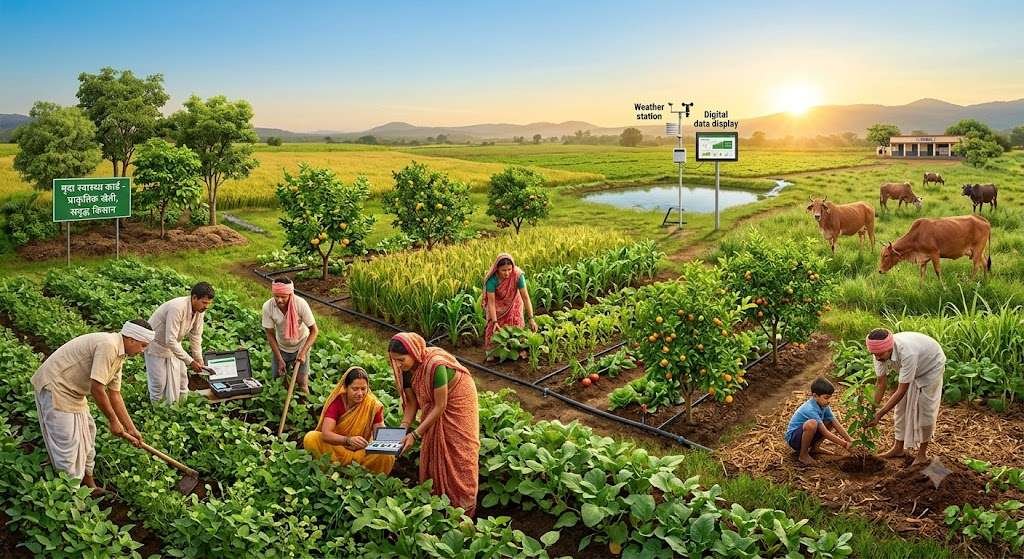
The approach includes practices such as natural farming, agroforestry, micro-irrigation, integrated farming and scientific soil management.
The goal is simple.
Farmers want productive land today without reducing the ability of that land to support crops in the future.
This is becoming more important as farms face changing rainfall patterns, heat stress and rising pressure on natural resources.
One of the biggest developments is the expansion of natural farming.
As of March 2026, natural farming clusters covered 8.80 lakh hectares and included 18.19 lakh farmers.
The government has also reported that around 109 lakh hectares had been brought under the Per Drop More Crop programme by May 2026.
In addition, more than 25.89 crore Soil Health Cards had been generated since the scheme began.
These numbers show how technology and traditional farming knowledge are increasingly being combined on Indian farms.
Soil is one of the most valuable assets on a farm.
Healthy soil supports crops, stores organic matter and helps retain nutrients and water.
Regenerative farming aims to improve this natural foundation instead of relying only on external inputs.
Farmers can use practices such as cover crops, mulching, green manure and reduced soil disturbance.
These methods can help protect soil from erosion and support soil organisms.
Over time, better soil health can also help farms become more resilient to climate stress.
Water is another major focus.
Micro-irrigation systems such as drip and sprinkler irrigation can deliver water closer to plant roots. This can reduce unnecessary water loss.
Better water management is especially important in regions that experience dry spells or irregular rainfall.
The government says such practices can improve water-use efficiency while supporting farm productivity and resilience.
Regenerative farming does not mean going back to the past.
Instead, it combines traditional knowledge with modern science.
Natural farming can use locally prepared biological inputs. At the same time, farmers can use soil testing, improved irrigation systems, farm machinery and digital tools.
This combination can make farming more resource-efficient.
It can also help farmers make better decisions about their land.
The move towards regenerative agriculture is important for more than one reason.
It can support soil health.
It can improve water efficiency.
It can protect biodiversity.
It can also help farms prepare for climate-related challenges.
The government notes that regenerative practices can support long-term farm productivity while improving environmental resilience.
For farmers, the larger question is no longer only how much a field can produce in one season.
It is also about how well that field can continue producing for many years.
The changing approach also reflects a wider understanding of farmland.
A farm is not simply a place where crops are grown.
It is an ecosystem.
Soil, water, trees, livestock, insects and crops all interact within it.
When these elements are managed together, the farm can become more resilient.
This is why practices such as agroforestry and integrated farming are receiving greater attention.
India’s agriculture sector has recorded strong growth in recent years. However, maintaining that growth will depend on protecting the natural resources that support farming.
The government’s August 23 update puts this challenge into clear perspective.
The future of Indian farms may depend increasingly on healthy soil, efficient water use, biodiversity and climate resilience.
Regenerative agriculture is still developing across different regions and farming systems. Its results can vary depending on crops, local conditions and how practices are implemented.
But its growing adoption signals an important change.
Indian farms are increasingly being viewed not just as sources of food, but as living systems that need to remain healthy for the next generation.
The future of farming may not simply be about producing more. It may be about producing better while protecting the land that makes production possible.