Indian farmland is entering a new phase.
For decades, farmland value was judged mainly by location, soil quality, crop potential and access to growing cities. Today, investors are looking at a wider set of factors.
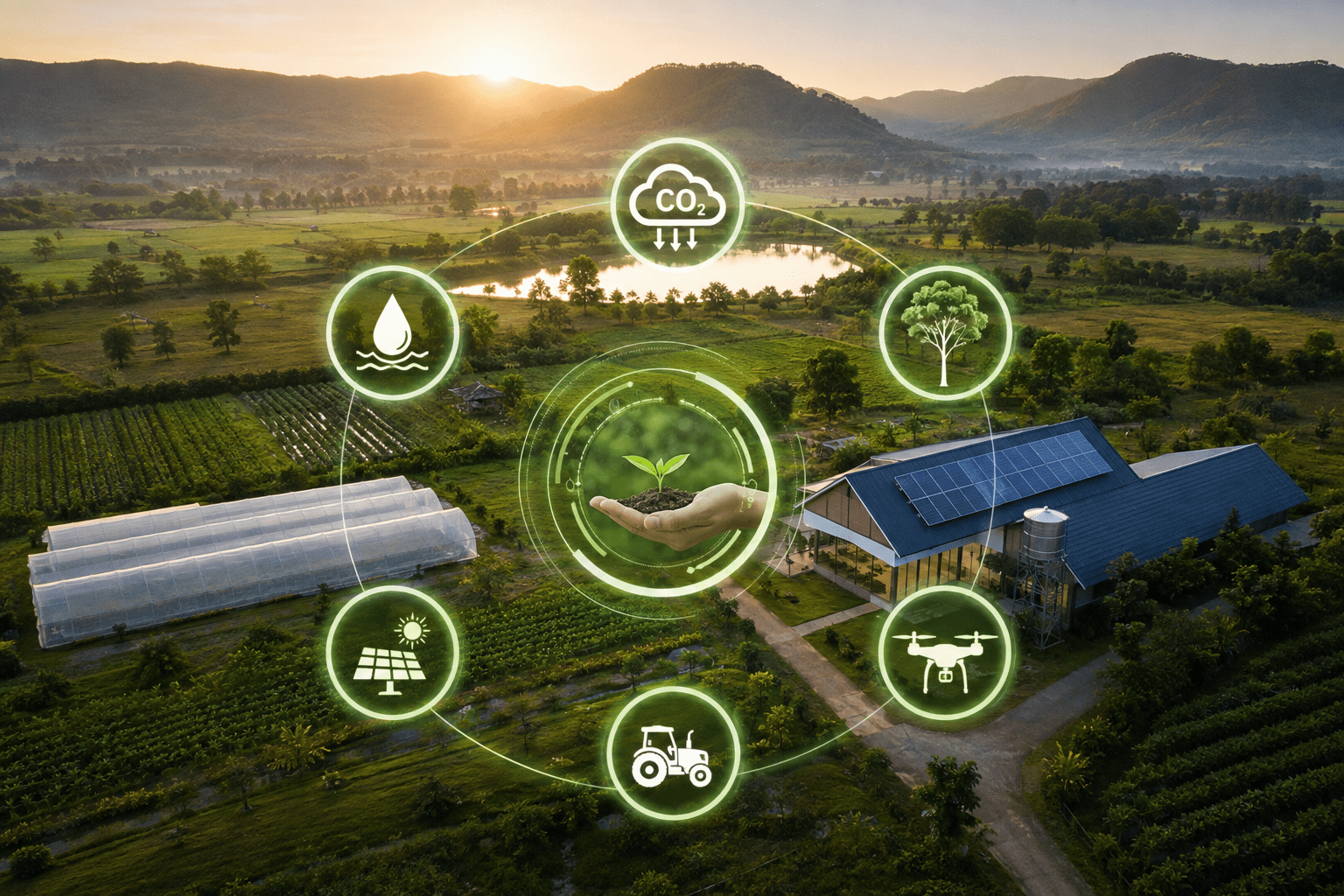
Water conservation, soil health, tree cover, biodiversity and carbon management are becoming important parts of the farmland conversation. This shift is creating interest in natural capital and the potential economic value of ecosystem services.
For investors considering managed farmland, the opportunity is not simply about growing crops. It is about understanding how responsible land management can improve long-term resilience, productivity and asset value.
An agricultural property provides more than a physical plot of land.
Well-managed farmland can support several ecosystem services. These include carbon storage, water retention, soil improvement, habitat protection and pollination. Some of these benefits can have measurable economic value, while others currently remain difficult to price.
This is where natural capital becomes relevant.
Natural capital refers to the natural resources and ecological systems that support economic activity. On farmland, this can include healthy soil, groundwater, vegetation, trees and biodiversity.
For investors, the importance of these assets is becoming clearer as climate risks, water stress and soil degradation receive greater attention.
However, ecosystem services should not be treated as guaranteed income. Their financial value depends on measurement, verification, regulation and the availability of suitable markets.
India is developing a regulated carbon market through the Carbon Credit Trading Scheme (CCTS).
The scheme includes both compliance and voluntary offset mechanisms. Agriculture is among the sectors approved for the offset mechanism. However, farmland owners cannot simply claim carbon credits because they use sustainable farming practices.
Projects must meet the relevant methodology and verification requirements.
As of 2026, the Bureau of Energy Efficiency lists an agriculture methodology covering methane recovery from livestock and manure management. Other methodologies are being developed and expanded across different sectors.
This distinction is important for farmland investors.
Soil carbon, agroforestry and other nature-based activities may have future potential. But they should be treated as emerging opportunities rather than guaranteed revenue streams.
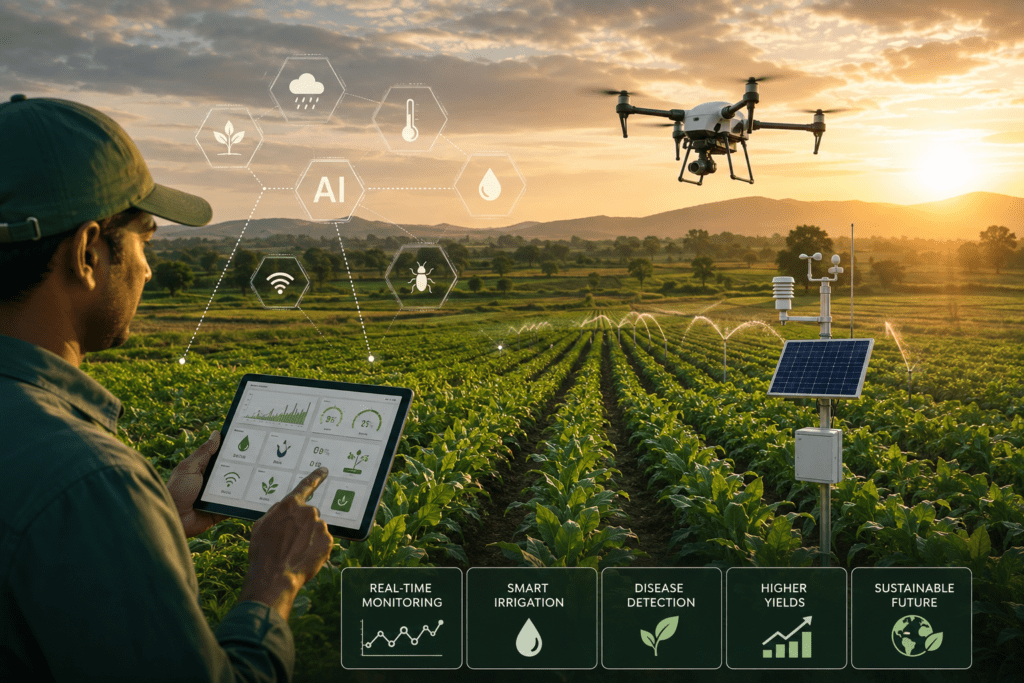
Technology is also changing the way managed farmland is operated.
Precision irrigation can help reduce unnecessary water use. Solar-powered irrigation systems can support energy efficiency where site conditions are suitable. Soil sensors can monitor moisture and other soil parameters.
Drones can also support farm operations through aerial surveys, crop monitoring and targeted applications.
The bigger advantage is data.
A professionally managed farm can collect information about irrigation, crop performance, soil conditions and farm operations. Over time, this data can help managers identify inefficiencies and make better decisions.
It can also provide useful evidence when sustainability performance needs to be measured.
However, technology alone does not create investment returns. Its value depends on how effectively it is integrated into farm management.
Sustainable farming does not replace legal due diligence.
Before investing in agricultural land for sale, buyers should verify ownership, land classification, survey details, encumbrances, mutation records, access rights and applicable state regulations.
Digital land-record systems can make this process easier.
In Karnataka, the Bhoomi system provides access to digitised land records. Maharashtra’s MahaBhulekh provides records such as 7/12 extracts, 8A extracts and property cards. Telangana currently operates Bhu Bharati, an integrated land-record management system.
These platforms are useful for due diligence, but an online land record should not be treated as a substitute for complete legal verification.
Buyers should also examine the applicable state land laws, conversion rules, ceiling provisions and transaction restrictions before completing a purchase.
In Karnataka, for example, Sections 79A and 79B of the Karnataka Land Reforms Act were omitted through the 2020 amendments. This changed the earlier framework around who could acquire agricultural land, but it did not remove the need to examine other applicable land regulations.
Traditional farmland economics usually focus on agricultural production.
Managed farmland can take a broader approach.
The value proposition may include:
This creates a more diversified asset model.
However, every component must be evaluated separately. Crop income, timber value, land appreciation and environmental credits have different risk profiles and timelines.
Investors should therefore avoid assuming that all these sources will produce income at the same time.
Natural capital is important, but location remains a major factor in farmland valuation.
Areas around rapidly growing cities such as Bengaluru, Hyderabad and Pune continue to attract attention because of urban expansion, infrastructure development and demand for weekend and second-home properties.
For farmland near Bengaluru, factors such as road connectivity, distance from employment centres, nearby infrastructure, water availability and surrounding development can influence buyer demand.
The same principle applies to other emerging rural corridors.
A farm with strong ecological practices but poor access may not have the same market appeal as a well-managed property located within a growing economic corridor.
The strongest farmland opportunities are therefore likely to combine three elements: productive land, responsible management and strategic location.
The next stage of farmland investment is likely to be more data-driven.
Investors are increasingly interested in measurable outcomes rather than broad sustainability claims. This creates an opportunity for professionally managed farms to document soil health, water use, crop performance, tree growth and other environmental indicators.
India’s carbon-market framework is also evolving. The CCTS provides a structure for project-based offset activities, while approved methodologies and verification systems continue to develop.
This does not mean that every sustainable farm will become a carbon-credit asset.
Instead, it signals a broader change: environmental performance is gradually becoming measurable and, in some cases, potentially monetisable.
That distinction will matter to serious investors.
When evaluating a managed farmland investment, investors should consider more than the advertised price per square foot.
A strong due-diligence process should examine:
1. Legal clarity
Verify ownership, land records, encumbrances, land classification and applicable regulations.
2. Water security
Study the availability, source and sustainability of water rather than relying only on seasonal availability.
3. Farm management
Understand who manages the land, how crops are selected and how maintenance is handled.
4. Technology
Look for practical use of irrigation systems, soil monitoring, farm data and other precision-agriculture tools.
5. Environmental performance
Check whether claims about carbon, soil health or biodiversity are supported by measurable data.
6. Revenue assumptions
Separate agricultural income, potential land appreciation and possible environmental revenue. Each should have its own assumptions and risks.
7. Location and connectivity
Evaluate access to major roads, cities, infrastructure and future development corridors.
The value of Indian farmland is beginning to be viewed through a wider lens.
Land remains the core asset, but the quality of the ecosystem surrounding that land can influence its productivity, resilience and long-term appeal.
For farmland investment in India, this creates an important shift. Sustainable water management, healthy soil, responsible agriculture and technology can support stronger farm operations. At the same time, India’s evolving carbon-market framework may create new opportunities for eligible and verified environmental projects.
The opportunity, however, should be approached realistically.
Natural capital is not an automatic source of profit. Carbon credits are not guaranteed. Agritech does not remove agricultural risk. And ecological benefits do not replace legal and financial due diligence.
The strongest managed farmland investments will be those that combine clear land ownership, sound farm management, strategic location, efficient technology and measurable environmental performance.
As India’s rural economy evolves, the future of farmland valuation may depend not only on how much land an investor owns, but also on how well that land is managed.