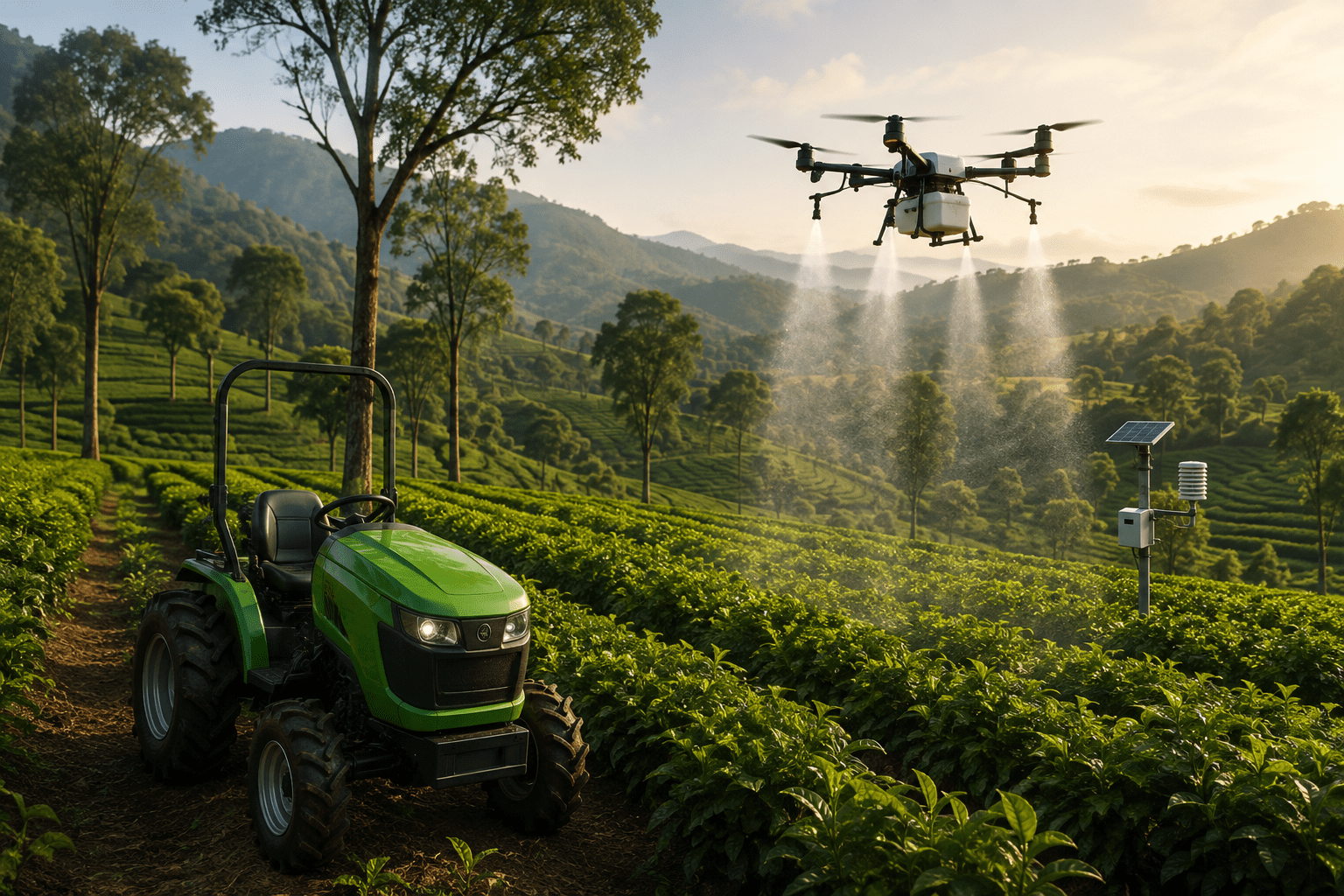
Southern India’s plantation sector is entering a new phase of growth. Electric micro-tractors and agricultural drones are becoming more common across coffee, tea, pepper, and cardamom plantations. Farm owners are adopting these technologies to improve efficiency and reduce dependence on manual labour.
This shift comes at an important time. Labour shortages and rising operating costs continue to affect plantation businesses across Kerala, Karnataka, and Tamil Nadu. As a result, many operators are investing in modern equipment to improve daily farm operations.
Electric micro-tractors are designed for plantation farming. They can move through narrow rows and uneven terrain with ease. This makes them suitable for coffee, tea, and spice estates.
Unlike conventional diesel machines, electric tractors produce lower emissions and require less maintenance. They also help reduce fuel consumption over time.
In addition, these compact machines make farm operations more efficient. Workers can complete routine activities faster while reducing physical effort.
Agricultural drones are becoming an important tool for plantation owners.
Today, many farms use drones to monitor crop health, inspect plantations, and apply fertilizers or crop protection products. These drones provide detailed aerial images that help managers identify issues early.
As a result, farmers can respond quickly to changing field conditions. Better planning often leads to improved resource management throughout the growing season.
Modern farming relies on accurate information.
Therefore, plantation operators are increasingly using soil moisture sensors, weather monitoring systems, GPS mapping, and automated irrigation. These technologies help farmers understand crop conditions more clearly.
They also improve water management and support efficient use of agricultural inputs. Consequently, farms can reduce unnecessary wastage while maintaining healthy crop growth.
The rise of mechanization is also influencing managed farmland projects.
Many professionally managed developments now include drip irrigation, internal roads, solar-powered systems, and digital farm monitoring. Professional teams oversee day-to-day farm activities, allowing owners to enjoy farmland without handling daily operations.
This model has become increasingly attractive to professionals, entrepreneurs, NRIs, and long-term investors.
High-value crops require continuous care.
Coffee, tea, pepper, and cardamom all depend on proper irrigation, nutrient management, and timely pest control. Technology helps plantation managers monitor these factors more effectively.
Furthermore, drone-assisted crop monitoring allows managers to inspect large plantations quickly. This improves planning and supports healthier plantations throughout the year.
Government support is helping modern agriculture grow.
Programmes such as the Sub-Mission on Agricultural Mechanization (SMAM) encourage farmers to adopt modern equipment. Meanwhile, the Agriculture Infrastructure Fund (AIF) supports investments in agricultural infrastructure and technology.
These initiatives are helping more farms modernize their operations while improving long-term productivity.
Modern agriculture is focusing on sustainability as well.
Electric machinery, efficient irrigation systems, and precision farming technologies help reduce resource consumption. At the same time, better monitoring improves water management and supports responsible farming practices.
As environmental awareness continues to grow, many plantation owners are investing in technologies that balance productivity with sustainability.
Managed farmland continues to attract investor interest.
Many buyers now evaluate farmland based on infrastructure, professional management, technology adoption, and long-term sustainability. These factors have become just as important as location.
Although every investment should be supported by proper legal and financial due diligence, technology is steadily improving the overall quality of managed farmland projects.
Mechanization is reshaping plantation farming across Southern India.
Electric micro-tractors, agricultural drones, and precision farming technologies are improving daily operations while supporting more efficient resource management.
As technology adoption continues to grow, managed farmland is expected to become more organized, more productive, and more attractive to long-term investors. Together with better infrastructure and digital farm management, these innovations are helping shape the future of India’s agricultural landscape.