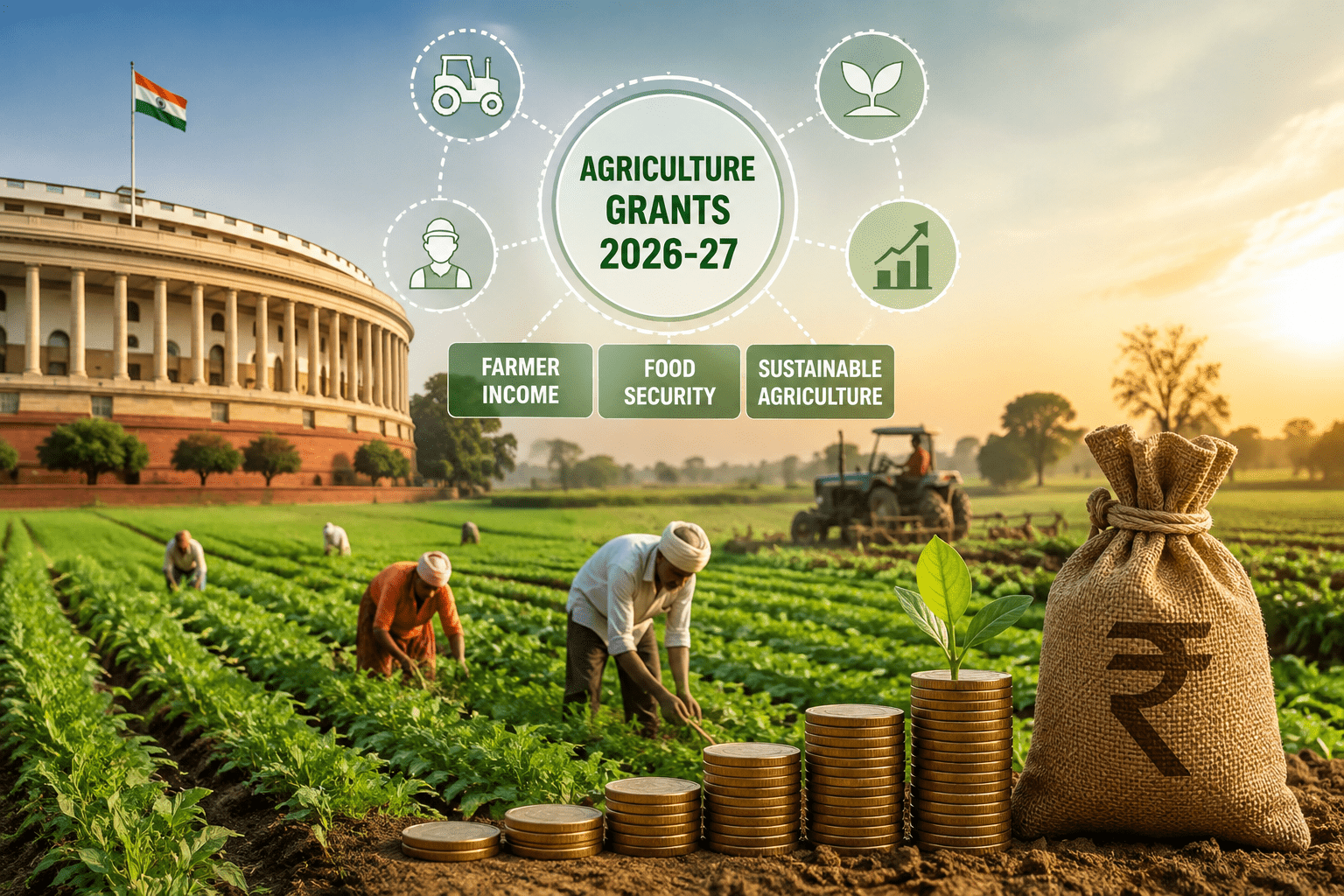
The Lok Sabha on Tuesday approved the Demands for Grants for the Ministry of Agriculture and Farmers Welfare for 2026–27, with the government reiterating its focus on food security, improving farmers’ incomes and strengthening India’s agricultural economy.
Replying to the discussion in Parliament, Union Agriculture and Farmers Welfare Minister Shivraj Singh Chouhan said the government’s agricultural priorities include ensuring food security, raising farmers’ incomes and increasing the availability of nutritious food.
The development comes as India continues to increase public investment in agriculture, with the sector receiving greater attention towards infrastructure, technology, productivity and climate resilience.
Also Read AgriStack and Digital Agriculture Gain Momentum as India Expands Technology-Based Farm Services
The approval of the agriculture ministry’s grants comes at a time when India is attempting to modernise its agricultural economy.
Government expenditure on the Department of Agriculture and Farmers Welfare has increased substantially over the past decade.
According to government data, the budgetary allocation for the Department of Agriculture and Farmers Welfare increased from ₹27,663 crore in 2013–14 to ₹1,40,528.78 crore for 2026–27.
The increase reflects the growing policy focus on agricultural infrastructure, farmer support programmes, research, technology and productivity.
Agriculture continues to remain an important part of India’s rural economy, supporting millions of farmers and contributing significantly to the country’s food supply.
Farmer income remains one of the central themes of the government’s agricultural policy.
Higher agricultural productivity alone does not necessarily translate into higher farm income.
Farmers also depend on access to markets, storage facilities, processing infrastructure, irrigation, technology and efficient supply chains.
This has resulted in a gradual shift in policy discussions from simply increasing crop production towards creating a stronger agricultural value chain.
Better infrastructure can allow farmers to reduce post-harvest losses and improve the value they receive from their produce.
Storage and processing can also help agricultural businesses move beyond the sale of raw produce.
Agricultural infrastructure is becoming an important component of India’s farming economy.
Irrigation systems, warehouses, cold storage facilities, packhouses, food-processing units and farm-to-market connectivity can all influence the commercial potential of agricultural production.
For farmers, these facilities can reduce dependence on immediate sales after harvesting.
For agricultural businesses, they can create opportunities for value addition.
And for landowners, productive infrastructure can improve the practical usability of agricultural land.
This is particularly relevant as India moves towards a more organised agricultural ecosystem.
The government’s agricultural strategy is also increasingly connected to digital technology.
Platforms such as AgriStack are being developed to create digital infrastructure around farmers, agricultural land and crop information.
The broader objective is to make agricultural services more efficient and data-driven.
Digital crop surveys, farmer registries and other technology-enabled systems can improve the way agricultural information is collected and used.
This could eventually support better decision-making around crop planning, insurance, procurement and agricultural services.
The transition is significant because Indian agriculture has historically depended heavily on fragmented records and local-level information.
Digital systems can provide another layer of visibility across the agricultural ecosystem.
The latest parliamentary discussion also highlights a broader trend in Indian agriculture.
Modern farming increasingly requires investment.
Farmers need access to irrigation, better seeds, machinery, storage, technology and market infrastructure.
At the same time, agricultural businesses are investing in processing, logistics, food technology and supply-chain infrastructure.
This means agricultural land is increasingly being viewed as part of a larger economic system rather than simply as a place where crops are grown.
A productive farm can connect land, water, technology, infrastructure and agricultural management.
The changing agricultural landscape is also relevant to the way farmland is evaluated.
Traditionally, the value of agricultural land has been associated with factors such as location, soil quality, water availability and productivity.
Those fundamentals remain important.
However, infrastructure and farm management are becoming increasingly relevant.
A property with reliable irrigation, good connectivity and appropriate agricultural infrastructure may offer greater operational flexibility than land without these facilities.
This does not mean that infrastructure automatically increases land value.
Instead, it highlights the importance of evaluating the quality and usability of agricultural land alongside its location.
The increased focus on agricultural infrastructure also brings attention to the concept of managed farmland.
Managed farmland combines agricultural land with organised farm operations such as crop planning, irrigation management, plantation maintenance, soil care and regular monitoring.
For urban landowners and long-term agricultural investors, this model can provide a more structured way to participate in agriculture.
Instead of purchasing land and leaving farm operations entirely unmanaged, owners can have agricultural activities planned and maintained through a professional management approach.
The model does not eliminate agricultural risks.
Crop prices, rainfall, water availability, operating costs and market conditions can all affect farm performance.
But better management can help improve the way agricultural resources are used.
The government’s continued focus on agricultural infrastructure could also influence the broader environment for farmland investment.
Investors considering agricultural land increasingly need to look beyond the purchase price.
Questions around water availability, road connectivity, soil quality, agricultural productivity, legal documentation and farm management can all become important during due diligence.
Infrastructure can also influence how easily land can be used productively.
A farm that has appropriate irrigation, storage or agricultural facilities may have different operating characteristics from a parcel of undeveloped agricultural land.
However, farmland remains a long-term asset, and investment outcomes are never guaranteed.
Location, regulations, agricultural performance, market demand and operating conditions continue to play an important role.
The government’s focus on food security comes against the backdrop of India’s growing population and changing food consumption patterns.
India needs to maintain agricultural productivity while dealing with challenges such as climate variability, water stress, soil degradation and changing market requirements.
This makes investment in agricultural productivity increasingly important.
The government has also highlighted the importance of nutritious food alongside food security and farmer welfare.
The objective is therefore not simply to produce more food.
It is to build an agricultural system that is productive, resilient and capable of supporting farmer livelihoods.
The latest parliamentary developments reflect a wider change taking place across India’s agricultural sector.
Public investment is increasing.
Technology is becoming more prominent.
Agricultural infrastructure is expanding.
Farmers are gaining access to new digital services.
And private capital is increasingly interested in agriculture-related businesses and assets.
This does not mean agriculture should be treated purely as an investment opportunity.
Agriculture remains a livelihood for millions of families and a critical component of India’s food system.
However, the growing combination of land, infrastructure, technology and farm management is creating a more organised agricultural economy.
The approval of the Agriculture Ministry’s Demands for Grants for 2026–27 provides another indication of the government’s continued focus on the sector.
The emphasis on farmer income, food security and agricultural development is likely to remain important as India addresses changing weather conditions, rising food demand and the need for greater farm productivity.
For farmers, the priority will be improving productivity and income.
For agricultural businesses, opportunities will increasingly emerge around infrastructure, processing, technology and supply chains.
And for people evaluating farmland as a long-term asset, the development reinforces an important consideration:
The future of agricultural land will depend not only on owning the land, but also on how effectively its resources, infrastructure and farming potential are managed.