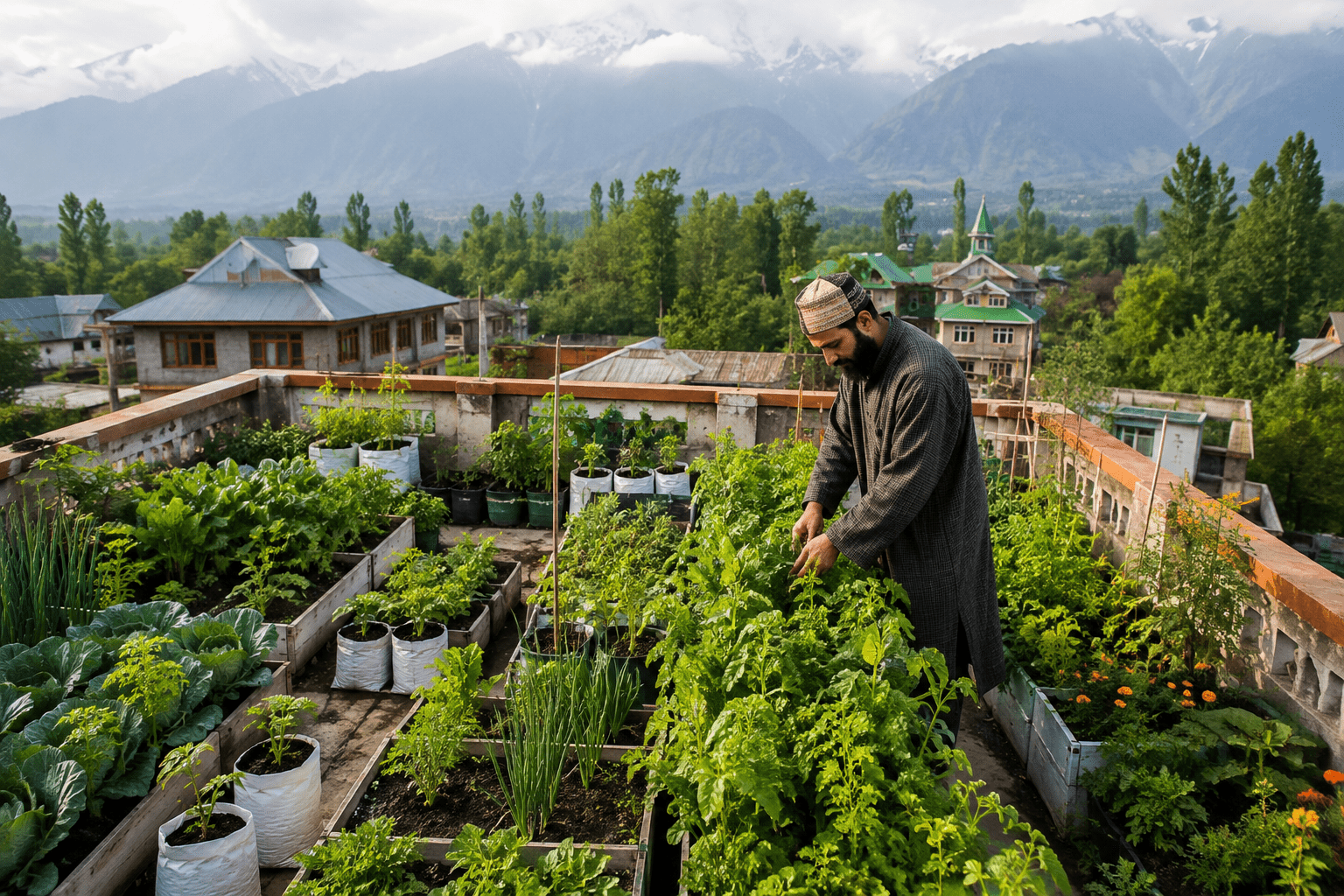
A rooftop in Shopian, Kashmir, is attracting attention for an unusual reason.
Instead of using the space for storage or household activities, farmer Haroon Rashid has turned his rooftop into a productive farm.
The farm is being used to grow a variety of crops. The approach shows how agricultural activity can be adapted to spaces that are normally not considered farmland.
The story, reported by The Times of India on August 11, highlights a simple idea: farming does not always have to begin with a large field.
Shopian is well known for its apple-growing landscape.
However, Rashid’s rooftop farm offers a different picture of farming in the region.
Instead of depending entirely on conventional farmland, he has created a smaller growing space above his home. The rooftop now supports multiple crops and has become an example of how unused urban or residential space can be put to productive use.
The idea is particularly interesting at a time when land availability is becoming an important issue for agriculture.
As towns and cities expand, agricultural land faces increasing pressure. Small-scale growing systems can offer another way to produce food closer to where people live.
One of the notable aspects of Rashid’s farming method is its focus on organic inputs.
According to the report, the rooftop farm does not rely on chemical inputs. Instead, organic manure and regular care are central to the way the crops are grown.
That approach reflects a wider interest in sustainable farming.
Farmers and consumers are increasingly paying attention to soil health, responsible input use and methods that can reduce environmental pressure.
Organic farming does not mean that agriculture becomes effortless. Crops still require water, nutrients, pest management and regular monitoring.
But the rooftop example shows how traditional farming knowledge can be adapted to a very different growing environment.
The most interesting part of this story is not simply the rooftop.
It is the question of how much productive space is actually available around us.
A rooftop, balcony, terrace or unused piece of land may not be large enough to replace a conventional farm.
However, such spaces can still support vegetables, herbs, fruits and other crops when they are planned properly.
This creates opportunities for small-space farming.
For households, it can provide access to fresh produce.
For communities, it can create local growing spaces.
For farmers and entrepreneurs, it can open the door to new forms of urban agriculture.
The model may not work everywhere. Roof strength, water availability, sunlight, drainage and local climate all need to be considered.
Still, the concept demonstrates that farming can be flexible.
The story also raises a broader question about what makes land productive.
Traditional agriculture depends on fields with suitable soil, water and access to farming infrastructure.
Rooftop farming changes that equation.
Instead of searching for additional land, growers can sometimes make better use of existing space.
This does not replace conventional farmland.
Large farms remain essential for producing food at scale.
But small growing spaces can complement traditional agriculture by bringing food production closer to households and communities.
That makes the idea relevant to the wider conversation around agricultural land and farm management.
Another important element of the Shopian rooftop farm is crop diversity.
Rather than focusing on a single crop, the space supports a variety of produce. This makes the rooftop more than a simple kitchen garden.
Crop diversity can also make small farming systems more useful to households.
Different crops can be harvested at different times. Some can be grown seasonally, while others may have shorter growing cycles.
For small farms, this kind of diversity can help make better use of limited space.
It also creates an opportunity to learn more about different crops and growing conditions.
Modern farming is increasingly about efficiency.
Farmers need to think carefully about land, water, labour and inputs.
The rooftop example offers one small but interesting lesson: productive agriculture does not always require more space. Sometimes it requires better use of the space already available.
Technology is also expanding these possibilities.
Drip irrigation, protected cultivation, sensors and digital farm-management tools can help farmers monitor growing conditions and use resources more efficiently.
Research published in August 2026 has also highlighted the growing role of digital decision-support tools in Indian farming, including their potential to support more sustainable pest-management practices and improve farm profitability.
Together, these developments point toward a more adaptive model of farming.
The Shopian example also connects with a larger sustainability conversation.
Agriculture depends heavily on natural resources.
Water, soil and land all have limits.
Using resources efficiently is therefore becoming increasingly important.
Small-space farming cannot solve India’s agricultural challenges by itself. However, it demonstrates a useful principle: existing resources can sometimes be used in new ways.
Organic manure, diverse crops and careful cultivation can turn an otherwise unused space into something productive.
That is a small change, but it can have a meaningful impact at the household level.
The idea of growing food at home is not new.
Kitchen gardens have existed in Indian households for generations.
What is changing is the way people are approaching them.
Rooftop and terrace farming can combine traditional gardening practices with modern growing techniques. In cities, where access to open land is limited, this can provide a practical way to reconnect with food production.
It can also introduce younger generations to farming.
For children who grow up surrounded by buildings, seeing vegetables grow from planting to harvest can create a direct connection with agriculture.
That connection matters.
Farming is not only an economic activity. It is also part of India’s food culture and rural heritage.
Haroon Rashid’s rooftop farm may be small compared with India’s millions of hectares of agricultural land.
But its significance lies in the idea behind it.
It challenges the assumption that farming can happen only in traditional fields.
As land becomes more valuable and cities continue to expand, farmers, households and entrepreneurs may increasingly explore unconventional spaces for growing food.
From rooftops to community gardens, agriculture is finding new places to take root.
The Shopian example shows that innovation in farming does not always require expensive technology.
Sometimes, it begins with looking at an ordinary space differently.
India’s agricultural future will continue to depend on traditional farms and the farmers who manage them.
But alongside them, new forms of cultivation are emerging.
Rooftop farming is one example.
It combines limited space, local food production and sustainable practices in a simple model.
The Shopian farmer’s experiment is therefore more than an unusual farming story. It is a reminder that the future of farming may involve finding new ways to use the spaces we already have.
And sometimes, the next farm may not be beyond the city.
It may be right above us.