Indian farming is moving closer to a technology-driven future.
Uttar Pradesh has announced new partnerships with Google, Network for Humanity, ITC and Aquabridge to improve farm productivity, farmer incomes and climate resilience.
The partnerships were announced on August 26, 2026, under the World Bank-funded UP-AGREES project. The programme will cover 28 districts across eastern Uttar Pradesh and Bundelkhand. It aims to benefit around 10 lakh farmers, 35,000 fish farmers and three lakh women.
One of the most interesting parts of the initiative is its focus on agricultural technology.
The partnership with Google and Network for Humanity will support an Open Network for Agriculture.
The proposed platform will bring several types of information together.
Farmers could access:
Instead of depending on multiple platforms, farmers could access different services through a single digital network.
This could make technology more useful at the farm level.
Farming decisions often depend on timing.
A farmer needs to know when to sow, how much water to use and when to sell a crop.
Weather conditions can change quickly. Market prices can also move from one day to another.
Having timely information can help farmers make better decisions.
The new digital agriculture network aims to bring these different pieces of information closer to farmers.
This represents a wider change in Indian agriculture.
Technology is no longer being used only for machinery and equipment. It is increasingly being used for information, planning and decision-making.
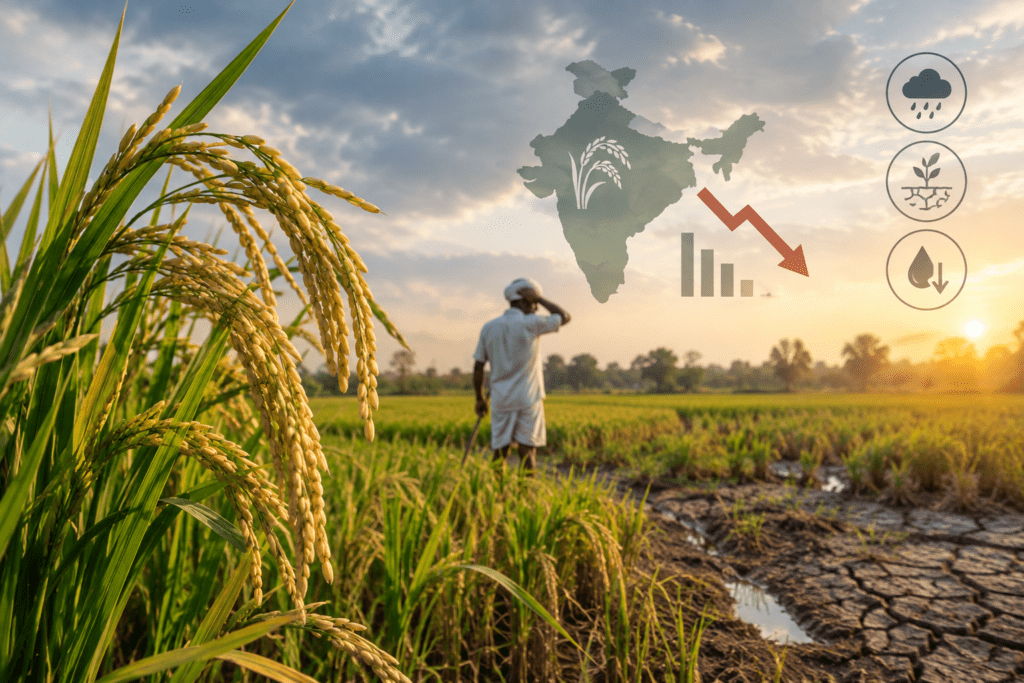
The UP-AGREES project is also focusing on climate resilience.
The programme is being implemented across 123 development blocks in 28 districts.
The project has already covered around 1.75 lakh hectares during the 2026 kharif season.
For the upcoming rabi season, the state plans to improve the productivity of crops such as wheat, peas, gram, lentils and mustard across another 1.75 lakh hectares.
The project is also working with the International Rice Research Institute to promote scientific and climate-resilient farming.
One example is Direct Seeded Rice (DSR).
Unlike traditional rice transplantation, DSR involves sowing rice seeds directly into the field.
The method is being tested across around 3,000 hectares during the kharif season under the project.
The wider aim is to find farming methods that can improve productivity while using resources more efficiently.
The partnership with ITC will focus on developing climate-resilient commodity clusters for paddy and wheat.
The state has proposed expanding climate-smart agriculture across more than two lakh acres.
A 1,500-acre paddy cluster has also been proposed in Bahraich.
The objective is to connect farm production with better technology, climate resilience and market opportunities.
The biggest change in the programme is its focus on farmer income.
The goal is not simply to produce more crops.
The state aims to increase farmer income per acre by 20–30%.
It also aims to reduce urea use by 25% and achieve savings of around 25–30% in labour and irrigation costs. These are targets under the project, not results already achieved.
This distinction is important.
Higher production does not always mean higher income.
A farm becomes more profitable when better yields are combined with lower costs, improved prices and stronger market access.
The project reflects a growing trend in agriculture.
Farm management is becoming increasingly data-driven.
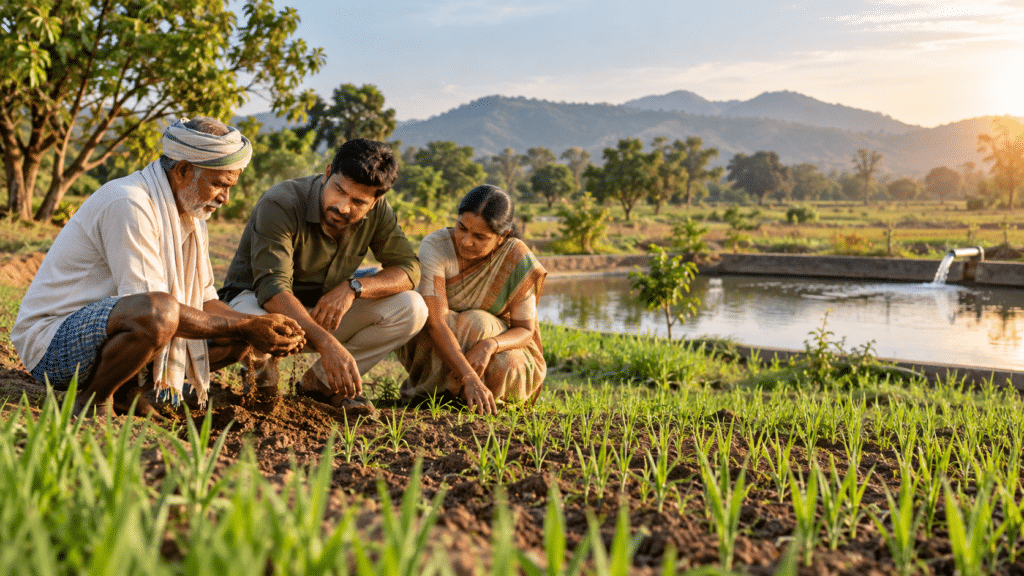
Farmers can use information about weather, soil, markets and crop conditions to make decisions.
This does not mean technology will replace farmers.
Instead, the aim is to give farmers better information so they can make more informed decisions.
That could become especially valuable as climate conditions become less predictable.
The UP-AGREES project is also expanding into aquaculture.
Aquabridge will support technology-driven fish farming, including AI-based management and automatic feeding systems.
An integrated aquaculture project covering around 60 acres is being developed in Unnao.
This shows how the modern farm economy is becoming more diversified.
Agriculture is no longer limited to traditional field crops.
It increasingly includes horticulture, livestock, fisheries, food processing, technology and rural entrepreneurship.
The Uttar Pradesh initiative offers a glimpse into how farms could operate in the coming years.
A farmer may increasingly rely on digital information alongside traditional experience.
Weather data could help with crop planning.
Market information could support selling decisions.
Soil information could guide input use.
Technology could help reduce labour and water costs.
Together, these changes could make farms more efficient and resilient.
The development in Uttar Pradesh reflects a larger shift in Indian agriculture.
The future of farming may not depend only on larger farms or higher production.
It may depend on better information, smarter resource use, stronger markets and technology that works for farmers.
The UP-AGREES project is still being implemented, so its long-term results will need to be measured over time.
But its direction is clear.
Indian farms are becoming increasingly connected to technology.
And for farmers, the next big agricultural revolution may happen not only in the field, but also through the information available at their fingertips.
The future farm may be powered by soil, seeds and water — but increasingly, it will also be powered by data.