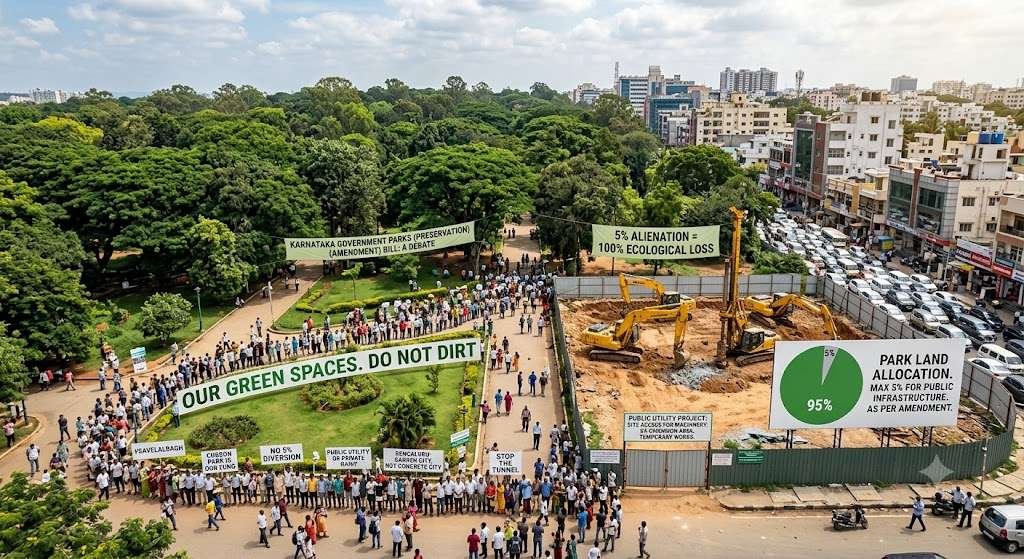
Bengaluru’s green spaces have become the centre of a growing public debate after Karnataka amended its parks preservation law to allow a limited portion of public park land to be used for infrastructure projects.
The Karnataka Government Parks (Preservation) Act, 1975 was amended on August 24, allowing up to 5% of park land to be diverted for public infrastructure. The move has attracted criticism from environmental groups, citizens and political leaders who say Bengaluru needs to protect its remaining green spaces as the city continues to expand.
The debate is particularly important for Bengaluru because parks are not simply recreational spaces.
They are part of the city’s everyday lifestyle.
Bengaluru has long been known as India’s Garden City.
Places such as Lalbagh Botanical Garden and Cubbon Park are deeply connected with the city’s identity. Residents use these spaces for morning walks, exercise, family outings, photography and simply spending time outdoors.
For many people, a park provides something that modern urban life often lacks.
Space.
There is space to walk.
Space to sit.
Space for children to play.
And space to experience trees and greenery within a busy city.
That makes the current debate about park land much larger than a question of infrastructure.
It is also a question about how Bengaluru wants people to live.
The Karnataka Government Parks (Preservation) Amendment allows the government to divert up to 5% of public park land for public infrastructure projects.
The legislation was passed on August 24 without debate in the state legislature, according to The Indian Express. Critics have argued that the change could put pressure on Bengaluru’s already limited green spaces.
The government, however, has defended the amendment as a way to provide flexibility for important public infrastructure.
This has created a clear disagreement.
Supporters see the change as a tool for infrastructure development.
Critics see parks as environmental assets that should not easily be converted for construction.
Environmental organisations have strongly opposed the change.
Greenpeace India said more than 200 citizens, resident groups and environmental organisations gathered at Lalbagh Botanical Garden on August 27 to demand that the government withdraw the amendment.
The groups argued that Bengaluru needs more natural spaces as the city becomes hotter and more vulnerable to climate-related problems.
They also pointed to the role of parks beyond recreation.
Green spaces can help cool neighbourhoods.
They can absorb rainwater.
They can provide relief from pollution.
They can support urban biodiversity.
In this sense, a park is not simply an empty piece of land.
It is part of the city’s natural infrastructure.
The controversy has become particularly significant because of concerns surrounding Lalbagh Botanical Garden.
Lalbagh is one of Bengaluru’s most recognisable green spaces. It is also a major part of the city’s cultural and environmental heritage.
A proposed tunnel road project has added another layer to the discussion.
Environmentalists and other critics have raised concerns about the potential impact of infrastructure development on Bengaluru’s green areas. The debate has turned Lalbagh into a symbol of the wider question of whether urban infrastructure should come at the cost of established natural spaces.
For residents, this is not an abstract environmental issue.
It concerns places they visit every week.
Bengaluru continues to grow as one of India’s major technology and business centres.
More people are moving to the city.
More homes are being built.
Roads and public transport systems need to expand.
Infrastructure must keep pace with the population.
But urban growth also creates pressure on land.
This creates a difficult challenge for planners.
The city needs infrastructure.
At the same time, it needs trees, parks, lakes and open spaces.
Finding a balance between the two is becoming increasingly important.
The latest legislation has brought that balance into sharper focus.
The discussion also highlights how people’s understanding of a good lifestyle is changing.
A modern lifestyle is often associated with convenience.
Easy access to offices.
Shopping centres.
Restaurants.
Entertainment.
Transport.
But there is another side to comfortable living.
People also need access to nature.
A morning walk beneath trees can provide a break from traffic and screens.
A family picnic can create time outdoors.
Children can experience plants, birds and insects.
Older residents can walk and socialise.
These simple experiences make green spaces important parts of everyday life.
The debate comes at a time when many urban residents are becoming more interested in nature-based lifestyles.
People are increasingly looking for homes near parks.
Families are choosing weekend destinations surrounded by greenery.
Nature stays and farm experiences are becoming attractive alternatives to conventional city entertainment.
Gardening and outdoor activities are also becoming part of urban lifestyles.
The reason is simple.
As cities become busier, people often value the opportunity to slow down.
This does not necessarily mean leaving the city.
It can mean having better access to nature within it.
Green spaces have an environmental role that extends beyond recreation.
Trees provide shade.
Vegetation can help reduce surface temperatures.
Open areas can help absorb rainwater.
Plants provide habitats for birds, insects and other urban wildlife.
This becomes especially important as cities experience changes in rainfall and temperature.
Bengaluru has already faced repeated discussions around flooding, heat and water management.
Protecting natural areas can therefore be part of a broader approach to building climate-resilient neighbourhoods.
That is why environmental groups have argued that Bengaluru’s parks should be treated as essential infrastructure rather than surplus land.
The response to the amendment also shows how strongly Bengaluru residents identify with their green spaces.
Citizens, resident associations and environmental organisations have increasingly become involved in conversations about trees, lakes, parks and development.
This participation matters.
Urban planning decisions ultimately shape the places where people live.
When residents speak about protecting a park, they are not only protecting trees.
They are protecting a place where people meet, walk, exercise and spend time together.
That makes environmental issues directly connected to lifestyle.
The conversation around Bengaluru’s green spaces also raises a broader question about the value of open land.
Parks are one form of green space.
Farmland, orchards, plantations and rural landscapes are others.
Each provides a different relationship with nature.
Farmland, in particular, connects people with agriculture and food production.
For urban families, visiting a farm can offer an opportunity to experience soil, crops, trees and outdoor life.
It can also give children a better understanding of where food comes from.
As Bengaluru expands, these connections between the city and surrounding rural landscapes become increasingly important.
The Bengaluru park debate reflects something bigger happening across urban India.
Nature is increasingly becoming part of the way people think about quality of life.
People are asking new questions when choosing where to live.
Is there enough greenery?
Are there open spaces nearby?
Can children play outdoors?
Can I walk safely?
Is the neighbourhood quieter?
Are natural areas accessible?
These questions show that environmental quality is becoming closely connected to lifestyle decisions.
The current debate does not mean that Bengaluru should stop developing.
Infrastructure is necessary.
Roads, public transport and civic facilities are essential for a growing city.
The challenge is ensuring that development does not unnecessarily weaken the natural systems that make the city liveable.
That requires careful planning.
It also requires understanding that green spaces have value even when they do not generate direct commercial returns.
A mature tree may not produce immediate revenue.
A park may not generate rent.
A lake may not function like a commercial property.
Yet all three can contribute to the quality of life of thousands of people.
The amendment has opened an important conversation about Bengaluru’s future.
Should the city prioritise infrastructure wherever additional land is required?
Or should existing green spaces receive stronger protection because they are already limited?
There is no simple answer.
But the debate makes one thing clear.
Bengaluru’s relationship with nature is changing.
The city needs to grow.
But residents also want a city where they can breathe, walk, relax and spend time outdoors.
That means nature cannot be treated as an afterthought.
Bengaluru’s latest park-land controversy is ultimately about more than the 5% provision in the amended law.
It is about the kind of city people want to inherit.
A city can have modern roads, technology companies, high-rise buildings and new infrastructure.
But it also needs trees.
It needs parks.
It needs lakes.
It needs open spaces.
And it needs a connection with the natural landscapes surrounding it.
For today’s residents, these are not merely environmental concerns.
They are lifestyle concerns.
As Bengaluru continues to grow, the challenge will be finding a way to build a modern city without losing the natural character that made the city special in the first place.
Focus Keyphrase:
Bengaluru green spaces
SEO Title:
Bengaluru Green Spaces Face Debate Over 5% Park Land Diversion
Slug:bengaluru-green-spaces-park-land-diversion
Meta Description:
Bengaluru’s green spaces face a new debate after Karnataka allows up to 5% of park land to be diverted for public infrastructure projects.