Sugarcane pricing has become a major issue in Karnataka’s agricultural markets, with farmers demanding better returns for their produce. On 15 October 2026, sugarcane growers in Belagavi continued their protest, asking the Central Government to announce a Minimum Selling Price (MSP) for sugar before further discussions on their demands.
The protest highlights a longstanding concern within the sugar industry: the relationship between the prices farmers receive for sugarcane and the prices sugar mills can obtain for the sugar they produce.
The development comes after the Centre established a committee on 14 October to examine sugarcane farmers’ demands in Karnataka and Maharashtra. The panel is expected to review issues related to sugarcane pricing, sugar selling prices, sugar recovery testing and weighment practices at sugar mills.
The developments are significant for Karnataka’s agricultural markets because sugarcane pricing affects farmers, sugar mills, agricultural workers and the wider rural economy.
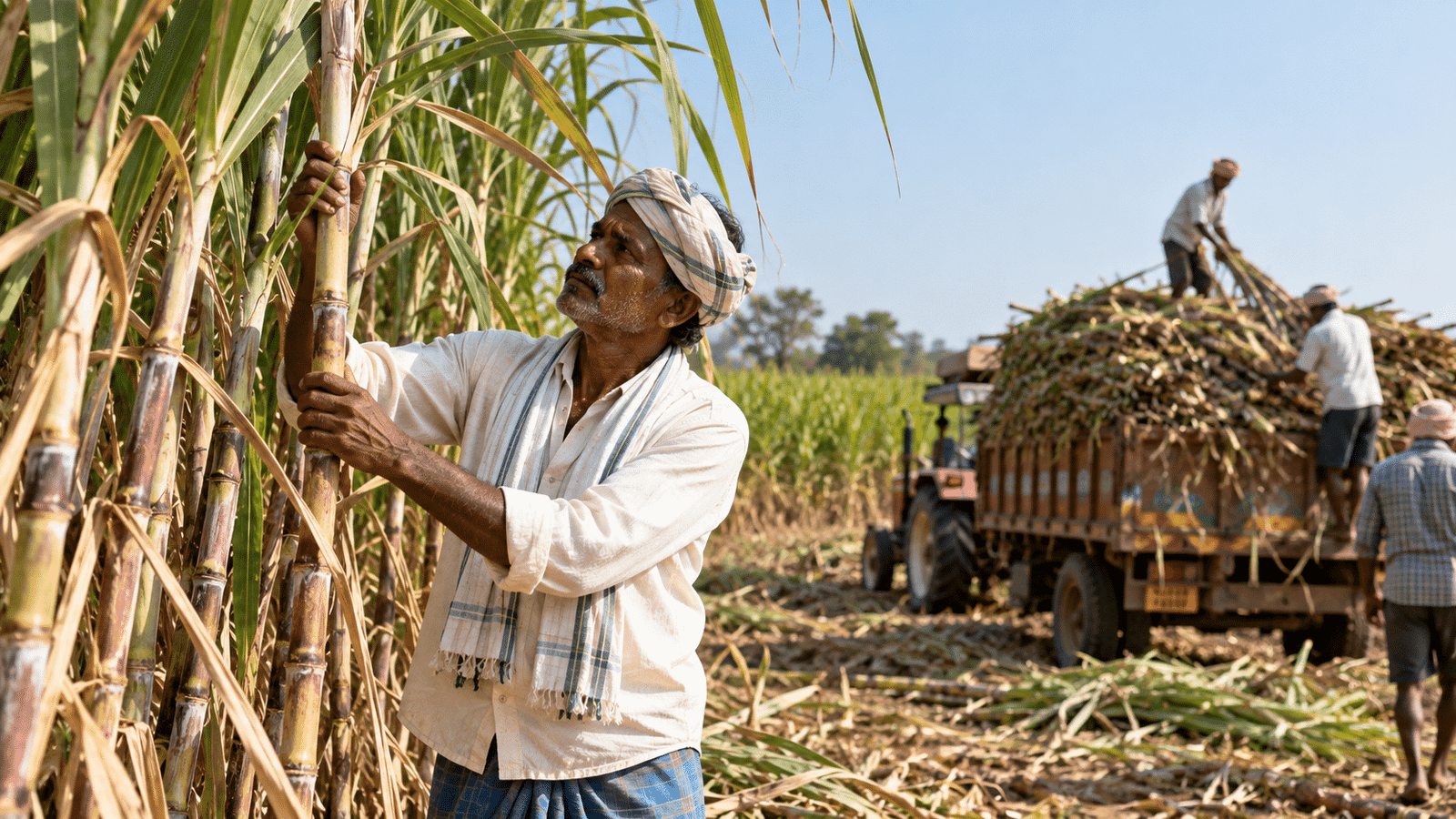
Sugarcane cultivation involves substantial expenditure on planting material, fertilisers, irrigation, labour and transportation. Farmers must also wait several months for the crop to mature before receiving payment for their produce.
For this reason, the price paid for sugarcane plays an important role in determining farm income.
Farmers argue that pricing arrangements should reflect the costs and challenges associated with cultivation. They are also seeking greater transparency in how sugarcane is weighed and how sugar recovery is calculated at mills.
These concerns have become particularly important in Karnataka, one of India’s major sugarcane-producing states.
Understanding the difference between these two pricing mechanisms is essential to understanding the current dispute.
The Fair and Remunerative Price (FRP) is the minimum price that sugar mills are required to pay sugarcane farmers under the applicable central government framework.
The FRP is determined by the Central Government, taking factors such as production costs, returns to farmers and sugar recovery into consideration.
The Minimum Selling Price (MSP) of sugar is the regulated minimum price at which sugar mills can sell sugar under the applicable government policy.
Sugarcane farmers argue that the price mills receive for sugar should be considered alongside the amount mills pay for sugarcane.
However, sugarcane FRP and sugar MSP are different mechanisms. Changing one does not automatically result in an equivalent change in the other.
On 14 October 2026, the Central Government established a committee led by former NITI Aayog member Ramesh Chand to examine demands raised by sugarcane farmers in Karnataka and Maharashtra.
The committee is expected to consider several issues, including:
The committee’s review could provide a basis for further discussions on pricing and operational issues within the sector.
However, the formation of a committee does not itself mean that sugar prices have been increased or that farmers’ demands have been accepted.
Sugarcane pricing affects more than the relationship between farmers and sugar mills. It can also influence agricultural investment, rural employment and decisions about future cultivation.
The price farmers receive determines part of their gross revenue. Their final earnings also depend on cultivation costs, crop yields, payment timelines and other expenses.
A higher price does not necessarily guarantee higher profits if production costs also rise.
Sugar mills must manage the cost of purchasing sugarcane, processing it and selling sugar.
The price of sugar, production volumes, operating costs and demand all influence mill finances.
Farmers consider expected returns, water availability, soil conditions and local market access when deciding which crops to cultivate.
Pricing policies can influence these decisions, but sugarcane also requires substantial water and a relatively long growing period.
Sugarcane cultivation supports agricultural labour, transportation, harvesting operations and sugar processing.
Changes in the sector can therefore affect employment and business activity across sugar-producing regions.
Karnataka has an established sugar industry, with sugarcane cultivation supporting many farming households and rural businesses.
Pricing disputes are particularly important because farmers need predictable returns while mills must remain financially viable.
The current discussions highlight the need to balance farmer income, production costs, sugar market conditions and the long-term sustainability of the industry.
Transparent weighing, reliable recovery testing and timely payments are also important for maintaining trust between farmers and sugar mills.
For managed farmland operators, the sugarcane pricing debate provides a broader lesson about the relationship between agricultural production and market conditions.
Farm management decisions should not depend on crop prices alone. Soil suitability, water availability, maintenance costs, labour requirements and market access must also be considered.
For orchard-based managed farmland, selecting crops and trees suited to local conditions can be particularly important. Sugarcane’s water requirements and cultivation cycle may make it unsuitable for some properties.
Responsible farmland planning involves assessing both the agricultural characteristics of the land and the economic realities of producing and selling crops.
For Mogg’s Estates, this is an opportunity to educate readers about the importance of informed agricultural planning rather than assuming that every crop or agricultural asset will deliver the same financial outcome.
The next important development will be the outcome of the committee’s examination and any subsequent decisions by the Central Government.
Farmers will be watching for clarity on sugar pricing, sugarcane returns and the operational issues affecting transactions with mills.
Until official decisions are announced, the committee’s formation should be viewed as a step towards reviewing the demands rather than confirmation of a pricing change.
Karnataka’s sugarcane pricing dispute highlights the challenges of balancing farm income with the economics of agricultural processing.
The Central Government’s decision to examine farmers’ demands creates an opportunity to review pricing arrangements and operational practices across the sugar industry.
For farmers, the key concerns remain fair returns, transparent transactions and timely payments. For the wider agricultural sector, the issue reinforces the importance of market awareness, responsible crop planning and sustainable farm management.
Key Takeaway: Sugarcane prices influence farm income, mill operations and rural economic activity. The outcome of the Centre’s review will be important for Karnataka’s sugar industry and its farming communities.