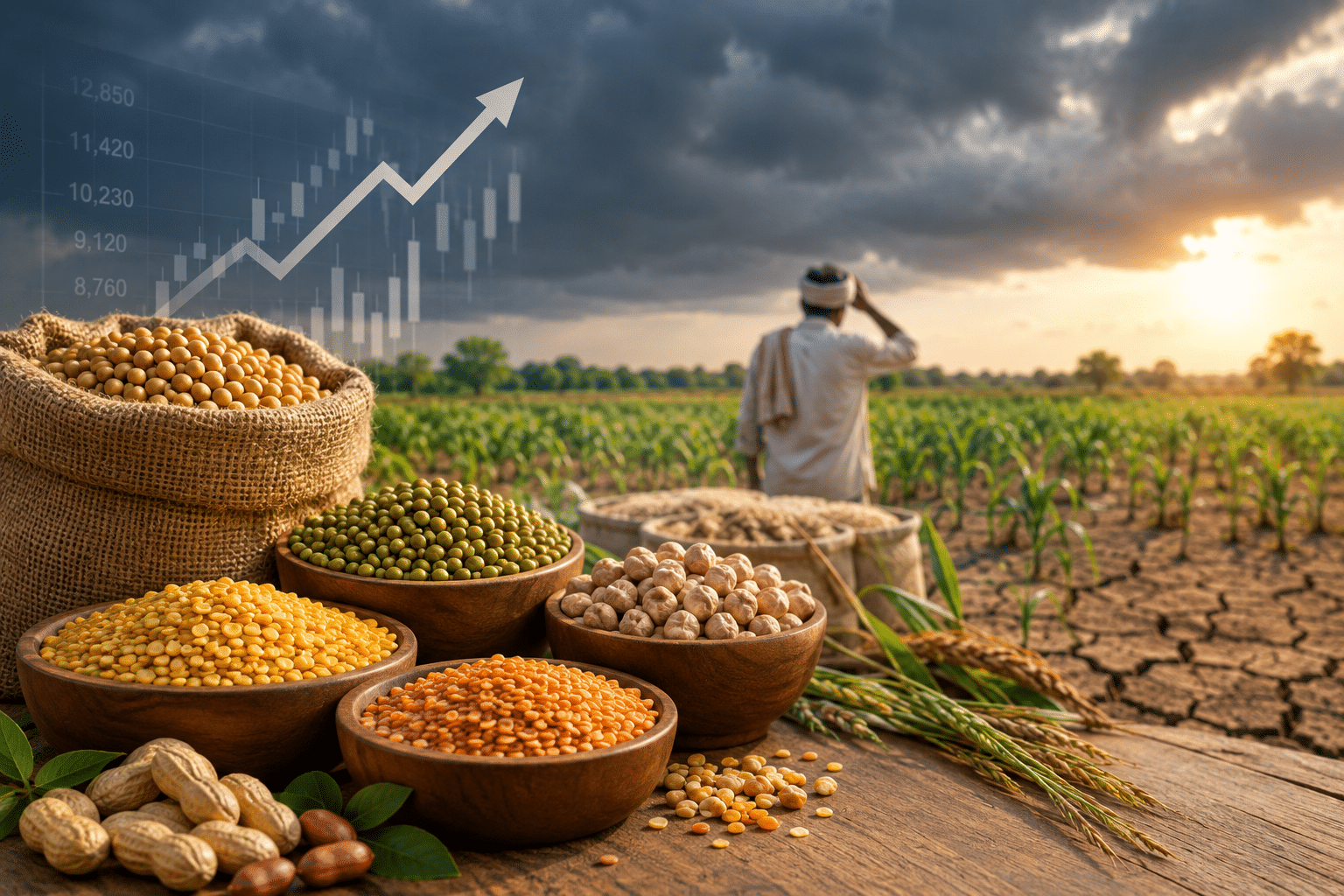
Agricultural commodity markets in India are seeing increased price pressure as below-normal rainfall affects some standing Kharif crops. Prices of several pulses and oilseeds have risen compared with the previous year, raising attention around crop output, food prices and the upcoming Rabi season.
According to a September 17 report by The Economic Times, prices of key commodities such as tur, chana, soyabean and groundnut have increased as rainfall shortages create concerns about crop production. The situation is also being closely watched for its potential impact on agricultural markets in the coming months.
Pulses and oilseeds are important components of India’s food and agricultural economy. Changes in their production can influence both wholesale and retail markets.
The recent rainfall deficit has raised concerns about the condition of some Kharif crops. Market participants are therefore monitoring crop arrivals, production estimates and weather conditions as the season progresses.
Government price data also shows that agricultural commodities continue to trade at varying levels across markets. As of September 21, 2026, the Department of Consumer Affairs reported an all-India average wholesale price of ₹11,532.26 per quintal for tur/arhar dal and ₹10,220.57 per quintal for moong dal.
Weather has a direct connection with agricultural supply. Rainfall affects crop growth, soil moisture and water availability, while changing conditions can influence expectations around future production.
This makes weather monitoring particularly important during the transition between the Kharif and Rabi seasons. Farmers, traders, food businesses and policymakers are watching rainfall patterns to understand how they could affect supplies and prices.
The recent movement in pulses and oilseeds shows how quickly agricultural markets can respond to changes in expected production.
Agricultural prices can also differ significantly between markets depending on crop quality, arrivals, demand and local supply conditions.
For example, Bengaluru APMC data for September 19 showed modal prices of around ₹11,000 per quintal for soyabean, ₹5,000 for groundnut, ₹3,500 for onion and ₹5,500 for ragi. These figures illustrate the variety of price movements across agricultural commodities and local markets.
Such differences highlight the importance of monitoring individual commodities and regional market conditions rather than relying only on national averages.
Government intervention can also affect agricultural commodity prices. Recent measures involving stock limits and buffer-stock sales have helped stabilise sugar and onion prices after earlier increases.
The Economic Times reported on September 19 that onion prices had stabilised following the release of buffer stocks at a controlled price of ₹35 per kg, while measures affecting sugar stocks also contributed to price stability. However, the report noted continued attention around the future direction of onion prices.
The latest developments underline the close relationship between weather, agricultural production and commodity markets.
As India moves towards the Rabi sowing season, market conditions will depend on several factors, including rainfall, soil moisture, crop arrivals, production expectations and government measures.
For the agricultural sector, the coming weeks will be important as farmers and market participants assess Kharif crop output and prepare for the next sowing cycle.
The recent price movement in pulses and oilseeds also highlights why agricultural markets remain closely connected to both environmental conditions and supply trends.