For a long time, Indian agriculture has faced a basic problem: farmers produce at small scale, while modern markets often operate at large scale.
A farmer may have good land, strong farming skills and a quality crop. But reaching a distant market can still involve several challenges aggregation, grading, storage, transportation, processing, quality control and finding reliable buyers.
Farmer Producer Companies (FPCs) are emerging as one way to address that gap.
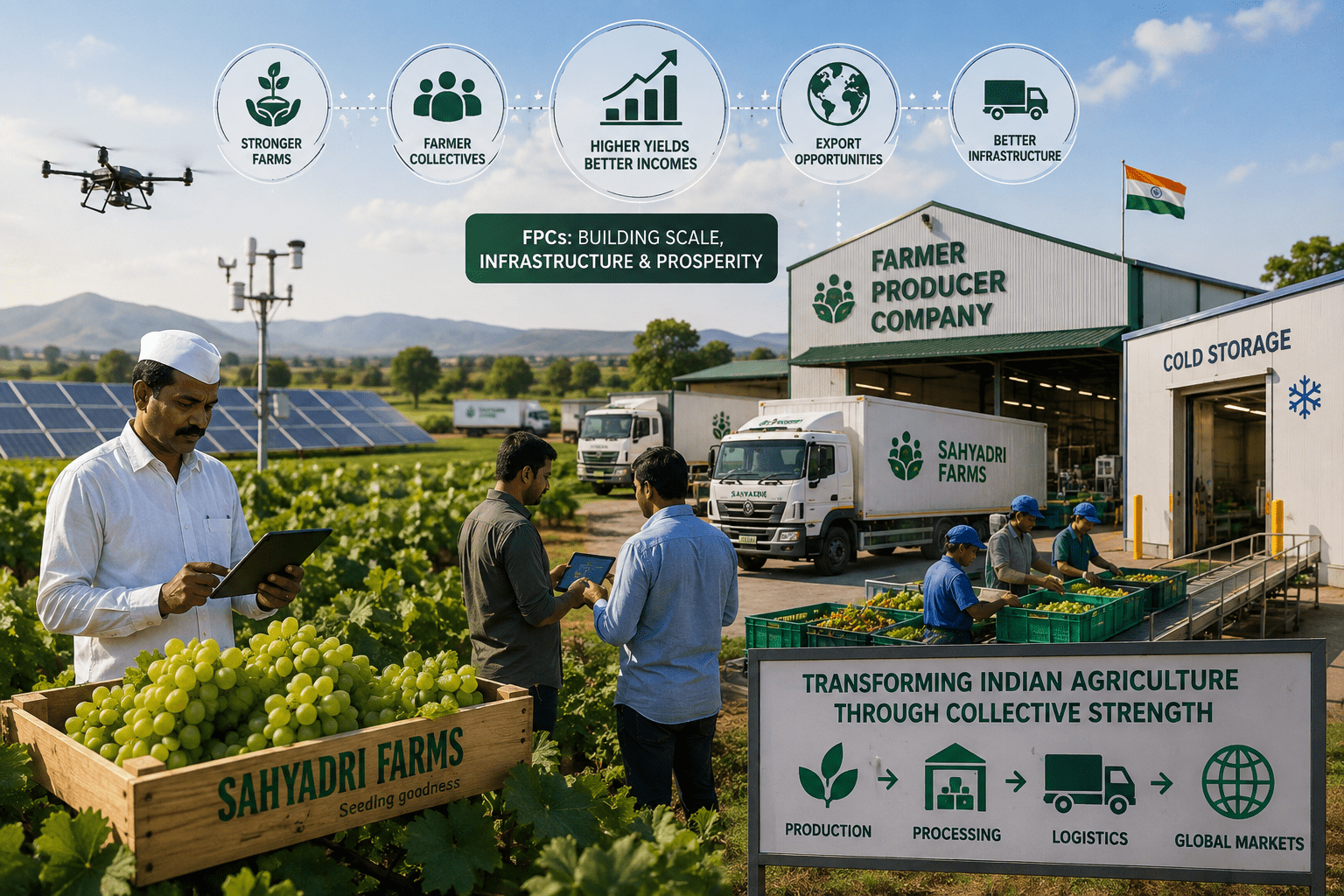
Maharashtra-based Sahyadri Farms offers one of the more notable examples. What began with a small group of farmers has developed into a large farmer-led horticulture business with production, post-harvest infrastructure, technology and export capabilities.
For India’s agricultural real estate market, the development raises an interesting question: Could better agricultural infrastructure make productive farmland more valuable over the long term?
The answer is not as simple as a guaranteed increase in land prices. But the relationship between farming infrastructure, market access and land productivity deserves closer attention.
From Individual Farms to a Larger Agricultural Network
Sahyadri Farms began with a group of smallholder farmers and gradually developed a broader agricultural ecosystem.
According to the company, it now works with more than 18,000 registered farmers covering around 31,000 acres and nine crops. Its infrastructure includes an agro-advisory team, packhouse, cold storage and technology systems.
The significance of this model is scale.
Individual farmers may struggle to invest in expensive post-harvest facilities or build direct relationships with international buyers. A farmer collective can spread those costs across a larger network.
It can also create common systems for crop planning, quality control, harvesting, processing and marketing.
This is where the FPC model becomes more than a way to sell produce together.
It becomes a value-chain model.
Why Infrastructure Matters to Agricultural Land
Land alone does not create a successful agricultural business.
The surrounding infrastructure matters too.
Cold storage can extend the selling window for perishable produce. Packhouses can support grading and sorting. Processing facilities can create additional value from crops. Better logistics can reduce the time between harvest and the final market.
These factors can influence the commercial productivity of an agricultural region.
However, this does not mean every farmland parcel near a processing centre will automatically command a premium.
Land value still depends on factors such as location, water availability, soil quality, road access, crop suitability, legal status and local demand.
The more reasonable conclusion is that strong agricultural infrastructure can improve the economic environment in which productive farmland operates.
Sahyadri Shows What Scale Can Achieve
Sahyadri’s growth illustrates the potential of this approach.
The company says it crossed ₹1,000 crore in turnover in FY2022–23, while processing and exporting produce from thousands of farmer-linked acres. It also reports investments in infrastructure and the creation of employment around its agricultural operations.
Its more recent corporate information reports a turnover of about ₹1,482.4 crore in FY2023–24, with more than 300,000 metric tonnes of crops procured and processed from over 26,000 farmers. The company also says it exports to more than 40 countries.
These numbers show something important about agricultural scale.
The opportunity is not simply about producing more crops.
It is about creating a system that can produce, collect, process and sell agricultural products efficiently.
Export Markets Raise the Importance of Quality
Export agriculture brings another layer of complexity.
International buyers often expect consistent quality, traceability, residue compliance, packaging standards and reliable supply.
India’s grape industry provides a good example. APEDA’s export procedures for grapes destined for the European Union include farm registration and residue-monitoring requirements, with GlobalG.A.P. certification referenced in the registration documentation.
This illustrates why organised agricultural networks can be valuable.
A farmer operating alone may find it difficult to manage every requirement involved in an international supply chain.
A larger organisation can provide technical advice, standardised practices, quality systems and post-harvest infrastructure.
That does not guarantee export success. But it can make participation in demanding markets more practical.
Technology Is Becoming Part of the Farm Infrastructure
The modern agricultural value chain is also becoming increasingly digital.
Farmers and agricultural organisations can use weather information, soil monitoring, crop advisory platforms, satellite imagery and other technologies to make better production decisions.
Sahyadri itself describes a technology backbone and digital systems that provide farmers with information related to crop varieties, farm inputs, climate conditions and markets.
For managed farmland, this development is particularly relevant.
A professionally managed farm can combine irrigation systems, crop monitoring, farm records and technology-based advisory services within one operating model.
The benefit is not that technology removes agricultural risk.
It doesn’t.
Weather, pests, disease, labour costs and market prices will continue to affect farm performance.
The advantage is better information and potentially better decision-making.
Financing Is Also Supporting Agricultural Infrastructure
Building this infrastructure requires capital.
The Government of India’s Agriculture Infrastructure Fund (AIF) was created to support post-harvest infrastructure and community farming assets. Eligible projects can receive loans with a 3% annual interest subvention on loans up to ₹2 crore, subject to scheme conditions. Eligible beneficiaries include Farmer Producer Organisations and other agricultural entities.
The scheme covers areas such as warehouses, cold chains, sorting and grading facilities, packhouses and other agricultural infrastructure.
By February 2026, the government reported that more than ₹80,224 crore in loans had been sanctioned for 1,50,431 projects under AIF since its launch.
For the agricultural real estate ecosystem, this matters because infrastructure can influence how efficiently farm produce moves from the field to the market.
What Does This Mean for Farmland Investors?
The FPC model does not mean that investors should simply buy agricultural land near a successful farmer collective.
There is no universal formula linking an FPC to a specific land-price premium or investment return.
Instead, investors should look at the fundamentals.
A farmland asset connected to a strong agricultural ecosystem may benefit from better access to:
These factors can potentially improve the operating environment for agriculture.
But they must be evaluated property by property.
The Bigger Shift: From Land Ownership to Agricultural Ecosystems
This is perhaps the most important change taking place.
Indian farmland is increasingly being viewed as part of a larger agricultural ecosystem.
The value of that ecosystem comes from the interaction between land, farmers, technology, infrastructure and markets.
Sahyadri Farms is an example of how a farmer-led organisation can build those connections at scale. Its growth from a small group of farmers into a large horticulture and export business shows what can happen when production is combined with processing, technology and market access.
For farmland investors, the lesson is not that every organised agricultural parcel will deliver superior returns.
The lesson is that the quality of the agricultural ecosystem surrounding land can matter almost as much as the land itself.
The Road Ahead for Indian Agricultural Real Estate
India’s agricultural sector is gradually moving towards more organised supply chains.
FPCs, digital agriculture, cold storage, food processing and improved logistics are all contributing to this transition.
As these systems develop, farmland may increasingly be evaluated on more than acreage and location.
Investors may look more closely at water security, soil health, farm management, market access, infrastructure and the strength of the surrounding agricultural network.
That could create new opportunities for professionally managed farmland.
But agriculture will remain a long-term, operational asset. Returns will vary by crop, location, management quality and market conditions.
The strongest opportunity may therefore not be farmland alone.
It may be farmland connected to a well-functioning agricultural ecosystem.
Key Investor Takeaways
1. Look beyond the land parcel
Evaluate water, soil, access, crop suitability, infrastructure and surrounding agricultural activity.
2. Understand the FPC model
Farmer Producer Companies can help smallholders achieve scale in procurement, processing, marketing and market access.
3. Study infrastructure carefully
Packhouses, cold storage, processing and logistics can strengthen agricultural value chains, but their benefits must be assessed on a local basis.
4. Use government financing where eligible
The Agriculture Infrastructure Fund can support qualifying agricultural infrastructure projects through interest subvention and credit guarantees.
5. Do not assume returns
FPC participation, export access or nearby infrastructure does not guarantee a particular farmland yield or capital appreciation.
6. Think in terms of ecosystems
The future of agricultural real estate may increasingly depend on how effectively land connects with technology, infrastructure, farmers and markets.