India’s relationship with France is entering a new phase, with technology, innovation and space emerging as important areas of cooperation. The development could have implications beyond traditional technology sectors, including agriculture, where satellite data, artificial intelligence and precision farming are becoming increasingly important.
For India’s managed farmland sector, the timing is significant.
Farm operators and agricultural investors are looking for better ways to understand soil conditions, water availability, crop health and weather risks. Earth-observation data and digital farming tools can provide information that was difficult to collect at scale only a few years ago.
The result could be a gradual shift in how farmland is managed and evaluated.
Instead of looking only at acreage, location and crop income, investors may increasingly consider the quality of farm data, irrigation efficiency, climate resilience and the technology supporting day-to-day operations.
India-France Cooperation Creates a Wider Technology Opportunity
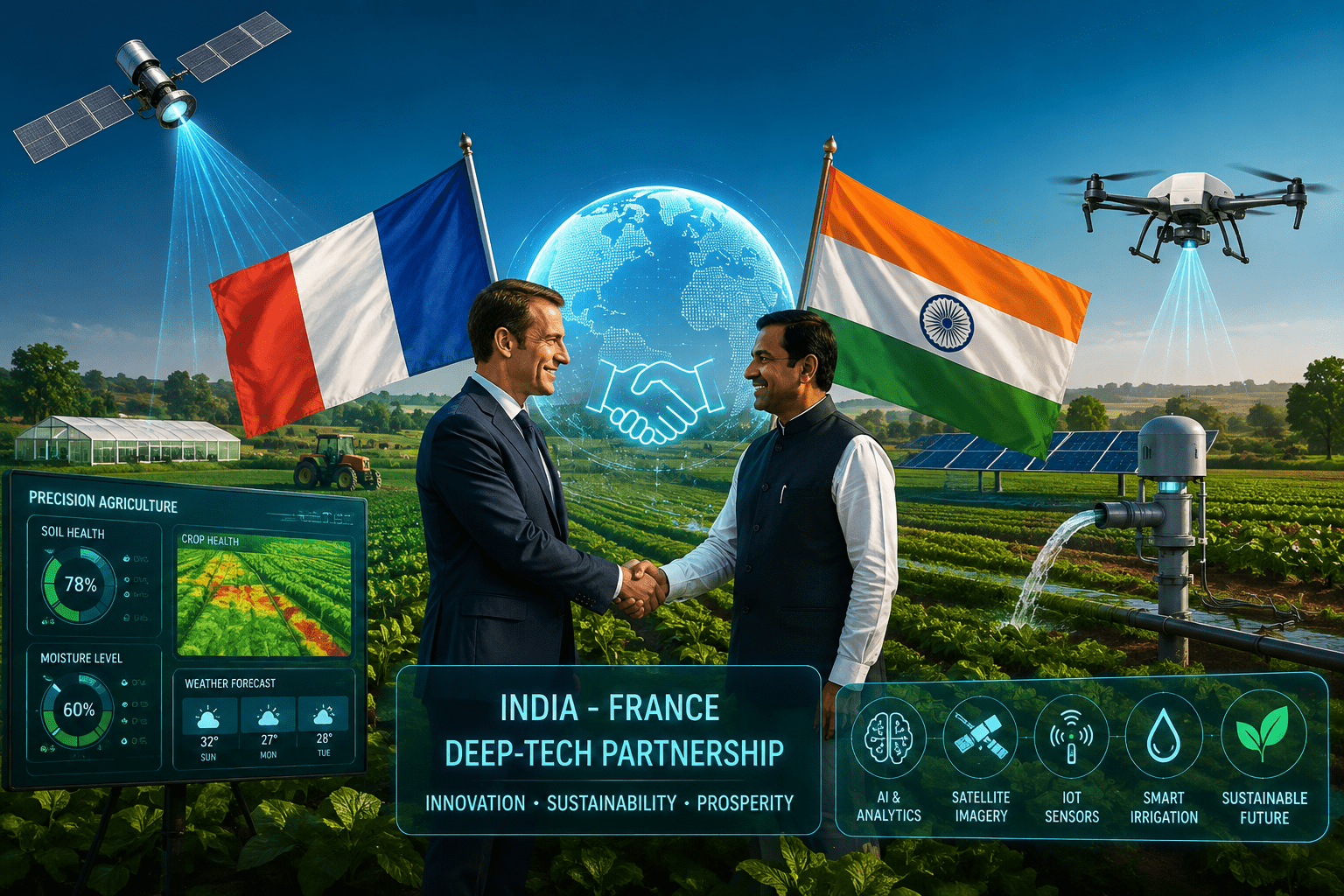
India and France have maintained a long-standing relationship in space and technology. In February 2026, the two countries announced a Special Global Strategic Partnership and reaffirmed cooperation in areas including artificial intelligence, innovation, research, digital technologies and space. They also inaugurated the 2026 India-France Year of Innovation.
This broader technology relationship does not mean that French technology is automatically being deployed across Indian farmland.
But it creates an environment where collaboration between companies, research institutions and technology providers can become easier.
France already has a strong agricultural technology ecosystem. Business France identifies precision agriculture, robotics, digital farming and sustainable agricultural technologies as important areas of French innovation. Its 2026 India programme also brought French companies and technology businesses into contact with Indian companies and investors.
Agriculture could therefore become one of several areas where the two technology ecosystems find common ground.
Satellite Data Is Changing the Way Farms Are Monitored
One of the biggest changes in modern agriculture is the growing use of remote sensing.
Satellite imagery can help farm managers monitor vegetation, identify changes in crop growth and observe large areas without visiting every part of a property. Combined with weather information and ground-level measurements, the data can support better irrigation and crop-management decisions.
This has particular relevance for managed farmland.
A professionally operated farm may have hundreds of individual decisions to make during a growing season. When irrigation, crop health and weather conditions can be monitored digitally, farm managers can respond earlier to changing conditions.
The technology does not eliminate agricultural risk. Weather, pests, disease and market prices will continue to affect farm performance.
What it can do is improve visibility.
Precision Agriculture Could Strengthen Farm Management
Indian agriculture is also seeing wider adoption of technologies such as drones, soil sensors, automated irrigation and digital farm-management platforms.
These tools can help farmers and farm operators use water and inputs more carefully.
For example, soil-moisture sensors can indicate when irrigation is required. Drone imagery can help identify areas of crop stress. Satellite data can provide a wider view of vegetation across an estate.
When these technologies work together, farm managers can move from routine, uniform treatment toward more targeted management.
That distinction matters for managed farmland.
The value of technology is not simply that it makes farming look modern. Its real value lies in whether it helps reduce waste, improve farm decisions and maintain productivity over the long term.
Technology Could Also Improve Farmland Investment Decisions
The impact may extend beyond farm operations.
For investors, one of the challenges with agricultural land has always been the difficulty of comparing the quality of different parcels.
Two properties with similar acreage can have very different characteristics. Soil quality, water availability, topography, drainage, crop suitability and access can all influence long-term performance.
Remote sensing and farm-level data can provide another layer of information.
This does not replace physical inspections, legal checks or professional valuation. Instead, it gives investors and operators additional evidence when assessing an agricultural asset.
Over time, better data could make managed farmland more transparent and easier to monitor.
Digital Land Records Add Another Layer of Transparency
Technology is also changing land-record management across Indian states.
In Karnataka, Bhoomi is integrated with other government systems, including Kaveri, to support digital management of land and registration-related records.
Maharashtra has its Mahabhumi platform, which provides services including digitally signed 7/12 extracts, 8A records, property cards, mutation services and land maps.
Telangana has also moved to its Bhu Bharati integrated land-record system under the Telangana Bhu Bharati (Record of Rights in Land) Act, 2025. The platform provides land-status and document-related services online.
These systems can make preliminary verification easier.
However, they should not be treated as a replacement for complete legal due diligence. Title history, encumbrances, survey boundaries, land-use restrictions, access rights and other state-specific requirements still need professional verification.
What This Means for Managed Farmland
The combination of land, technology and professional farm management could gradually change the investment proposition for managed farmland.
An investor may increasingly ask questions such as:
These questions shift the conversation from simply owning agricultural land to understanding how the asset is managed.
That distinction could become increasingly important as more investors look for real assets with measurable operating performance.
The Opportunity Is Long Term, Not Guaranteed
It would be premature to suggest that India-France technology cooperation will immediately transform farmland valuations or produce fixed investment returns.
Agriculture remains a complex business.
Technology costs money. Satellite data needs interpretation. Sensors require maintenance. Crops remain exposed to weather and disease. And land values depend on location, regulation, infrastructure and broader market conditions.
The opportunity is therefore better understood as a gradual improvement in information, efficiency and risk management.
If technology can help farm operators make better decisions and maintain productive land, it could strengthen the underlying quality of managed agricultural assets.
A New Chapter for Indian Farmland Investment
The next stage of India’s farmland market may be shaped by more than land availability and location.
It could be shaped by data.
India’s expanding agritech ecosystem, combined with its growing cooperation with France in AI, innovation, space and technology, creates opportunities for new agricultural applications. France’s established expertise in precision agriculture and digital farming adds another potential source of technology and collaboration.
For investors, the message is simple: technology will not remove agricultural risk, but better information can help manage it.
As satellite monitoring, AI, drones, sensors and digital land records become more common, professionally managed farmland could become easier to monitor, operate and evaluate.
The future of agricultural real estate may therefore not be defined by land alone.
It may be defined by land plus data, technology and management.