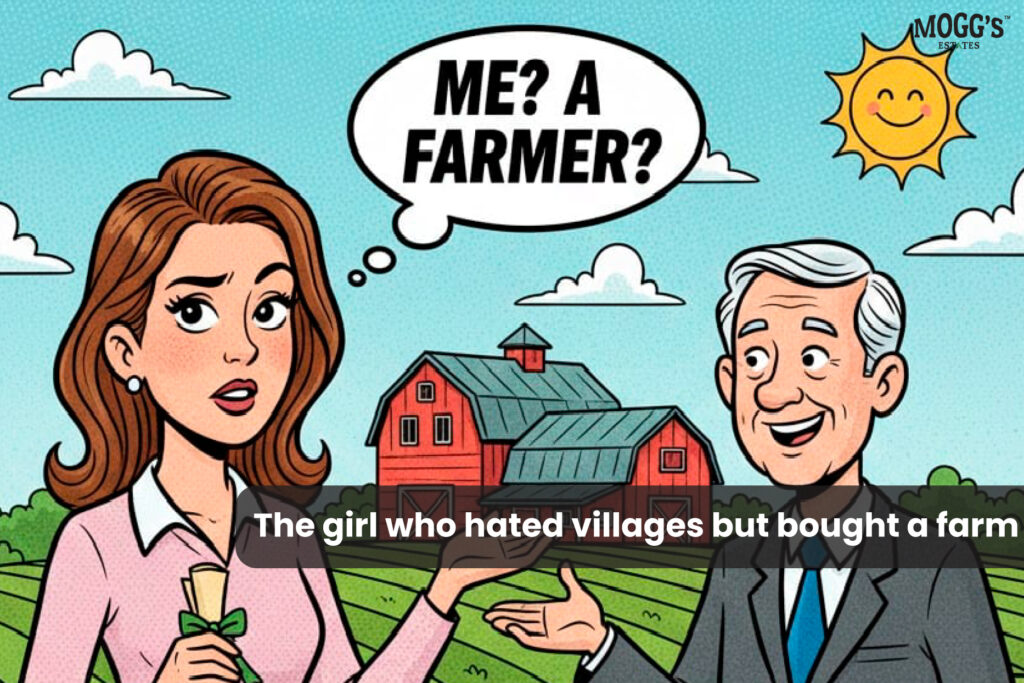
If you had asked Aarohi five years ago if she would ever own farmland, she would have laughed and ordered another iced coffee. Villages made her uncomfortable. The silence felt loud. The roads were too slow. The air smelled unfamiliar. She had grown up between school buses, office elevators, cafes that closed at midnight, and deliveries that arrived before she could feel the inconvenience of waiting. To her, villages were places you passed on highways, not places you stayed in.
Aarohi lived in Bengaluru. She worked in marketing. Her weekdays were loud with deadlines, and her weekends were loud with brunch plans. Every problem in her life was solved with either money, noise, or movement. When the pandemic slowed the city, she felt stranded in her own apartment. That was the first time silence entered her life without permission. She tried filling it with work calls, workouts, scrolling, and endless virtual conversations. Nothing stuck. When the city reopened, she ran back into it as if nothing had happened.
It was her cousin who first cracked her belief system. He invited her to a managed farmland property outside the city. She said no three times. On the fourth time, she agreed only because she had no other weekend plan and because the road trip felt like an escape. She packed as if she were going to a punishment camp. Sneakers, she did not expect to get dirty. A hoodie she doubted she would use. Zero expectations.
The first surprise was the drive. The traffic thinned earlier than she expected. The buildings slowly gave way to trees. The sky started feeling wider. Her phone signal dipped for a few minutes, and anxiety rose in her throat before she realized no one needed her urgently. The second surprise was the gates. This was not the village she had imagined. The land was organized. Green but precise. Calm but planned. Paths that made walking easy. Water lines that made irrigation quiet. A place that felt alive but not chaotic.
She stayed for one night. Just one. There was no dramatic transformation. No cinematic tears. Just something subtle. She slept more deeply than she had in years. She woke up without her alarm. She drank chai without checking notifications. When she left, she said little. She just took more photos than usual.
Back in the city, her life resumed exactly where she had left it. The traffic returned. The inbox filled up. The meetings overlapped. Yet something in her had shifted without asking for permission. She found herself looking at those photos more often than she wanted to admit. She followed a few pages on farmland and sustainability. She started reading about managed farmland as an asset. She dismissed the thought many times. She was not that person. She was a city girl.
Three months later, her office announced restructuring. Teams changed. Job security felt fragile. The salary was the same, but the silence under it felt new. That was when she booked her second visit. This time she travelled alone. She walked more. She spoke less. She met a few people who already owned plots there. Some were investors. Some were families. Some were couples planning weekend homes. All of them spoke about the land in a way people rarely talk about investments. There was logic, yes. But there was also emotion.
That is when Aarohi learned the difference between buying land and owning land that is managed. The burden of maintenance was handled. The trees were nurtured. The water systems were monitored. The land grew even when the owner was busy living their city life. It was not just dirt. It was a working asset that breathed.
The idea followed her back again.
Her friends did not understand when she first mentioned it. They asked if she was bored. They joked about snakes and mosquitoes. They sent reels of luxury apartments and said this is what success should look like. She laughed with them, but she did not feel like laughing inside. For the first time, the noise no longer convinced her.
She ran the numbers quietly. The exact amount she was about to put into an upgraded car could go into farmland. One would depreciate. The other would grow. One would give her weekend photos. The other would provide her decades of value. It was not a poetic decision. It was practical. The poetry came later.
The day she signed her documents, there was no celebration. No Instagram post. No loud announcement. She went to work right after, as nothing extraordinary had happened. But inside, something felt anchored for the first time. She owned soil. Not borrowed space. Not rented air. Real ground.
Over the months, she often visited her land. Some weekends she stayed back. Some weekends, she just walked away. The land changed slowly. So did she. Her idea of returns expanded. Money still mattered. But peace now mattered too. She began saving differently and spending differently and choosing differently.
The city did not become her enemy. It simply stopped being her only identity.
One evening, standing in the middle of her plot, she realized the irony. She had hated villages all her life. But what she truly hated was disorder without dignity. Once she saw land nurtured with care, managed with precision, and protected with vision, her fear disappeared. What she had bought was not escape. It was balanced.
This is precisely why managed farmland is not serving the same audience it did a decade ago. Today, it is the first time investors. It is young professionals. It is working women. It is couples without inherited wealth. It is parents who want long-term certainty. Farmland has shifted from being a farmer’s asset to being a future planner’s strategy.
In and around Bengaluru, this shift is becoming visible. People are looking beyond city saturation. Beyond inflated apartment prices. Beyond overstretched returns. Farmland stands at the intersection of emotional security and logical growth. It offers tangible ownership in a world filled with digital uncertainty.
At Mogg’s Estates, this shift is not treated like a trend. It is treated like a responsibility. That is why projects like Mogg’s Terra Hill are built around managed ecosystems instead of just plotted sales. The focus is not only on selling land. It is on creating a living, breathing asset that grows with its owner. Irrigation systems. Plantation planning. Community spaces. Water management. Long-term care. These are not add-ons. They are the foundation.
For investors like Aarohi, this makes the difference between buying land and building an asset quietly in the background of a loud city life.
She still lives in Bengaluru. She still works in marketing. She still enjoys cafes, movement, and speed. But now she also knows where she will go when the noise becomes too convincing. She knows her money is not floating only in numbers on a screen. She knows a part of it is rooted.
The day her friends finally visited her land, the questions changed. The jokes stopped. The curiosity began. Nobody asked her anymore why she bought farmland. They asked how.
Sometimes growth does not begin with ambition. It starts with exhaustion. Sometimes, investment does not begin with spreadsheets. It begins with silence. And sometimes the person who swore she would never step into a village ends up choosing land as her most confident decision.
Farmland does not replace the city. It rewires your relationship with it.
If you are someone who believes you are too urban for land, too modern for soil, too busy for trees, you are precisely the person farmland is quietly waiting for. Not as an escape. But as a foundation.
Because trends fade. Noise exhausts. Assets that grow with you do not.
If you would like to explore how managed farmland works and why it is becoming a serious long-term investment choice for urban professionals, Mogg’s Estates lets you experience land before you own it. Sometimes you do not fall in love with a place at first sight. Sometimes you fall in trust with it first.