For decades, Indian families have relied on familiar assets to grow and protect their wealth. Gold locked away for safety, stocks tracked daily on apps, and property bought with long-term intent. Today, as investors look beyond short-term returns and market noise, a quieter but powerful contender is gaining attention. Farmland.
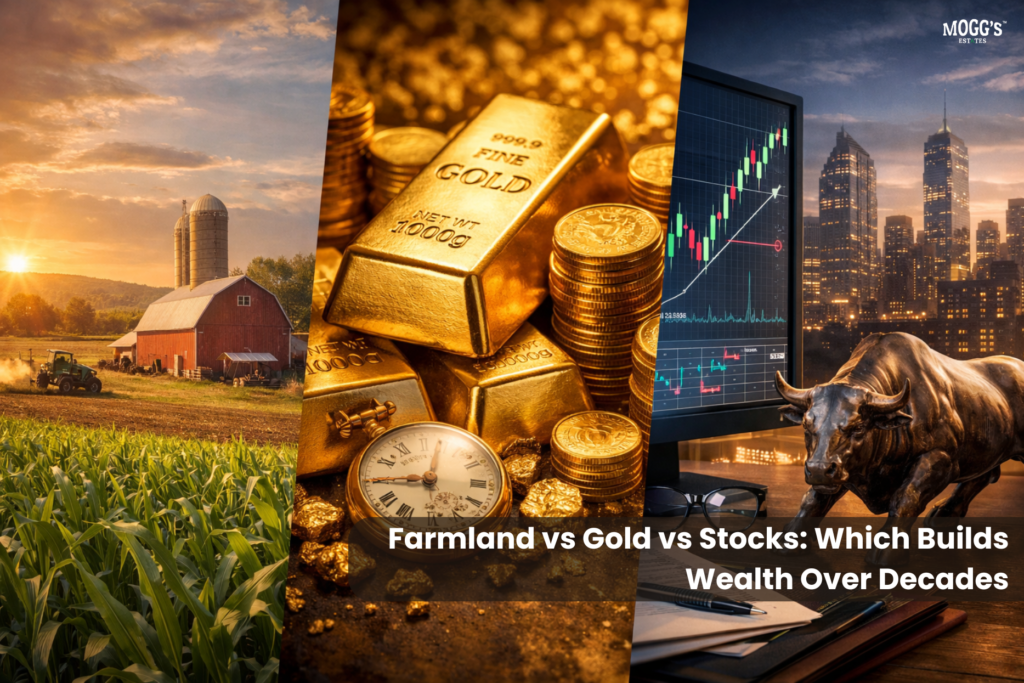
When the conversation shifts to farmland vs gold vs stocks, the real question is not which asset spikes the fastest, but which one steadily builds wealth over decades. Especially in India, where investing is deeply tied to family security, inflation protection, and legacy, the best long-term investment must offer more than just numbers on a screen.
This blog takes a grounded look at how farmland, gold, and stocks perform over the long run, and why managed farmland is increasingly being seen as a serious wealth-building asset in India.
Understanding long-term wealth in the Indian context
Long-term wealth in India has never been about chasing trends. It has always been about owning assets that survive economic cycles, inflation, policy changes, and lifestyle shifts. Indian investors traditionally value assets that are tangible, stable, and capable of being passed down.
That is why gold, land, and equities dominate investment conversations. But each of these assets behaves very differently over decades.
To understand which one truly builds wealth, we need to look beyond short-term performance and examine their long-term nature.
Gold: a trusted store of value, not a growth engine
Gold holds emotional and financial significance in Indian households. It is gifted at weddings, inherited across generations, and trusted during uncertain times.
Gold works well as a hedge against inflation and currency devaluation. During economic slowdowns or global instability, gold prices often rise as investors seek safety. Its liquidity and universal acceptance make it dependable in emergencies.
However, gold does not generate income. It remains idle. Over long periods, its price movement is cyclical, with extended phases of stagnation. Once storage costs, making charges, and security expenses are factored in, real returns often barely beat inflation.
In the farmland vs gold comparison, gold protects wealth but rarely multiplies it. It is insurance, not a growth strategy.
Stocks: high potential, high volatility
Stocks have gained popularity, especially among younger Indian investors. The promise of compounding and wealth creation makes equities attractive.
Historically, equity markets have delivered strong long-term returns. Well-chosen stocks and mutual funds can outperform inflation and generate significant wealth over time. Stocks offer liquidity, diversification, and accessibility even with smaller investments.
But stock market investing comes with emotional and psychological challenges. Markets are volatile. Returns are uneven. Long-term success depends on discipline, patience, and the ability to stay invested during crashes.
Stock returns are also sensitive to global events, interest rate cycles, corporate performance, and regulatory changes. In the farmland vs stocks debate, stocks offer speed and scale, but also uncertainty.
Farmland: the asset that grows quietly
Farmland has always been valuable in India, but it was historically accessible only to farmers or large landowners. Today, managed farmland investment has changed that.
Farmland is a productive asset. Unlike gold, it grows something. Unlike stocks, it is not driven by daily market sentiment.
Over decades, farmland has benefited from land scarcity, population growth, rising food demand, and inflation-linked appreciation. Agricultural land in India has consistently appreciated over the long term, especially in regions with strong water access and soil quality.
Farmland also offers income potential through crops or leasing, along with capital appreciation of the land itself. This dual return structure makes farmland unique among long-term investments.
Managed farmland: making land ownership practical
One of the most significant barriers to farmland investment used to be management. Managed farmland solves this.
Managed farmland allows investors to own agricultural land while professional teams handle plantation, maintenance, harvesting, and monetisation. This turns farmland into a passive, long-term asset suitable for urban investors.
Companies like Mogg’s Estates have made managed farmland accessible, transparent, and professionally run. Investors benefit from land appreciation and farm income without dealing with daily operations.
Comparing farmland, gold, and stocks over decades
Gold offers stability but limited growth. Stocks offer high growth but high volatility. Farmland offers steady appreciation with income generation.
Gold does not produce income. Stocks may provide dividends, but they are not guaranteed. Farmland generates annual agricultural income along with long-term appreciation.
Gold protects against inflation moderately. Stocks protect against inflation over long periods if invested wisely. Farmland is directly linked to inflation through food demand and land scarcity.
Gold is physical but idle. Stocks are digital and intangible. Farmland is physical, productive, and enduring.
When viewed over decades, farmland stands out as a balanced asset that combines stability, productivity, and long-term value.
Why farmland is emerging as the best long-term investment in India?
India’s population continues to grow, but land does not. Food security, sustainability, and agricultural productivity are becoming national priorities. These forces quietly push farmland values upward.
Urban investors are also seeking diversification beyond stock markets and traditional real estate. Farmland offers portfolio balance, absolute asset security, and intergenerational wealth creation.
This is why farmland investment in India is increasingly viewed not as an alternative asset, but as a core long-term strategy.
Wealth beyond numbers Gold is inherited.
Stocks are often sold. Farmland is lived with.
Land carries emotional and practical value. It becomes part of a family’s story. Over generations, farmland can support income, appreciation, and future opportunities.
For investors thinking beyond returns, farmland represents permanence and continuity.
Where Mogg’s Estates fits in?
Mogg’s Estates enables investors to participate in managed farmland projects designed for long-term value creation. With a focus on sustainability, professional management, and transparent ownership, Mogg’s Estates bridges urban capital with agricultural opportunity.
By investing through a managed farmland model, investors gain exposure to one of India’s most resilient asset classes without operational involvement.
Gold preserves wealth. Stocks accelerate wealth when managed well. Farmland quietly builds wealth year after year.
For those looking for the best long-term investment in India, farmland stands out not because it is flashy, but because it is foundational.
In a world driven by screens and speculation, land remains real.
And over decades, tangible assets endure.