We live in a world where wealth often feels invisible. Numbers move on screens. Assets exist as entries in apps. Investments are tracked through notifications rather than touch. In today’s digital economy, money moves faster than ever, but certainty feels harder to find.
As technology reshapes how we earn, spend, and invest, a growing number of investors are quietly returning to something older, slower, and more grounded. Tangible assets.
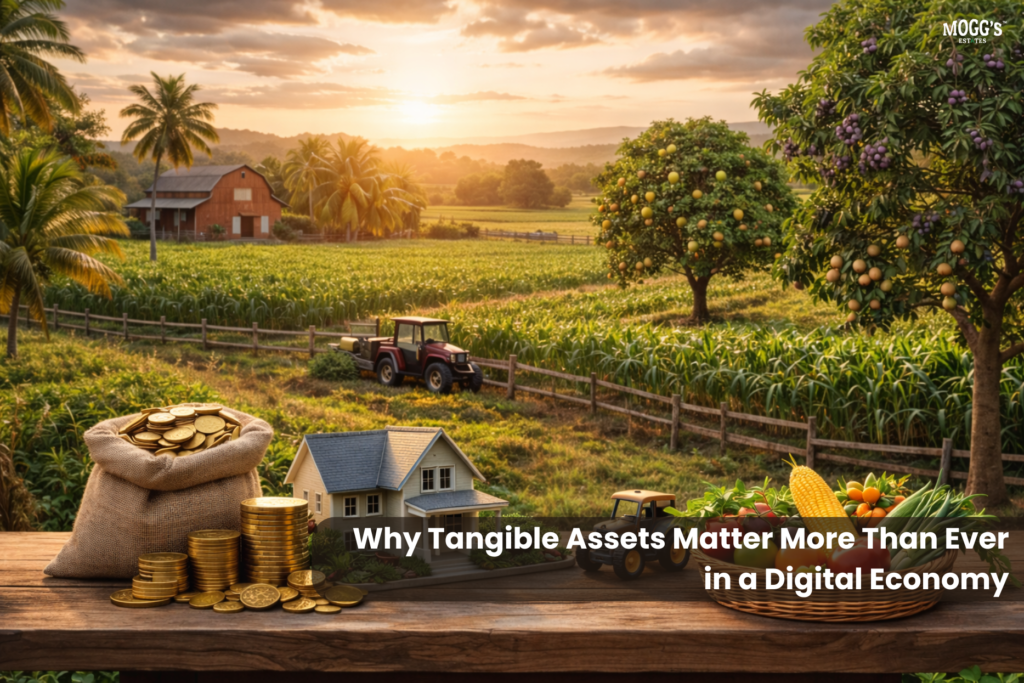
In an age dominated by digital products, virtual currencies, and paper wealth, tangible assets like land, farmland, and real assets are proving why they still matter deeply, especially in the Indian investment landscape.
The rise of digital wealth and its limitations
Digital assets have transformed investing. Stocks, mutual funds, crypto, and online instruments offer speed, accessibility, and scale. For many, wealth creation now happens entirely on a phone.
But digital wealth comes with fragility. Market volatility, algorithm-driven trades, sudden crashes, regulatory changes, and platform dependency can wipe out value overnight. What exists digitally can also disappear digitally.
This is why investors are reassessing what absolute security looks like. In this reassessment, tangible assets are regaining importance.
What makes an asset tangible and why it matters
A tangible asset is something you can see, touch, and physically own. Land, farmland, real estate, commodities, and infrastructure fall into this category.
Tangible assets offer three fundamental advantages in a digital economy.
First, they are independent of technology platforms. They do not rely on servers, apps, or systems to exist.
Second, they hold intrinsic value. Land feeds people. Farmland produces crops. These assets serve real-world needs that remain constant regardless of market cycles.
Third, they provide psychological stability. Ownership feels real. Value is not abstract.
In times of uncertainty, tangibility builds confidence.
India’s historical preference for tangible assets
Indian investors have always understood the value of tangible assets. Gold, land, and property have traditionally formed the backbone of family wealth.
This preference is cultural, but it is also practical. India has experienced economic shifts, currency changes, and policy reforms. Tangible assets have survived all of them.
As the digital economy expands, this wisdom feels increasingly relevant rather than outdated.
Farmland as a tangible asset with purpose
Among tangible assets, farmland stands out uniquely. It is not just owned, it is productive.
Farmland produces food. It responds to inflation. It benefits from population growth and rising demand. Unlike digital assets that depend on perception, farmland depends on necessity.
Over decades, agricultural land in India has shown steady appreciation, particularly in regions with strong soil quality and water access.
This makes farmland not just a hedge, but a foundation.
Managed farmland bridges modern investing with tangible assets
One reason farmland was historically inaccessible to urban investors was management complexity. Today, managed farmland has changed that.
Managed farmland allows investors to own agricultural land while professionals handle farming operations, maintenance, harvesting, and monetization. This makes farmland a passive, long-term investment suitable for modern lifestyles.
Mogg’s Estates has been instrumental in making managed farmland accessible to urban investors who want tangible ownership without operational involvement. By combining professional management with sustainable farming practices, Mogg’s Estates enables investors to participate in absolute asset ownership with clarity and confidence.
Why tangible assets protect against digital volatility
Digital markets are fast, interconnected, and emotionally charged. News travels instantly. Fear spreads quickly. Value can rise or fall based on sentiment rather than fundamentals.
Tangible assets move differently.
Land does not react to daily headlines. Farmland does not lose value because of a tweet. These assets grow slowly, quietly, and steadily.
In a portfolio, tangible assets act as stabilizers. They reduce dependency on market timing and algorithm-driven cycles.
Inflation and the case for tangible assets
Inflation erodes purchasing power. Digital returns often struggle to keep pace with real-world cost increases. Tangible assets like farmland naturally adjust to inflation. As food prices rise, agricultural income rises. As land becomes scarcer, its value increases.
This inflation linkage makes farmland one of the most reliable long-term investments in India.
Tangible assets and intergenerational wealth
Digital wealth is often liquidated. Stocks are sold. Funds are rebalanced. Tangible assets are passed down.
Land becomes legacy. Farmland becomes part of a family’s identity. It provides security across generations, not just returns for one cycle. This is why families increasingly view farmland investment as a form of intergenerational wealth creation rather than short-term gain.
Psychological comfort in ownership
There is a subtle but powerful difference between owning a digital asset and owning land. One lives on a screen. The other exists regardless of screens. In uncertain times, this distinction matters. Tangible assets provide emotional reassurance. They remind investors that some value exists beyond systems and platforms.
This psychological stability is often overlooked, but it plays a significant role in long-term decision-making.
The sustainability angle
Modern investors are not just focused on returns. They care about impact. Farmland investment, mainly when managed sustainably, supports food security, soil health, water conservation, and rural livelihoods.
Mogg’s Estates focuses on sustainable managed farmland practices that align financial growth with environmental responsibility. This allows investors to participate in tangible asset ownership that also contributes positively to society.
Tangible assets in a digital future
Technology will continue to shape investing. Digital tools will improve access, transparency, and efficiency. But as the world becomes more virtual, the value of what is real increases.
Tangible assets anchor wealth in reality. They balance innovation with permanence. In the future, the strongest portfolios will likely combine digital growth assets with tangible foundations.
Why investors are returning to land
Across India, urban professionals, entrepreneurs, and families are rediscovering farmland. Not because it is trendy, but because it is timeless.
Land does not promise instant gratification. It promises durability.
In a digital economy built on speed, durability is rare and valuable.
Where Mogg’s Estates fits in this shift
Mogg’s Estates enables investors to participate in managed farmland projects designed for long-term value creation. With transparent ownership models, professional management, and a focus on sustainability, Mogg’s Estates bridges the gap between digital investors and tangible assets.
For those seeking to balance modern investing with real-world security, managed farmland offers a compelling path.
The digital economy has changed how wealth is created, but it has not changed what wealth ultimately needs to do. Protect, grow, and endure.
Tangible assets matter because they exist beyond systems. They serve real needs. They hold value through time.
In a world where so much feels temporary, land remains permanent.
And in that permanence lies its power.