Parenting in India has changed. Today’s parents are more informed, more intentional, and more aware of the long-term impact of their choices. Education is no longer just about grades. Success is no longer just about income. More families are now thinking about values, exposure, emotional grounding, and the kind of world their children grow up in.
In this shift towards conscious parenting, an unexpected element is quietly becoming relevant—farmland ownership.
At first glance, parenting and farmland investment may seem unrelated. But for many Indian families, owning farmland is emerging as a powerful way to raise grounded children while building long-term family wealth.
What conscious parenting really means today
Conscious parenting is not about perfection. It is about awareness. It is about making choices that align with long-term emotional, mental, and ethical development rather than short-term convenience.
Indian parents today are asking more profound questions. How much screen time is too much? How do children learn patience? How do they understand effort, growth, and responsibility? How do they connect with food, nature, and reality in an increasingly digital world?
These questions are pushing families to look beyond classrooms and gadgets.
The disconnect modern children face
Most urban children in India grow up surrounded by screens. Food arrives in packets. Vegetables come pre-cleaned. Milk comes in cartons. Very few children understand where food actually comes from.
This disconnect is not intentional, but it has consequences. Children grow up seeing consumption without creation. Speed without process, results without patience.
Conscious parenting seeks to bridge this gap. One of the most effective ways to do that is through exposure to nature and the land.
Farmland as a classroom beyond textbooks
Farmland offers lessons no school curriculum can replicate.
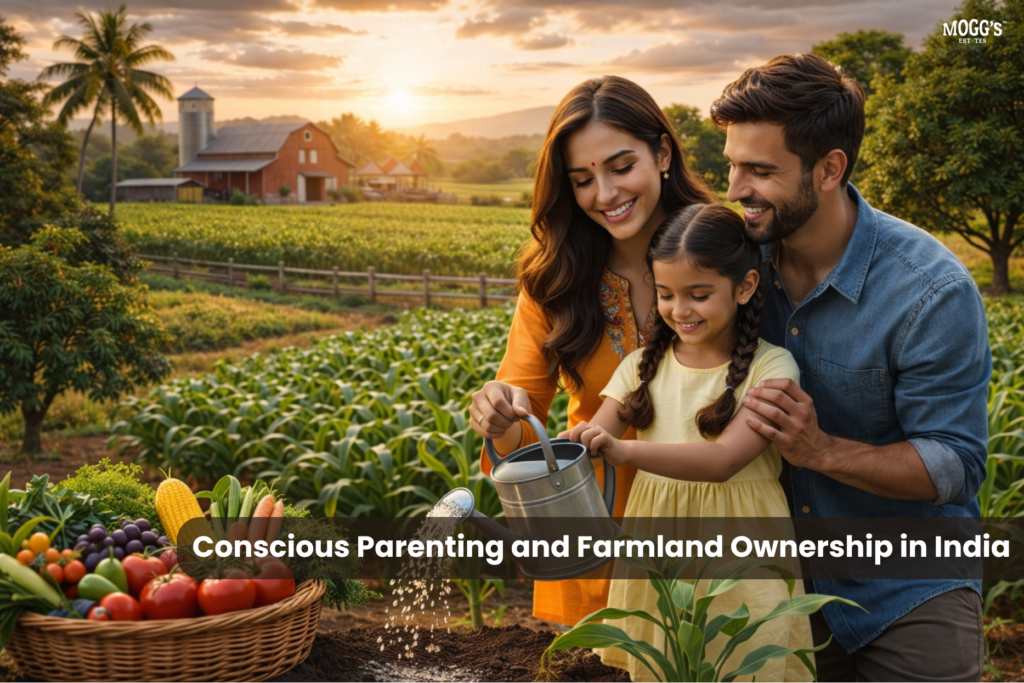
When children visit a farm, they see effort before outcome. They see time, care, and consistency. They learn that growth cannot be rushed. Crops take months. Seasons matter. Nature responds to respect.
These experiences shape perspective.
For children raised with access to farmland, weekends become more than leisure. They become learning experiences rooted in reality rather than screens.
Why farmland ownership matters more than farm visits
While occasional farm visits are valuable, farmland ownership creates continuity.
Ownership turns land into a familiar space rather than a one-time experience. Children grow up revisiting the same soil, watching trees grow, and observing seasons change year after year.
This builds a sense of belonging. The land becomes part of their story.
For families investing through managed farmland, this continuity comes without operational stress. The land grows, produces, and evolves while remaining accessible.
Managed farmland and modern parenting
Managed farmland has made farmland ownership practical for urban families.
With professional teams handling cultivation and maintenance, parents can focus on exposure and experience rather than logistics. This allows families to enjoy the benefits of farmland without the burden of farming.
Mogg’s Estates offers managed farmland projects designed for long-term value and sustainability. These projects allow families to own farmland as an asset while also using it as a space for learning, connection, and grounding.
Teaching children to value beyond money.
One of the biggest challenges of modern parenting is teaching children the value of money without raising entitlement.
Farmland ownership introduces a healthier narrative. Children see that wealth is built slowly. Those returns come from patience. That income can come from creation, not speculation.
This understanding is complex to teach through digital investments alone.
When children see farmland produce food and generate income over time, money becomes connected to effort and responsibility.
Conscious parenting and environmental awareness
Environmental consciousness is becoming an essential value for Indian families. Parents want children to respect nature, understand sustainability, and care about the planet.
Farmland naturally instils these values.
Children learn about soil health, water conservation, and seasonal balance. They see the impact of sustainable practices firsthand.
Mogg’s Estates focuses on responsible farmland development and sustainable agricultural practices. This aligns well with families who want their investments to reflect their values.
Farmland as a legacy, not just an asset
For many Indian families, the idea of legacy is fundamental.
Farmland represents continuity. It is not easily sold, flipped, or forgotten. It stays.
Children who grow up knowing their family owns land often develop a stronger sense of responsibility towards the future. The land is not just inherited wealth; it is inherited stewardship.
This mindset is central to conscious parenting.
Financial security and emotional security
Conscious parenting also involves creating stability.
Farmland offers financial security through long-term appreciation and agricultural income. Unlike volatile markets, farmland grows steadily and predictably.
For parents, this means reduced anxiety about the future. For children, it means growing up in an environment where financial decisions are calm and considered rather than reactive.
This emotional stability matters more than parents often realise.
Why Indian families are returning to the land
Across India, urban families are rediscovering farmland.
Not because it is nostalgic, but because it offers balance.
In a life dominated by speed, farmland slows things down. In a world full of abstraction, it brings reality back. In a system focused on consumption, it teaches creation.
This is why farmland ownership is increasingly seen as both a parenting choice and an investment strategy.
The role of Mogg’s Estates in family-focused farmland ownership.
Mogg’s Estates enables families to own managed farmland that aligns with long-term goals. Transparent ownership, professional management, and thoughtfully planned farmland communities make it easier for families to integrate land into their lives.
For parents who want their children to grow up grounded while also building tangible wealth, managed farmland offers a meaningful solution.
Raising children who understand roots
Children raised with access to land grow up differently. They understand cycles. They respect effort. They value patience.
These qualities cannot be downloaded or taught overnight.
In a digital economy where everything feels instant, farmland teaches waiting. In a world of virtual rewards, it teaches real outcomes.
That is the quiet power of land.
Conscious parenting is about aligning actions with values. Farmland ownership does precisely that.
It connects children to nature. It teaches responsibility. It builds long-term family wealth. It creates legacy.
In India, where land has always held deep meaning, farmland ownership is finding new relevance in modern parenting.
For families looking to raise grounded children while securing the future, farmland is not just an investment.
It is a choice.