When Raghav first heard the term passive income, he imagined stock dividends and rental apartments. He lived in Bengaluru, worked long hours in tech, and, like most people around him, believed that money had to be constantly monitored to grow. Every investment he owned came with alerts, apps, and anxiety.
Farmland was never part of his plan.
It entered his life quietly, through a conversation with his father, who mentioned owning land was the only investment that had never demanded his attention yet had never failed him.
That conversation changed how Raghav thought about wealth.
The misconception around farmland income
Many people assume farmland is only about long-term appreciation. They believe income comes only when land is sold years later. This belief keeps farmland out of most urban portfolios.
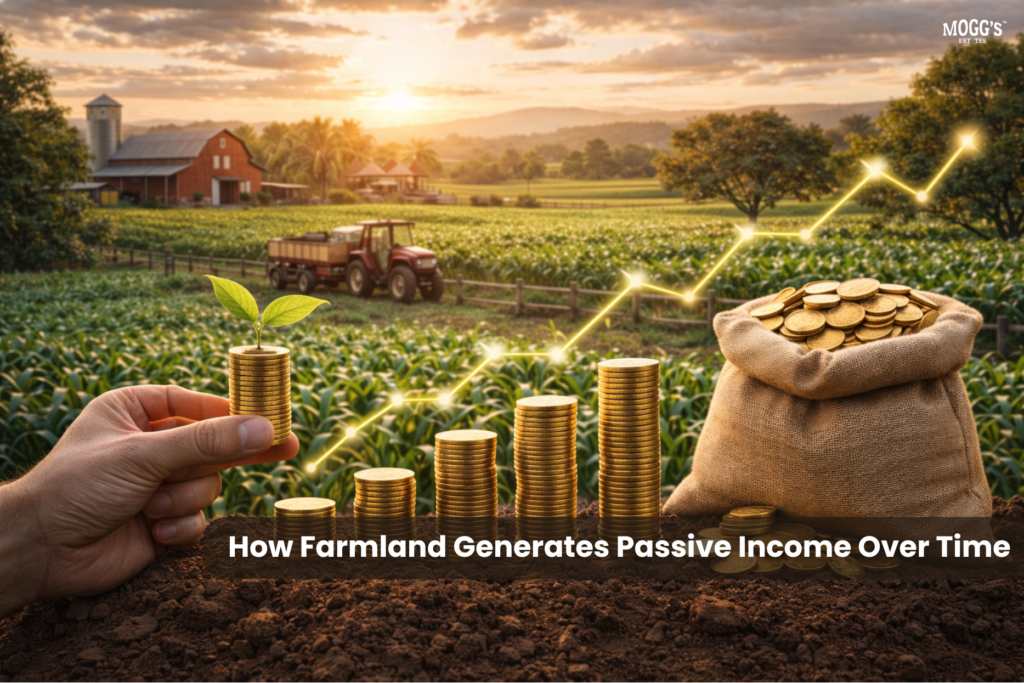
In reality, farmland can generate steady passive income over time when managed properly.
Unlike speculative assets, farmland earns through production. Crops grow. Trees mature. Harvests repeat. Income flows annually rather than waiting for an exit.
This is what makes farmland fundamentally different.
Understanding passive income in farmland investment
Passive income does not mean zero involvement. It means predictable income without daily effort.
On farmland, passive income is generated from agricultural yields. This can come from fruit plantations, timber trees, lease income, or mixed farming models.
When farmland is professionally managed, the investor earns while specialists handle operations.
This is where managed farmland becomes relevant.
How farmland income begins quietly?
In the early years, farmland income was modest. Saplings are planted. Soil is prepared. Water systems are built. Growth takes time.
This phase tests patience, but it also lays the foundation for compounding returns.
Unlike stocks that react instantly to sentiment, farmland rewards consistency. Each season adds value. Each year strengthens the yield.
Raghav watched this happen slowly. He did not receive notifications. He received updates at the end of harvest cycles.
And that difference mattered.
The role of managed farmland in passive income
Traditional farmland ownership required constant supervision. Urban investors struggled with distance, labor, and unpredictability.
Managed farmland solved this gap.
Managed farmland allows investors to own agricultural land while professionals manage cultivation, maintenance, harvesting, and marketing. The land works while the owner remains hands-off.
Mogg’s Estates has developed managed farmland projects that focus on long-term productivity rather than short-term yield. By choosing suitable crops, maintaining soil health, and ensuring water sustainability, these projects are designed to generate consistent income over time.
Multiple income streams from one asset
Farmland is not limited to a single income source.
Depending on the model, income can come from annual crops, fruit harvests, timber value, leasing, or future agri-tourism potential.
This diversification within the same asset reduces risk. If one crop underperforms, others continue.
Over time, this layered income structure stabilizes returns and smoothens fluctuations.
Why does farmland income improve with time?
Unlike machines or buildings, farmland does not depreciate. With proper care, soil fertility improves. Trees mature. Water systems stabilize.
As plantations age, yields increase. Operating costs are reduced. Income becomes more predictable.
This is the opposite of most assets that require increasing maintenance as they age.
Farmland improves as it grows older.
Inflation and farmland income
One of the most substantial advantages of farmland passive income is its link to inflation.
As food prices rise, agricultural income rises. Farmland income adjusts naturally to cost increases without renegotiation.
This makes farmland an effective hedge against inflation, especially for long-term investors.
Raghav noticed this during years when market returns were flat, but agricultural prices rose steadily.
Farmland vs rental income
Rental income is often compared to farmland income. While rentals offer steady cash flow, they also entail vacancies, maintenance, tenant issues, and regulatory changes.
Farmland income, when managed professionally, avoids many of these challenges. There are no tenants to chase, no interiors to repair, and no depreciation of the core asset.
The land remains intact while income flows through produce.
The psychological shift of earning from land
What surprised Raghav the most was the emotional difference.
His stock income felt abstract. Numbers moved, but nothing felt real. Farmland income felt earned. It came from soil, rain, effort, and time. It felt grounded.
This psychological stability became as valuable as the income itself. Long-term wealth creation alongside income farmland offers something rare. Income and appreciation together. While annual yields generate passive income, the land itself appreciates due to scarcity, demand, and development in the area. Over the decades, this dual benefit quietly compounds wealth. This is why farmland is increasingly seen as a core long-term investment in India.
Why farmland suits patient investors?
Farmland is not for those seeking instant returns. It rewards patience, discipline, and long-term thinking. For investors willing to wait, farmland offers steady income without the emotional volatility of other asset classes. In a world driven by speed, this slowness becomes a strength.
The role of Mogg’s Estates in long-term farmland income
Mogg’s Estates focuses on creating managed farmland projects that prioritize sustainable income generation. From crop selection to farm management, the emphasis is on consistency rather than speculation.
Investors benefit from transparent ownership, professional execution, and long-term value creation.
For urban investors like Raghav, this model removed complexity while preserving authenticity.
Farmland as retirement income?
Many investors are now viewing farmland as a source of retirement income. Unlike pensions tied to markets, farmland income continues as long as the land produces. It does not depend on market sentiment or interest rates. This makes farmland particularly attractive to those planning long-term financial security. The compounding effect of time, farmland income compounds differently.
Each reinvestment improves soil. Each year strengthens the yield. Each season builds resilience. The longer the farmland is held, the more predictable and stable the income becomes. This compounding is slow but durable.
Passive income is often misunderstood as effortless wealth. In reality, the most reliable passive income comes from assets that work quietly in the background.
Farmland does precisely that, it generates income through necessity. It appreciates through scarcity. It endures through cycles. For investors seeking stability, sustainability, and long-term wealth, farmland offers a path that requires little ongoing attention. Sometimes, the best income is the one that grows while you live your life. And sometimes, that income comes from soil.