For most investors, confidence is not built solely on numbers. It comes from clarity. Understanding where money is placed, how it behaves over time, and whether it will still hold meaning years later. This is the story of one such journey, where curiosity slowly turned into conviction. It begins with a simple site visit and ends with long-term confidence, showing how farmland, when structured correctly, becomes more than just another asset.
Arjun had always considered himself a responsible investor. Like many working professionals in India, his financial life followed a familiar pattern. Mutual funds for growth, a bit of gold for security, and savings kept aside for emergencies. On paper, everything looked fine. Yet, there was a constant sense of incompleteness. Every investment demanded attention. Markets needed monitoring, headlines influenced decisions, and returns often felt tied to forces outside his control.
When farmland first entered the conversation, it did not spark excitement. It felt unfamiliar and slightly intimidating. His first reaction was practical rather than emotional. How does farmland investment even work in India? Is it complicated? Is it safe? That question led him to explore further, eventually bringing him to his first site visit with Mogg’s Estates.
Walking the land changed the conversation.
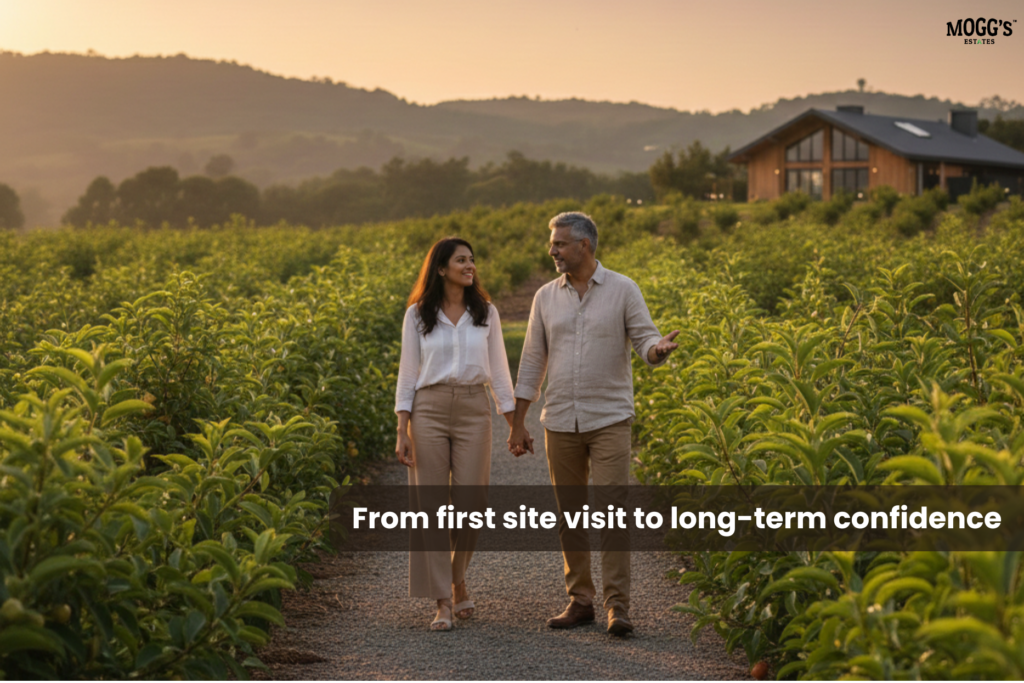
The site visit did not feel like a sales pitch. There was no rush, no exaggerated claims, and no pressure to commit. What stood out immediately was transparency. The land was real and clearly demarcated. Soil quality was explained in detail, water access was visible, and the overall layout felt intentional rather than speculative. For the first time, Arjun was not investing through a screen or a statement. He was standing on what he was considering owning.
That physical experience mattered more than expected. Farmland investment is deeply tangible. It does not exist on dashboards or fluctuates by the hour. Being present on the land shifted the conversation from returns to understanding. Numbers had always guided his decisions, but this time, context played an equally important role. The site visit built a sense of trust that spreadsheets never had.
Understanding the farmland investment process in India
One of the biggest reasons investors hesitate to invest in farmland is perceived complexity. Arjun had the same concerns. Is farmland legal to buy? What documents need to be verified? Who manages the land after purchase? What happens if the owner lives far away? These questions often stop people before they begin.
Mogg’s Estates addressed each of these concerns methodically. The farmland investment process in India was explained step by step, from land titles and RTC records to ownership structure and long-term management. There were no vague answers or shortcuts. Everything was laid out clearly, making the process feel structured rather than risky. This clarity removed uncertainty, and with it, fear. Trust in investing is built when systems are explained openly, not when they are hidden behind jargon.
The decision was not emotional; it was grounded.
Contrary to popular belief, Arjun did not invest in farmland because it felt exciting. He invested because it felt stable. There was no urgency or fear of missing out. Instead, there was a quiet sense that this asset aligned with how he wanted to build wealth. He was not chasing fast returns. He wanted something that could exist in the background while he focused on his career and personal life.
Managed farmland made this possible. With professional teams handling plantation, maintenance, and long-term planning, the land did not become another responsibility. It became a foundation. Ownership was clear, involvement was optional, and expectations were realistic. For the first time, an investment respected his time.
The early years taught patience.
In the first year, nothing dramatic happened. There was no sudden appreciation and no headline-worthy growth. Surprisingly, this was reassuring. The land was consistently maintained, crops were professionally managed, and updates were factual and periodic. Unlike stocks, there was nothing to check daily and nothing to react to emotionally.
This experience introduced Arjun to a new kind of investing, one that did not demand constant attention. The asset did not test his patience; it strengthened it. Over time, this calm consistency became the foundation of long-term confidence.
When markets became uncertain
As expected, market volatility returned a few years later. Equities fluctuated, conversations turned anxious, and many investors began questioning their decisions. Arjun noticed something different in himself this time. He was calmer. His farmland investment did not react to headlines or global sentiment. It continued to exist as it always had, grounded and unaffected by short-term noise.
This stability changed how he viewed his entire portfolio. Farmland became the anchor that allowed him to think more clearly about other investments. Instead of reacting, he responded thoughtfully. The presence of a stable, tangible asset improved his overall decision-making.
Trust is built over time, not promises.
Trust is rarely created during onboarding. It is built over time, especially during periods of silence. When there is no urgency, no constant communication, yet everything continues to function smoothly, confidence deepens. Mogg’s Estates continued managing the land professionally, without surprises or unexplained changes. There were no sudden deviations from the promised terms.
This consistency mattered far more than marketing. Over time, Arjun’s trust shifted from expectation to experience. The investment stopped feeling like a decision and became a certainty.
Why farmland creates a different kind of confidence
Confidence from farmland is quiet. It does not come from outperforming others or chasing benchmarks. It comes from owning something tangible, limited, and essential. In India, land carries cultural and financial meaning that is understood across generations. This shared understanding adds another layer of security.
Arjun realised that even his parents, who questioned other investments, were comfortable with farmland ownership. That acceptance mattered. It reinforced the idea that land is not just an asset, but a universally respected store of value.
Managed farmland and the urban investor
Modern investors seek simplicity without sacrificing depth. Managed farmland bridges this gap effectively. Through Mogg’s Estates, Arjun did not need to learn farming, coordinate labor, or visit frequently. Ownership was clear, and management was professional, making farmland compatible with urban lifestyles.
This structure allowed farmland to become part of his long-term strategy without disrupting daily life. It was an investment that worked quietly in the background, aligned with his priorities.
Long-term confidence changes behavior.
As years passed, Arjun noticed a subtle but important shift. He stopped reacting to market noise. Knowing that part of his wealth was rooted in land reduced the pressure to chase trends or overthink short-term fluctuations. He began making calmer, more intentional decisions across his portfolio.
This is an often-overlooked benefit of stable assets. They do not just add value; they improve how investors think. Farmland did not merely diversify his investments; it diversified them. It stabilized his mindset.
The role of Mogg’s estates in the journey
What made this journey successful was not only land selection, but structure. Mogg’s Estates focused on long-term value creation rather than short-term selling. From the first site visit to documentation and ongoing management, every stage was designed to reduce uncertainty and build clarity.
This approach builds confidence slowly, but permanently. In investing, permanence matters.
From ownership to legacy thinking
Over time, Arjun stopped viewing the land purely as an investment. It became something he could pass on, something that would exist beyond market cycles and economic shifts. This transition from returns to legacy was subtle but powerful.
Farmland naturally encourages long-horizon thinking. It aligns with how wealth has traditionally been built and preserved in India.
Confidence in investing does not come from speed. It comes from stability. Arjun’s journey from the first site visit to long-term confidence was not dramatic. It was deliberate, grounded, and patient. That is precisely why it worked.
Farmland investment, when structured well, does not demand belief. It earns trust over time. For those exploring the farmland investment process in India, experience matters as much as returns. And when that experience is transparent, professionally managed, and rooted in real assets, confidence follows naturally.