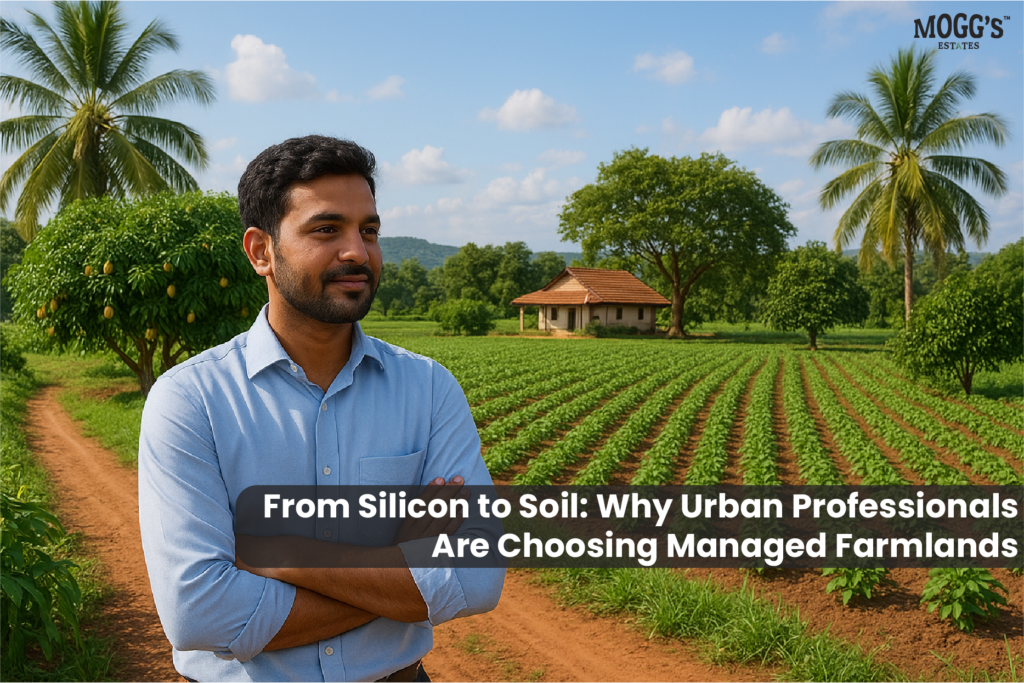
There’s a new trend reshaping the aspirations of India’s urban workforce, a silent but powerful drift from silicon to soil.
Where once the dream was a high-rise apartment with a balcony garden, today the dream is to own a piece of earth, a managed farmland, a small farmhouse, an orchard filled with mango trees, or a weekend retreat wrapped in nature.
Urban professionals, techies, entrepreneurs, NRIs, young founders, and corporate leaders are increasingly turning their attention from traditional real estate to farmland investments, mainly managed farmland near Bangalore in areas such as Kanakapura, Kunigal, Hoskote, Maddur, and Nelamangala.
But why this shift?
Why is soil suddenly more attractive than cities?
Let’s dive deep into the movement that’s transforming how India’s professionals see wealth, wellness, and the future.
1. The Lifestyle Shift: Escaping Concrete Without Leaving the City Life Behind
The past decade of fast-paced urban life has pushed people into a cycle of burnout. Work-from-home, hybrid cultures, nonstop traffic, and shrinking green spaces have made nature feel like a luxury.
Managed farmlands offer the perfect counterbalance.
Unlike raw farmland, which demands time, knowledge, and constant presence, managed farmland offers buyers the joy of owning land without the daily responsibility of farming it. Companies like Mogg’s Estates handle cultivation, soil management, crop cycles, irrigation systems, harvest planning, and security while the landowner enjoys:
- A peaceful weekend getaway
- A private farmhouse experience
- A natural environment for kids and pets
- A break from screens, noise, and pollution
It’s the new-age luxury, owning nature without abandoning city life.
2. Real Estate Fatigue: Farmland Offers What Apartments Don’t
Apartments depreciate.
Farmland appreciates.
This simple truth is driving thousands of professionals towards agricultural land.
Urban real estate has begun to show diminishing returns, saturation, and unpredictable maintenance costs. Meanwhile, farmland ROI has demonstrated stable, consistent appreciation due to:
- Scarcity of agricultural land near metro cities
- Growing demand for weekend farm living
- Innovative farming practices that generate passive income
- Rising land value in regions like Kanakapura, Maddur, and Hoskote
Companies like Mogg’s Estates offer developed farm plots with plantations, drip irrigation, farmhouses, and gated community amenities, reducing risks and increasing land value dramatically.
Professionals are discovering that soil often grows money faster than cement.
3. Passive Income Through Agriculture: The New Wealth Formula
Unlike traditional plots, which lie idle, managed farmland generates agricultural income from:
- Coconut plantations
- Mango orchards
- Timber crops
- Pepper, papaya, guava, banana, or multi-crop plantations
- Organic and naturally grown vegetables, chilli, tomato, brinjal, leafy greens
- High-value crops based on soil analysis
Farmland doesn’t just grow plants; it grows wealth.
Investors love the idea of land that:
✔ Earns
✔ Appreciates
✔ Requires no day-to-day involvement
This is why managed farmland near Bangalore is booming.
4. The Legal Comfort: No More Confusion, No More Risks
Ask any professional why they avoided farmlands earlier, and you’ll hear one word: legal.
Land titles, survey numbers, 11E sketches, conversion doubts, cultivation rights, fencing disputes- these things scared buyers away.
But companies like Mogg’s Estates changed the game.
Their projects in Kanakapura, Kunigal, Hoskote, Maddur, and Nelamangala come with:
- Clear titles
- 11E sketch
- Proper survey maps
- Legal verification
- Fully fenced farmland communities
- Gated access & security
- Road connectivity
- Water and electricity infrastructure
This legal clarity has made farmland buying as safe and straightforward as buying an apartment.
5. A Growing Wellness Trend: Nature Is Becoming Non-Negotiable
Professionals aren’t just buying farmland for ROI, they’re buying it for well-being.
Today’s workforce wants:
- Fresh air
- Green open spaces
- Organic food
- A place to disconnect
- A private space for their children to play
- A sense of grounding and community
Farmland provides that emotional reset that urban life can’t.
Places like Mogg’s Terrahill (Kunigal) and Mogg’s Nidhivanaa (Hoskote) are built not just as agricultural projects, but as lifestyle ecosystems with:
- Walking trails
- Water bodies
- Clubhouses
- Multipurpose courts
- Camping and farm retreat spots
- Weekend activities like bonfires, stargazing, farm tours, and more
This blend of nature + community is attracting families seeking something more profound than weekends at malls and restaurants.
6. Sustainability & Future Security: Owning Soil Feels Right
Professionals are now thinking long-term.
They want to invest in something that retains its value for decades.
Farmland is future-proof.
Even if markets fluctuate, even if cities change, land remains land.
Add sustainability-driven agriculture into the mix, and buyers feel they’re contributing to something meaningful, such as soil preservation, tree planting, groundwater recharge, and long-term ecological balance.
This emotional and ethical connection makes farmland investment feel like a responsible choice.
7. The NRI Factor: A Gateway to Roots
NRIs are some of the biggest buyers of farmland today. Why?
Managed farmlands allow them to own land, stay connected to India, and retain a piece of their roots, without being physically present to manage the land.
Platforms like Mogg’s Estates offer end-to-end management, regular updates, and remote monitoring, making them ideal for NRI investors seeking stable, long-term, non-volatile assets.
8. Farmland as a Weekend Destination: Not Just an Investment, an Experience
Many Bangalore professionals are turning their farm plots into:
- Cosy weekend cottages
- Airbnb-style farm stays
- Event-ready farmhouses
- Outdoor experiences for family and friends
Farm life is becoming a lifestyle hobby, like golf, trekking, or cycling.
Owning a farmhouse in Kanakapura or Nelamangala is now a status symbol, calm, exclusive, elegant, and rooted in nature.
9. Community-Living in Farmland: A Trend That’s Growing Fast
Earlier, farmland meant isolation.
Today, managed farmlands mean community living in nature.
Each project is designed like a private green town with:
- Internal roads
- Security
- Streetlights
- Water pipelines
- Plantation zones
- Common activity spaces
Urban professionals want privacy but also want a sense of belonging, and these communities deliver precisely that.
10. The Emotional Pull: Soil Makes Us Feel Human Again
Despite all our modern comforts, something inside us longs for the earth, real, living soil.
Professionals say:
- “I want my children to grow up around nature.”
- “I want to harvest fruits from my own land.”
- “I want a place where time slows down.”
- “I want to own something real.”
The decision is emotional as much as it is financial.
From silicon screens to living soil, it’s a return to what truly matters.
Final Thought: This Is Not a Trend, It’s a Movement
Urban India is shifting, growing, evolving.
And the future looks green.
Managed farmland is not just about land.
It’s about lifestyle, wellness, wealth creation, sustainability, identity, and emotional fulfilment.
Companies like Mogg’s Estates have made the dream accessible, legal, systematic, and deeply rewarding.
For anyone seeking long-term value, passive income, and a soulful escape from the rush of city life, moving from Silicon to Soil might be the most intelligent decision of 2025 and beyond.