
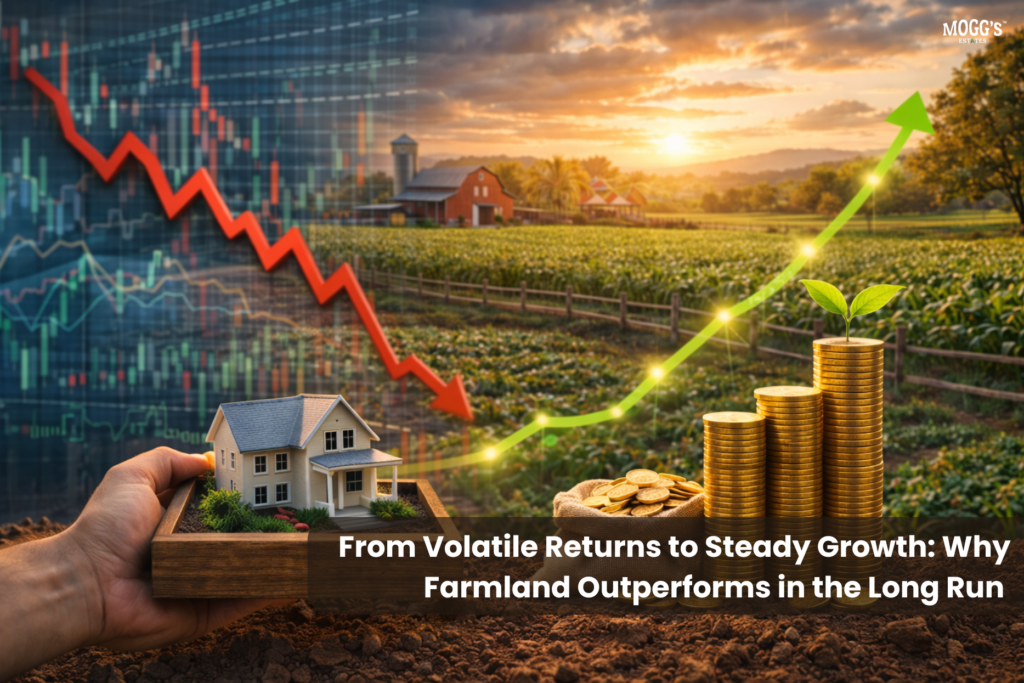
For years, investing has been equated with speed: faster trades, quicker exits, higher short-term gains. Apps refresh every second. Markets react instantly. Portfolios rise and fall before breakfast.
Yet, as more investors look back over decades rather than months, a different pattern begins to emerge. The assets that truly build wealth are rarely the loudest. They are the quiet ones.
Farmland is one such asset.
In a world dominated by volatile returns, farmland stands out for its steady, predictable growth. Especially in India, farmland has consistently outperformed many financial assets when measured over long periods, not because it moves fast, but because it moves forward.
Understanding volatility and why it exhausts investors
Volatility is often marketed as an opportunity. In reality, it is emotional pressure.
Stocks fluctuate daily. Mutual funds swing with sentiment. Even well-diversified portfolios experience sharp drawdowns during global events, interest rate changes, and periods of political uncertainty.
While long-term equity investors may eventually recover losses, the journey is rarely smooth. Many exit early, panic sell, or time the market poorly. The cost of volatility is not just financial, it is behavioral.
This is where farmland differs fundamentally.
Farmland does not react to noise.
Farmland is not priced by the minute. It does not respond to headlines or quarterly earnings. Long-term fundamentals drive its value.
People need food. The population grows. Land supply remains finite. These forces operate steadily, regardless of market sentiment.
This insulation from daily noise allows farmland to grow quietly while other assets fluctuate wildly.
Why long-term growth matters more than short-term spikes
Short-term returns look impressive in isolation. Long-term growth builds actual wealth.
Farmland may not double in a year, but it compounds over decades. Its growth is gradual, but consistent.
In India, agricultural land in well-connected regions has shown steady appreciation over long periods. Unlike assets that rise sharply and fall just as fast, farmland tends to retain gains once they are made.
This permanence is a key reason farmland outperforms in the long run.
Income and appreciation working together
One of farmland’s most significant advantages is that it does not rely on a single source of return.
Farmland generates income through agricultural produce while simultaneously appreciating.
This dual return structure creates compounding benefits. Income can be reinvested. Land value continues to rise. Over time, these layers of growth strengthen each other.
Most volatile assets depend solely on price appreciation. When markets stall, returns stop.
Farmland keeps working.
The role of managed farmland in consistent performance
Historically, farmland ownership required active involvement and expertise. This limited participation and consistency.
Managed farmland changed that.
Managed farmland allows investors to own agricultural land while professionals handle cultivation, maintenance, harvesting, and monetization. This removes operational risk and ensures consistency.
Mogg’s Estates has developed managed farmland projects focused on long-term productivity rather than speculative gains. Crop planning, soil health, and water management are designed to support steady income and long-term appreciation.
This professional approach significantly improves long-run outcomes.
Farmland vs stocks over decades
Stocks can deliver high returns, but only if investors remain invested through volatility.
Many do not.
Farmland requires no timing. There is no entry point anxiety or exit pressure. Ownership itself creates value over time.
While equities may outperform farmland in select periods, farmland often outperforms over complete economic cycles.
It avoids deep drawdowns and preserves capital during downturns.
This stability matters when building generational wealth.
Inflation and the farmland’s natural advantage
Inflation erodes purchasing power and distorts returns.
Farmland naturally adjusts to inflation. As food prices rise, farm income increases. As land becomes scarcer, its value rises.
This inflation linkage protects real returns without the need for constant rebalancing.
In contrast, volatile assets often struggle to keep pace with inflation during periods of instability.
Why farmland suits patient capital
Farmland rewards patience. It penalizes impatience.
Investors who expect instant results are disappointed. Investors who allow time to work are rewarded.
This aligns farmland with long-term financial goals such as retirement planning, legacy creation, and wealth preservation.
The longer farmland is held, the more predictable its performance becomes.
Reduced risk through real-world demand
Many modern investments are driven by perception. Brand value. Market sentiment. Future expectations.
Farmland is driven by necessity.
Food demand does not disappear during recessions. Agricultural production continues regardless of economic cycles.
This real-world demand anchors farmland value and reduces downside risk.
Emotional stability and better decision-making
One overlooked advantage of farmland is emotional stability.
Because farmland does not fluctuate daily, investors are not tempted to overreact. This improves overall financial behaviour.
Many investors find that owning farmland makes them more disciplined across their entire portfolio.
Less panic. Fewer impulsive decisions.
This behavioural benefit compounds returns indirectly.
Sustainability strengthens long-term returns.
Sustainable farming practices improve soil health, water retention, and crop productivity.
Managed farmland projects that prioritize sustainability tend to outperform over the long run because they protect the underlying asset.
Mogg’s Estates integrates sustainability into farmland development to ensure long-term productivity rather than short-term extraction.
This focus strengthens resilience and future value.
Farmland as a counterbalance to modern risk
Modern portfolios are often concentrated in digital and financial assets.
Farmland introduces a physical counterbalance. It exists independently of financial systems, technology platforms, and regulatory shifts.
This independence enhances portfolio durability.
In times of uncertainty, real, productive assets matter more.
Why Indian investors are rethinking growth
Across India, investors are moving away from chasing quick returns and towards building lasting wealth.
They are recognizing that steady growth often outperforms volatile growth over time.
Farmland fits this mindset perfectly.
It does not promise excitement. It promises endurance.
The role of Mogg’s Estates in long-term farmland investing
Mogg’s Estates enables investors to access managed farmland designed for consistent, long-term growth. Transparent ownership, professional management, and thoughtful land selection ensure that investors benefit from farmland’s natural advantages without operational complexity.
This approach aligns farmland investing with modern expectations while preserving its timeless value.
Volatility creates stories. Stability creates wealth.
Farmland may never dominate headlines, but it quietly compounds value year after year.
In the long run, the asset that grows steadily often outperforms the one that moves fast.
For investors seeking durability, inflation protection, income, and peace of mind, farmland offers a path away from volatility and towards lasting growth.
Sometimes, the most substantial returns come from assets that grow slowly.
Just like the land itself.