
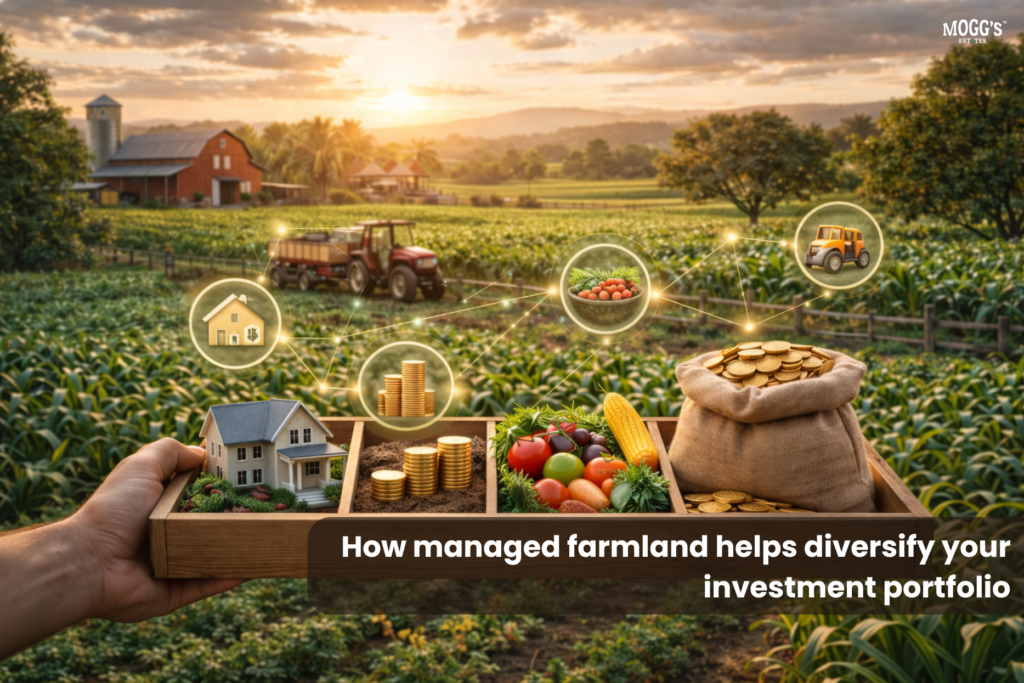
For years, diversification meant one thing. Do not put all your money in one place. Spread it across stocks, mutual funds, fixed deposits, maybe a little gold. For most Indian investors, this formula felt complete.
But as markets became more volatile and global events began affecting portfolios overnight, many investors realized something important. Their money might be spread across instruments, but it was still concentrated in one system.
That is when the idea of proper diversification began to change.
Today, diversification is not just about owning different financial products. It is about owning various kinds of assets. Digital and physical. Volatile and stable. Fast-moving and slow-growing.
This is where managed farmland enters the conversation.
What diversification really means in modern investing?
Diversification is about reducing risk, not chasing more returns. It works by ensuring that when one asset class underperforms, another holds steady or performs differently.
Most traditional portfolios in India are heavily linked to financial markets. Interest rates, inflation, and policy decisions influence stocks, mutual funds, bonds, and even fixed deposits.
When these factors shift, everything moves together.
Proper diversification requires assets that are not closely correlated with markets.
Farmland fits this role naturally.
Farmland as a non-correlated asset
Farmland does not react to stock market crashes. It does not depend on quarterly earnings or global indices. Its value is driven by food demand, land scarcity, soil quality, and long-term population trends.
This makes farmland a non-correlated asset.
When markets fluctuate, farmland remains steady. When inflation rises, farmland often benefits. When uncertainty increases, tangible assets become more important.
Adding farmland to a portfolio reduces overall volatility.
Why managed farmland matters more than traditional land ownership?
While farmland has always been valuable, traditional ownership came with challenges. Distance, lack of expertise, operational complexity, and unpredictability kept many investors away.
Managed farmland solves this problem.
Managed farmland allows investors to own agricultural land while professionals handle cultivation, maintenance, harvesting, and monetisation. This transforms farmland into a passive, long-term investment that fits modern lifestyles.
Mogg’s Estates has built and managed farmland projects specifically for investors who want diversification without operational stress. With transparent ownership models and professional farm management, managed farmland becomes accessible and reliable.
Portfolio diversification beyond numbers
Most portfolios look diversified on paper. Different funds. Different stocks. Different sectors.
But when markets fall, they often fall together.
Farmland behaves differently because it is rooted in necessity. People need food regardless of economic conditions. Agricultural output continues through cycles.
This difference in behaviour strengthens portfolio resilience.
By adding managed farmland, investors introduce stability into portfolios dominated by financial assets.
Tangible assets and risk reduction
One of the most significant risks in modern investing is overexposure to intangible assets.
Digital wealth depends on platforms, regulations, and systems. Tangible assets like farmland exist independently.
This independence reduces risk.
Land does not disappear due to software issues. Crops do not depend on market sentiment. Farmland continues to exist and produce value regardless of external noise.
This physical certainty balances digital exposure.
Income diversification through farmland
Managed farmland does not just diversify capital; it diversifies income.
While stocks may pay dividends and bonds may pay interest, farmland generates income through agricultural yields.
This income is seasonal, predictable, and inflation-linked.
For investors relying heavily on salary or market returns, farmland offers an alternative income stream not tied to employment or market cycles.
Farmland and inflation protection
Inflation affects almost every asset class.
Cash loses value. Fixed returns struggle to keep up. Even equity returns fluctuate.
Farmland offers natural inflation protection. As food prices rise, agricultural income rises. As land becomes scarcer, its value increases.
Including farmland in a portfolio protects purchasing power over time.
Managed farmland and long-term allocation strategy
Modern portfolio strategies increasingly recommend allocating a portion of wealth to alternative assets.
Managed farmland fits perfectly into this category.
It complements equities by reducing volatility. It complements gold by generating income. It complements real estate by offering lower maintenance and long-term appreciation.
Over decades, this balance improves portfolio outcomes.
Emotional diversification and investor behaviour
Diversification is not just financial. It is emotional.
Investors often make poor decisions under stress. Market volatility triggers fear and impulsive actions.
Farmland moves slowly. It does not demand daily attention. It does not provoke emotional reactions.
This calm asset stabilises investor behaviour and encourages long-term thinking.
Many investors find that owning farmland makes them less reactive with the rest of their portfolio. Sustainability and future relevance
Diversification today also means aligning investments with future relevance.
Farmland supports food security, sustainability, and rural livelihoods. As environmental concerns grow, assets that address real-world needs become increasingly important.
Mogg’s Estates focuses on sustainable, managed farmland practices that enhance soil health and long-term productivity. This ensures that diversification is not only financial but also responsible.
Farmland as a hedge against concentration risk
Many urban investors unknowingly carry concentration risk. Salaries from one industry. Investments linked to the same economy. Assets tied to similar cycles.
Farmland introduces geographic and economic diversification.
It reduces dependency on a single city, sector, or system. This becomes increasingly valuable as economies become more interconnected.
Why Indian investors are adding farmland to portfolios?
Across India, professionals, entrepreneurs, and families are reassessing how their wealth is structured.
They want stability alongside growth. Security alongside opportunity. Managed farmland offers precisely that.
It does not replace stocks or traditional investments. It strengthens them.
This is why farmland is increasingly seen as a strategic allocation rather than an alternative.
The role of Mogg’s Estates in portfolio diversification
Mogg’s Estates enables investors to add managed farmland to their portfolios with clarity and confidence. Through professionally managed projects, transparent ownership, and long-term planning, Mogg’s Estates makes farmland a practical diversification tool.
For investors seeking a balance between digital growth and tangible security, managed farmland provides a meaningful solution.
Diversification is evolving in a world where markets move fast, and systems feel fragile; owning something real matters more than ever.
Managed farmland offers stability, income, inflation protection, and long-term appreciation. It behaves differently from financial assets and strengthens portfolios from the inside.
Proper diversification is not about owning more of the same.
It is about owning what endures.
And in India, few assets endure like land.