On most weekday mornings, Rhea’s house looked like every other working parent household in Bengaluru. Alarm clocks rang early. Breakfast was rushed. Lunch boxes were packed while emails were already being checked. Her five year old son Aarav ate quickly, tablet propped up on the dining table, cartoons playing softly in the background.
Rhea noticed it one morning. Aarav was chewing without looking at his food. He did not know what was on his plate, where it came from, or why it mattered. He only knew the screen.
That moment stayed with her.
Rhea and her husband Kunal were not careless parents. They read parenting books. They limited screen time. They enrolled Aarav in weekend activities. Yet something felt missing. Their child was growing up fast, but disconnected from the basics of life. Food arrived through delivery apps. Vegetables came wrapped in plastic. Milk came in packets. Everything essential was invisible.
They were raising a child in a digital world, but forgetting to anchor him to the real one.
The question that changed everything
One Sunday afternoon, while cleaning the fridge, Aarav asked a simple question.
“Where do tomatoes come from?”
Rhea paused. She almost said the shop. Then she stopped herself.
That was when she realized how far removed their life had become from the source of what sustained them. For a family that cared deeply about values, sustainability, and conscious living, this gap felt uncomfortable.
They did not want their child to grow up thinking food was just another product. They wanted him to understand effort, seasons, patience, and care. They wanted him to know soil.
That was the beginning of a different kind of thinking. Not just about parenting, but about how they invested their money.
Conscious parenting goes beyond screen limits
Conscious parenting is often discussed in terms of emotional regulation, communication, and digital boundaries. But there is another layer that is rarely talked about. Environment shapes values.
Children learn responsibility not through lectures, but through exposure. When everything in life is instant and invisible, patience disappears. When outcomes are detached from effort, entitlement creeps in.
Rhea and Kunal began looking for ways to ground their child. They wanted weekends that were slower. Spaces where Aarav could touch, observe, and participate. Places where learning happened naturally.
They did not want a hobby farm fantasy. They wanted something sustainable, real, and long term.
That search led them to farmland.
Why farmland felt different
At first, farmland ownership was not about investment returns. It was about intention.
They visited a managed farmland project near Bengaluru through Mogg’s Estates. The moment Aarav stepped onto the land, something shifted. He ran freely. He touched the leaves. He watched workers tend to plants. He asked questions. Real questions.
Why is the soil wet here? Why does this tree need space? Why do plants grow slowly?
For the first time, learning was not forced.
Rhea realized that farmland offered something no activity class could. It offered context. It connected effort to outcome. Time to reward. Nature to nourishment.
This was conscious parenting in practice.
The investment they did not explain to everyone
When Rhea and Kunal decided to invest in managed farmland through Mogg’s Estates, they did not announce it widely. Friends asked why they were not buying another apartment or increasing their stock portfolio.
They did not feel the need to justify it.
They were investing in an asset that served two purposes. Financial stability and experiential value for their child.
Managed farmland made the decision practical. Professional teams handled plantation, maintenance, and operations. The land generated agricultural income. Over time, it would appreciate in value.
But for Rhea, the true return showed up every weekend.
Farm visits replaced screen time
Slowly, farm visits became a ritual. Aarav learned to recognize crops. He learned seasons. He learned that food takes time. He learned respect for labor.
Screen time reduced naturally. Not because it was restricted, but because something else was more interesting.
This is what conscious parenting looks like when values are embedded into lifestyle choices. Children mirror what they experience, not what they are told.
Value beyond financial returns
Farmland investment in India is often discussed in terms of appreciation and passive income. Those matter. But for families like Rhea’s, there is another dimension.
Farmland becomes an educational environment. A grounding space. A reminder that wealth is not only measured in money.
In a world where children grow up measuring success in likes and numbers, farmland teaches them process, patience, and responsibility.
This is value beyond returns.
Why more parents are thinking this way
Across urban India, working parents are facing the same dilemma. High exposure to screens. Low exposure to nature. High stimulation. Low grounding.
At the same time, parents are rethinking how they invest. Volatile markets create anxiety. Traditional real estate feels saturated. Gold feels passive.
Managed farmland offers an alternative that aligns with conscious living.
It is tangible. It is productive. It is real.
Farmland as a long term family asset
From an investment perspective, farmland offers stability. Agricultural land in India has historically appreciated over time. Food demand grows with population. Land supply does not.
Managed farmland simplifies ownership for urban investors. Through structured projects like those offered by Mogg’s Estates, families can own farmland without dealing with operational complexity.
From a parenting perspective, farmland becomes a shared asset. Children grow up seeing it. Understanding it. Respecting it.
This builds a relationship with wealth that is healthy.
Teaching money without teaching greed
One of the biggest challenges modern parents face is teaching children about money without creating obsession.
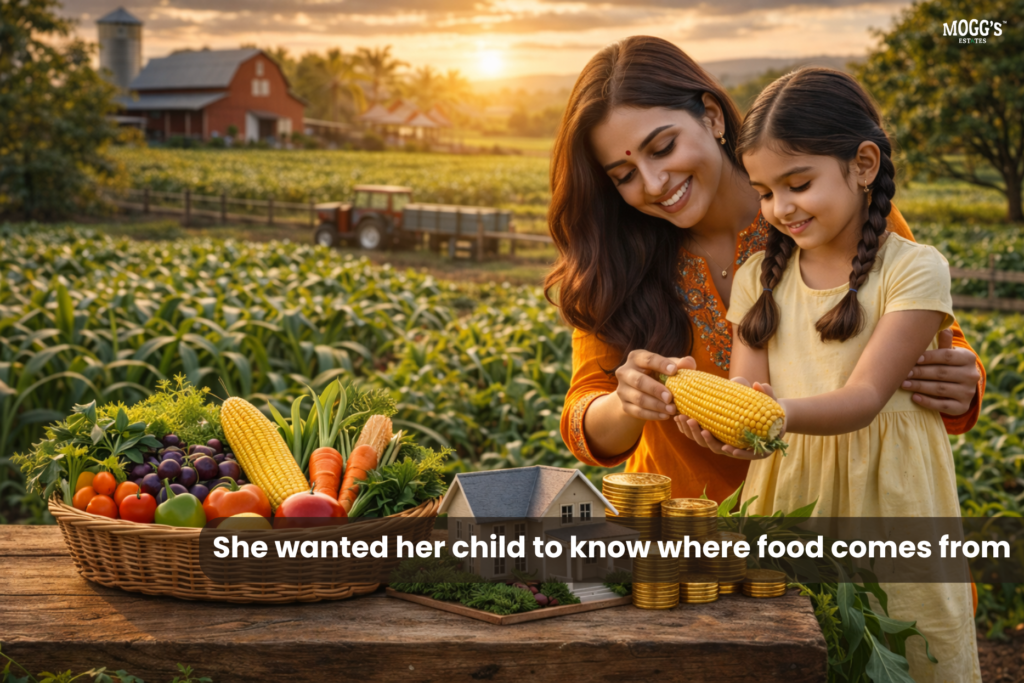
Farmland helps bridge that gap. It shows children that money can create something useful. Something nourishing. Something sustainable.
Aarav learned that land needs care. That income comes after effort. That growth is slow but reliable.
These are lessons no classroom teaches.
Why this matters in India today
India is urbanizing rapidly. Children are growing up in apartments, disconnected from agriculture, even though farming remains the backbone of the country.
Conscious parenting in India today means reconnecting children to roots while preparing them for the future.
Farmland ownership allows families to do both.
It offers a hedge against market volatility. It supports sustainable agriculture. It creates real world learning experiences.
The role of Mogg’s Estates
Mogg’s Estates plays a crucial role in making this possible. By offering managed farmland projects designed for long term value, they allow families to participate without operational stress.
Their approach combines professional farm management, transparent ownership, and sustainability focused planning.
For families like Rhea’s, this model makes farmland ownership practical and meaningful.
A different definition of success
Years from now, Rhea does not know what profession Aarav will choose. But she knows something important.
He will know where food comes from. He will understand patience. He will respect effort.
And somewhere in his memory, there will be soil under his feet.
Conscious parenting is not about perfection. It is about alignment.
When investments reflect values, children absorb lessons without words.
Farmland is not just an asset class. It is a classroom. A grounding force. A long term decision that shapes both wealth and worldview.
In a fast moving digital economy, raising grounded children may be one of the most valuable investments a family can make.
And sometimes, the best way to teach the future is to plant it in soil.