For decades, investors have searched for the best long-term investment in India. Something that does not panic during downturns, does not vanish during crashes, and does not depend on perfect timing. Markets rise and fall. Headlines change every year. But one asset has quietly survived every economic cycle, every policy shift, and every global disruption. Farmland.
From the Harshad Mehta crash to the dot-com bubble, from the 2008 financial crisis to the pandemic-era volatility, farmland has remained steady. Not flashy. Not loud. Just reliable.
In a world driven by screens, charts, and short-term returns, farmland stands apart as a tangible asset that retains value across generations.
What Every Market Crash Has Taught Indian Investors
Every major market crash teaches the same lesson. Paper wealth can disappear faster than it is created.
Stock markets are essential for growth, but they are also emotional. Fear spreads quickly. Liquidity dries up. Valuations collapse overnight. Even fundamentally substantial investments go through long periods of uncertainty.
Gold performs better during crises, but it remains idle. It does not generate income. It only protects value. Real estate in cities has experienced cycles of boom and stagnation, often driven by regulation, oversupply, and debt.
Through all of this, agricultural land has remained resilient. Not because it reacts to markets, but because it serves a purpose beyond investment.
Food demand does not stop during recessions. Land does not become irrelevant during crashes. Soil continues to produce. Ownership continues to matter.
Why Farmland Behaves Differently From Other Assets
Farmland is not driven by sentiment. Fundamentals drive it. India will always need food. The population continues to grow. Urbanization reduces cultivable land. These realities create long-term pressure on agricultural land values.
Unlike stocks, farmland is not marked to market every day. There is no daily price tick to trigger panic. Unlike gold, it is productive. It generates crops, income, and value simultaneously.
Farmland appreciation in India has historically been steady rather than explosive. That stability is precisely why it survives crashes.
It does not depend on quarterly results, interest rate decisions, or global fund flows. It depends on land scarcity, water access, soil quality, and location. These factors do not collapse overnight.
A Look Back at Farmland Through Indian Economic Cycles
During the 2008 global financial crisis, equity markets wiped out years of gains in a matter of months. Real estate in many cities froze. But agricultural land transactions continued.
During the pandemic, when markets crashed and uncertainty peaked, farmland prices did not fall sharply. In many regions, they remained flat or appreciated slowly.
Why? Because landowners do not sell farmland in panic. It is rarely leveraged. It is often held debt-free. It is seen as security, not speculation. This behavior alone makes farmland one of the most substantial long-term investments in India.
The Emotional Value of Land in Indian Households
In India, land has always meant more than money. It represents stability. It represents roots. It represents something tangible that can be passed on.
Parents understand land. Grandparents’ trust land. Even today, when families discuss wealth, land is spoken about with respect.
This cultural trust matters. Assets that are emotionally trusted are not sold easily. They are held patiently. Patience is what protects farmland during market crashes.
Managed Farmland and the Modern Investor
Earlier, farmland ownership required direct involvement. Farming knowledge, local presence, and operational effort were necessary. Today, managed farmland has changed that equation.
Managed farmland allows urban investors to own agricultural land while professionals handle planting, maintenance, and farm operations. This structure turns farmland into a passive, long-term asset.
Companies like Mogg’s Estates focus on making farmland investment accessible, transparent, and professionally managed. Investors benefit from land ownership without operational stress.
This evolution is bringing farmland into modern portfolios.
Why Smart Money Looks at Farmland During Volatile Times
When markets become unpredictable, experienced investors shift focus from returns to resilience.
They ask different questions. Will this asset survive the next downturn? Will it hold value even if growth slows? Will it still matter twenty years from now?
Farmland answers these questions confidently.
It is not correlated strongly with stock markets. It benefits from inflation. It produces income through agriculture. It appreciates over time due to land scarcity.
This combination is rare.
Farmland vs Stocks During Long-Term Cycles
Stocks can create wealth quickly, but they require discipline, emotional control, and timing. Many investors enter at peaks and exit during crashes.
Farmland does not require timing. It requires patience.
Over decades, farmland appreciation may appear slower on paper, but it compounds quietly. It does not wipe out value in one bad year. It does not depend on perfect exits. This makes farmland ideal for investors who want stability alongside growth.
Why Farmland Fits the Definition of Best Long-Term Investment in India
The best long-term investment is not the one with the highest short-term returns. It is the one that stays relevant across generations.
Farmland checks critical boxes:
- It is tangible
- It is productive
- It is limited in supply
- It benefits from population growth
- It survives inflation
- It holds cultural trust
Few assets meet all these conditions simultaneously.
Farmland as a Portfolio Stabilizer
Modern portfolios often suffer from overexposure to volatile assets. When everything is digital, everything reacts together.
Farmland acts as a stabilizer. It reduces portfolio volatility. It offers diversification away from financial markets.
This is why high-net-worth individuals and family offices quietly allocate capital to land. They are not chasing headlines. They are building foundations.
Mogg’s Estates and the Long View of Wealth
Mogg’s Estates focuses on farmland projects designed to create long-term value. The emphasis is not on speculation, but on sustainability, land quality, and professional management.
For investors who want farmland exposure without operational involvement, managed farmland through Mogg’s Estates offers a structured path. The goal is not fast exits. The goal is enduring value.
The Asset That Outlives Trends
Trends change every decade—technology shifts. Markets evolve. New asset classes appear. Land remains.
Farmland does not become obsolete. It does not depend on consumer behaviour. It does not require reinvention.
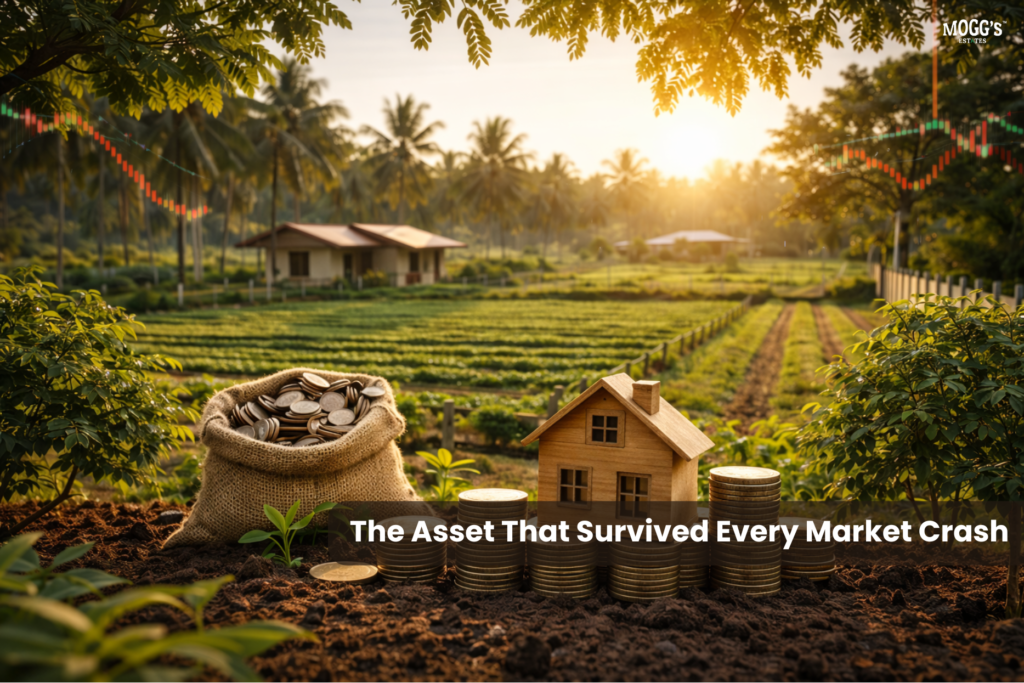
As long as people eat, farmland matters. That simple truth is why farmland has survived every market crash in history. In times of uncertainty, the smartest investors do not look for excitement. They look for endurance.
Farmland has proven, across decades, that it can withstand crashes, protect wealth, and quietly grow value.
For anyone seeking the best long-term investment in India, farmland deserves serious consideration, not as an alternative asset, but as a foundational one.
Markets will continue to rise and fall. Headlines will keep changing. Land will still be there. And that is its greatest strength.