
Nisha and Kunal never planned on raising their child differently. Like most working parents in the city, they believed they would figure it out as they went. Both worked long hours in Bengaluru. Mornings were rushed. Evenings were tiring. Weekends were meant for recovery.
Their son Aarav was born into this rhythm.
At first, everything felt manageable. Short walks. Picture books. Soft toys. But as Aarav grew older, screens slowly entered the picture. A cartoon while feeding. A phone during car rides. A tablet during busy calls. It was convenient. It kept him quiet. It bought them time.
By the time Aarav turned five, screens were no longer occasional. They were routine.
He knew cartoon characters better than trees. He could swipe before he could tie his shoes. When asked where food came from, he said the supermarket.
That answer stayed with Nisha. It was not guilt. It was discomfort.
They were not bad parents. They read articles. They limited screen time when they could. They enrolled Aarav in weekend classes. But everything still happened indoors. Controlled. Artificial.
One Friday evening, exhausted after a long week, they accepted an invitation from friends to visit a managed farmland project outside the city. It was meant to be a break. A drive. Fresh air.
They did not expect it to change anything.
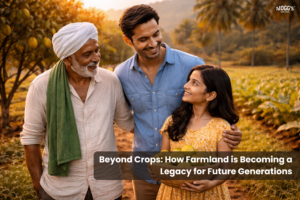
The moment they stepped out of the car, Aarav ran ahead. Not toward a play area. Not toward a screen. Just toward open land. He touched the soil. Asked questions. Why is this brown? Why is that green? What is growing here?
No one handed him instructions. No one rushed him. He was curious in a way they had not seen before.
That day, Aarav watched farmers work. He picked fallen leaves. He followed ants. He asked where vegetables come from and got honest answers. He was tired by evening, but it was the good kind of tired.
That night, he slept without asking for a screen. That weekend turned into another. Then another.
Slowly, farm visits replaced mall visits. Outdoor walks replaced indoor play zones. Aarav began recognizing plants. He understood seasons. He learned patience by watching things grow.
Nisha and Kunal began to notice something else. They felt calmer, too.
The farm became their pause button. A place where time slowed down. Where conversations happened naturally. Where parenting felt less forced.
That is when they started thinking beyond weekends.
They learned more about family farmland investment and managed farmland ownership. They understood that owning farmland did not mean quitting jobs or becoming farmers. It meant owning land that was professionally handled while offering long-term value.
For them, the investment decision was not driven by returns alone. It was driven by intention.
They invested in managed farmland with Mogg’s Estates. What changed was not just their portfolio. It was their lifestyle.
Aarav grew up knowing where food comes from. He knew that carrots grow under the soil. Those fruits take time. That’s not to say everything is instant.
He spent weekends learning through observation, not instruction.
This is what conscious parenting often looks like. Not perfection. Just better choices repeated over time.
In a world where children grow up on screens, eco childhood in India is becoming rare. Parents are constantly fighting attention battles. Screens are everywhere. Convenience is tempting.
But land offers something screens cannot. Perspective.
Children who spend time around farmland develop patience. They understand cycles. They learn responsibility without pressure. They see effort turn into outcome.
These are lessons no app can teach.
For Nisha and Kunal, the farmland also became a financial anchor. While markets fluctuated and expenses grew, their land remained steady. It appreciated quietly. It produced agricultural value. It did not demand daily involvement.
This is the overlooked side of farmland investment, the value beyond financial returns.
Family farmland investment is not just about diversification. It is about aligning money with values. It is about choosing assets that reflect the life you want your child to grow up seeing.
Mogg’s Estates understands this deeply.
Their managed farmland projects are designed not just as investment products but as ecosystems. Soil health. Water management. Plantation planning. Long-term sustainability. Everything is built for time, not speed.
This allows families to own land without operational stress while staying connected to it emotionally.
For Aarav, the farm became normal. He did not see it as a getaway. He saw it as a place where life made sense.
He knew that food does not magically appear. That growth takes patience. That nature rewards care. These are subtle lessons, but they compound over time, just like land.
As Aarav grew older, his screen time reduced naturally, not because of strict rules but because he had alternatives. Real alternatives.
This is where many parents struggle. They try to remove screens without replacing them with meaningful experiences.
Land offers that replacement. It provides open space. Curiosity. Learning without a curriculum.
In conversations around the best investments in India, we often talk about numbers. Returns. Appreciation. Yield.
But some investments quietly shape who we become. Farmland is one of them.
For working parents, it offers balance. For children, it provides grounding. For families, it gives a legacy.
Years later, when Nisha and Kunal look back, they do not talk about entry price or market timing. They talk about weekends. Conversations. Dirt under fingernails. Questions asked and answered honestly.
Their farmland grew in value. But more importantly, their child grew with values. This is what conscious wealth looks like.
Choosing assets that do not just grow money but grow people. In a fast-paced urban world, owning farmland is not about escape. It is about connection.
Connection to food. To time. To what matters. If you are a parent thinking about the future, ask yourself what kind of childhood you are investing in.
At Mogg’s Estates, we believe farmland is more than an asset. It is an environment. One that shapes families quietly, year after year.
Because some returns cannot be measured in percentages, they show up in how a child understands the world.
And that might be the most substantial investment of all.