Riya was seven years old when her parents realized she could swipe before she could truly run. Her mornings began with cartoons. Her evenings ended with games. Her meals happened between notifications. Silence made her restless. Waiting made her uncomfortable. Dirt made her panic. Her world was made of glass screens and glowing colors.
Her parents noticed it slowly. The way she stopped noticing birds. The way she asked questions was only when her videos buffered. The way she thought milk came from packets and trees existed mainly as wallpaper on phones. They were not careless parents. They were just busy ones. Both worked in the city. Both chased stability the way most young parents do through salaries, schedules and strength that rarely had time to rest.
Weekends became the only promise they made to themselves. Family lunches. Short trips. Malls. Soft play zones. Yet even there, Riya’s world stayed on her screen. The outside world just became the background.
One evening, while scrolling through work emails, her father paused on an article about managed farmland near Bengaluru. It was not an investment article at first. It was about families spending weekends on farms. Children learning where food comes from. Parents are slowing down without trying. The seed of the idea entered quietly.
They did not tell anyone. They visited the land just once at first. Without Riya. Without plans. Without expectations.
It was simple. Open. Alive. The kind of place that did not demand attention but invited it gently. They walked through trees they did not recognize. They touched soil that felt cooler than the city pavements. They spoke to people who did not check their phones while speaking. On the drive back, they did not talk about returns. They talked about Riya.
Two months later, they took her along.
At first, she complained. There was no network inside certain parts of the farm. She could not load her videos. Her fingers kept refreshing her screen reflexively. When the internet returned, she found no interest in it. Something else had taken her attention.
A butterfly landed on her shoe. A real one. Not animated. A dog ran past her, chasing nothing. A woman watered plants slowly, as if in no hurry at all. Riya followed her parents without knowing why. She asked strange questions that night. Why does the sky look bigger here? Why are there so many stars? Why does the air smell different?
Her parents did not answer everything. They just listened.
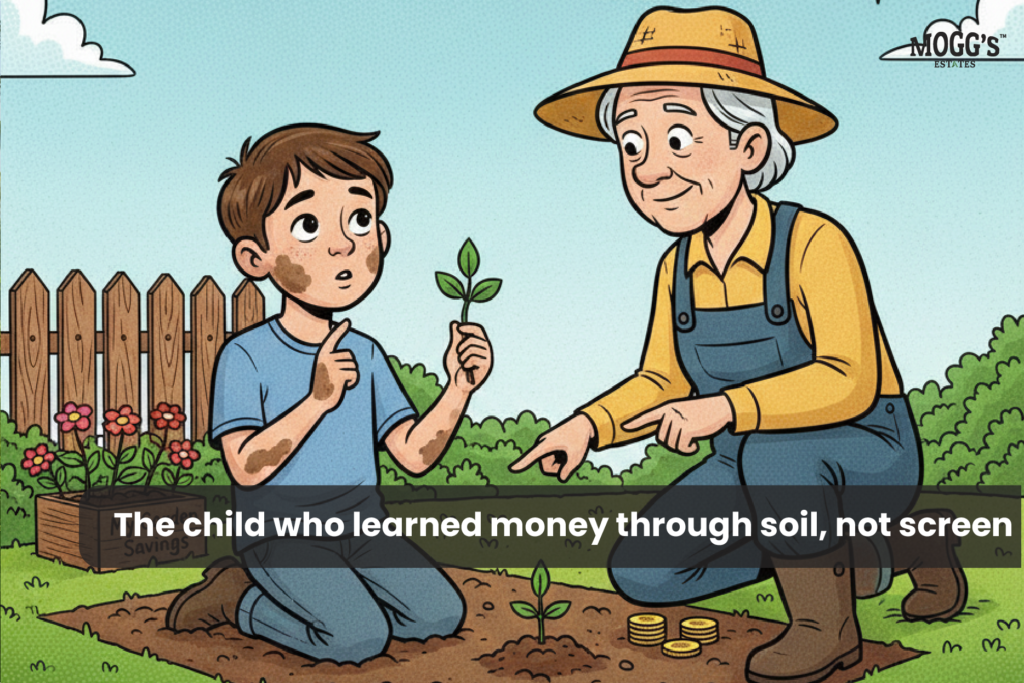
The second visit was different. Riya carried a small bag with muddy shoes inside it. She planted a seed with her own hands. She named the tree after herself. She asked when it would grow. Her father said slowly. She waited the entire weekend for something that could not be rushed.
That was the first time she learned patience without someone teaching it to her.
Weeks passed. Then months. The farm became their quiet ritual. No grand plans. No forced learning. Just land doing what land does. Holding. Healing. Growing.
Riya slowly stopped asking for her tablet right after reaching. She began asking where the dog was and if the tree had grown. Suppose the soil were wet after last night’s rain. She learned that carrots lived underground. That water did not belong to taps alone. That mud washed off. That bugs were allowed to exist without being deleted.
At school, while her classmates argued over the newest games, she spoke about worms and compost. Teachers smiled. Parents listened.
Her parents noticed a difference that charts could not measure. She slept more deeply. She ate better. She asked better questions. Her patience grew in places screens had never touched.
This was when the shift in their own thinking began.
They had initially looked at farmland as a weekend escape. Then, as an emotional decision for their child. Much later, they came to see it as an asset. But not in the traditional way they had been taught to view wealth.
Their parents’ generation trusted gold. Their own generation chased apartments. Their daughter’s generation was shaping inside a world where everything was virtual. Farmland was physical. It demanded presence. It rewarded patience.
They began to learn about managed farmland as a real investment class. They understood how land appreciates, how food security shapes future economies, how water access would become more valuable than parking spaces, and how returns from land are not always loud but are often inevitable.
More importantly, they understood something deeper. Their money was no longer moving only to beat inflation. It was moving to shape a childhood.
At Mogg’s Estates, they found language for what they were feeling. Managed farmland that balances emotion and economics. Ecosystems that are protected, not exploited, spaces where families do not just invest but reconnect. Projects like Mogg’s Terra Hill are built around this belief. That land is not a product. It is a living financial system.
Riya never heard words like asset allocation or land appreciation. But she learned something far more powerful. That value is slow. That growth cannot be refreshed. That money can live in places that breathe.
When her friends spoke about vacations, she talked about trees. When they spoke about games, she spoke about seeds. When they asked what her father did for work, she said he worked in the city and on the farm. The farm had become part of his identity, too.
Years later, when Riya turned ten, she sold vegetables she helped grow at a small community market inside the farmland. The money she earned was not much. But the lesson was enormous. She learned that money is born from patience. From cycles. From things you care for before they care for you.
Her parents did not celebrate the amount. They celebrated the understanding.
Urban parents often worry about screen addiction, attention spans and emotional disconnect. They install rules. They download apps. They negotiate screen time. But rarely do they change the environment that shapes the child.
This is why family farmland investments are quietly becoming the new form of conscious parenting in India. Not everyone will become a farmer. But every child who touches land becomes grounded.
Eco childhood is not about removing technology. It is about balancing it with something older than electricity. Soil teaches weight. Wind teaches direction. Rain teaches rhythm. None of these lessons arrives through a screen.
From a pure investment perspective, farmland stands strong even without the emotion. It offers tangible ownership. It resists volatility. It holds value through cycles that markets cannot predict. With managed farmland, the burden of maintenance is removed while the benefits remain. Plantation, irrigation, security, and long-term care are handled professionally. This makes farmland accessible even to urban families who cannot physically tend to land.
But when farmland becomes part of a child’s life, it becomes more than an appreciating asset. It becomes a shaping ground.
Riya’s parents did not plan this transformation. They did not set out to change her relationship with money, nature, or herself. They simply chose a different weekend once. That choice became a pattern. That pattern became a philosophy.
Today, Riya still uses screens. She still enjoys games. She still watches cartoons. But she also knows what it means to wait. She knows what effort looks like without reward at first. She knows that some of the most essential things grow unseen.
When asked what she wants to become when she grows up, she no longer answers quickly. She says she wants to do something that helps things grow. Her parents do not interrupt her.
They have already seen what soil can do.
Farmland will continue to be seen as an investment option for returns. And rightly so. But for some families, it will begin as something far quieter. A weekend plan. A child’s breath. A different kind of wealth.
In a world where children learn how to earn through screens and parents learn how to save through numbers, farmland teaches a lesson no curriculum can contain. That money starts where effort begins. That life does not refresh. That value grows when it is not rushed.
At Mogg’s Estates, families are not just buying plots. They are buying time outdoors. They are buying breaths between notifications. They purchase an inheritance that cannot be lost to a software update.
The child who learned about money from the soil will always respect what screens can never teach.
If you are a parent thinking about long-term security, not just in numbers but in values, managed farmland offers a rare intersection of both. Your wealth grows silently. Your child grows visibly.
And one day, when your child understands patience before profit, roots before returns and value beyond display, you will realize your smartest investment was not only in land. It was in the kind of human your child became.