On most weekdays, Arjun’s world was made of glass walls and glowing screens. His office overlooked the endless skyline of Bangalore, where cranes competed with clouds, and traffic lights dictated the rhythm of life. He tracked stock charts before breakfast, answered calls between meetings, and checked property portals during coffee breaks. Like many city investors, he believed wealth was built in towers, apartments, commercial spaces, and fast-moving markets.
Land, to him, was something rural. Something distant. Something old-fashioned.
That changed on a quiet Saturday morning.
A colleague had invited him to visit a managed farmland project developed by Mogg’s Estates. Arjun agreed casually, expecting a long drive and a polite tour. He did not expect this visit to reshape his view of investment completely.
The First Step onto the Soil
The road gradually left behind traffic noise and concrete flyovers. The air felt cleaner. The horizon opened up. When Arjun finally stepped onto the farmland, he noticed something unusual: silence. Not emptiness, but peaceful silence.
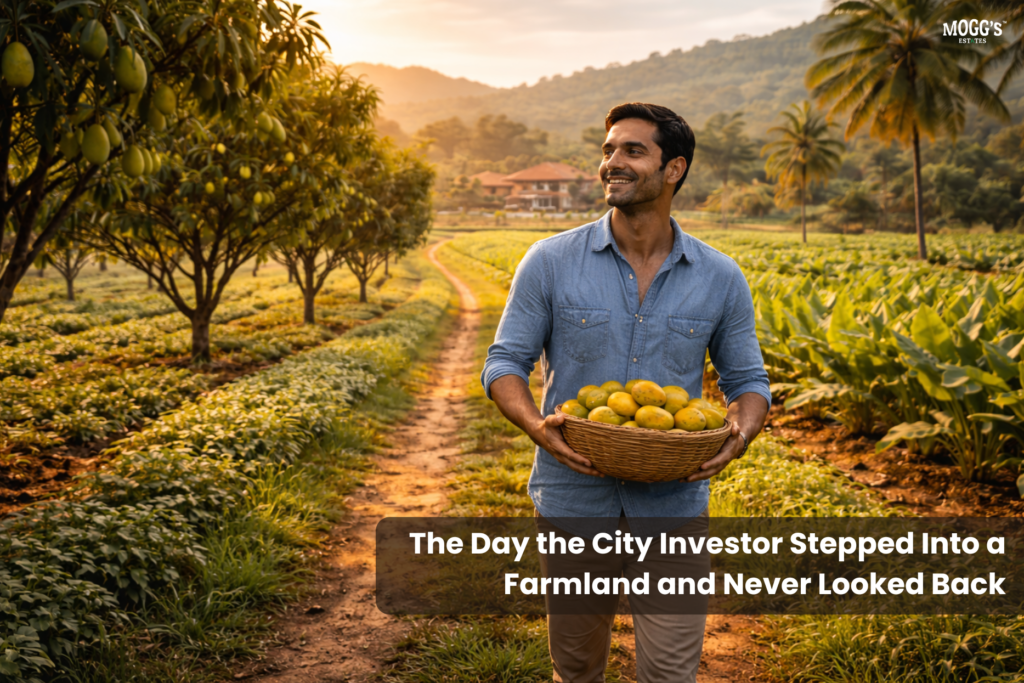
Rows of mango and coconut trees stretched neatly across the landscape. Drip irrigation lines were laid with precision. Farm managers moved confidently between plots. It did not look like a random agricultural field. It looked organized. Planned. Professional.
This was not traditional farming. This was premium managed farmland near Bangalore.
For years, Arjun had heard about farmland investment, but he dismissed it as complicated. Legal risks. Water issues. Labor problems. Crop failures. Too much uncertainty.
But here, he learned what managed farmland truly meant.
What Managed Farmland Really Is
Managed farmland is not just buying a piece of agricultural land. It is structured ownership combined with professional farm management. Investors own the land, while experienced teams handle cultivation, irrigation, crop selection, maintenance, and harvesting.
For a city investor like Arjun, this model solved the biggest problem: time.
He did not need to become a farmer. He did not need to supervise workers or study soil science. The farmland was maintained systematically, with crop planning based on long-term yield potential. Legal documentation was transparent. Infrastructure was already in place.
It felt less like a gamble and more like a strategy.
And as he walked deeper into the orchard, something shifted inside him.
Beyond Stocks and Apartments
Arjun had invested in stocks for years. He had also purchased an apartment near the IT corridor. The apartment brought rental income, but also maintenance fees, association issues, and constant market fluctuations. The stock market brought returns and stress.
Farmland felt different.
It was tangible. Finite. Rooted in something essential, food.
The project team explained how farmland near Bangalore was becoming increasingly attractive. With rapid urban expansion, agricultural land close to the city was limited. Demand for sustainable investments was rising. People were looking for diversification beyond stocks and traditional real estate.
Managed farmland had quietly emerged as a third asset category, one combining land appreciation, agricultural income, and lifestyle value.
Arjun listened carefully. For the first time, he wasn’t thinking about short-term gains. He was thinking about stability.
The Turning Point
The defining moment came unexpectedly.
The farm manager invited Arjun to hold a handful of soil. It was dark, moist, and rich. “Healthy soil,” he said, “is long-term wealth. It supports generations.”
That sentence stayed with him.
In the city, value was measured in square feet. Here, value was measured in seasons.
The team explained how premium managed farmland projects focus on water management systems, crop selection based on soil studies, and sustainable farming practices. Long-term crops such as mango, coconut, and chikku are selected for consistent yields and market demand.
Unlike speculative land parcels, these were organized farmland communities. Clear boundaries. Defined plots. Professional oversight.
For someone searching for the best farmland near Bangalore, these factors mattered more than flashy marketing.
Understanding Premium Managed Farmland
Not all farmland investments are equal.
Premium managed farmland typically includes:
- Verified legal documentation
- Irrigation infrastructure
- Professional farm management
- Long-term crop planning
- Sustainable agricultural practices
- Community-level development
- Ongoing maintenance support
Without these elements, farmland can be risky. With them, it becomes strategic.
Arjun realized that many people hesitate because they do not understand how managed farmland works. They imagine isolated land parcels requiring constant attention. But the model he saw was structured, transparent, and scalable.
This was farmland designed for modern investors.
The Emotional Return
That afternoon, Arjun sat under a mango tree. The wind moved gently through the leaves. He imagined bringing his parents here. He imagined his children running across open space instead of playing indoors.
Farmland was not just an asset. It was an experience.
City life had conditioned him to measure everything in numbers. But here, there was another type of return, peace of mind.
Weekend visits could become family rituals. Children could learn about agriculture and sustainability. Parents could reconnect with their roots.
Managed farmland near Bangalore offered proximity without isolation. Close enough for weekend drives. Far enough to feel like a retreat.
The Financial Perspective
Emotion alone does not drive investment decisions. Arjun wanted data.
The team explained how farmland appreciation near expanding cities has historically been strong due to limited supply. As Bangalore continues to grow, peripheral agricultural zones gain strategic importance.
Agricultural income from fruit-bearing trees can add another layer of returns. Over time, as orchards mature, yields stabilize and increase. While returns are not instant, they are consistent when managed professionally.
Unlike apartments that depreciate, well-maintained farmland appreciates with care. Soil fertility strengthens. As trees mature, their productivity increases.
And most importantly, land is finite.
Managed farmland adds diversification to a portfolio. It reduces dependency on volatile markets. It balances urban real estate exposure.
For Arjun, it made financial sense.
Sustainability as Strategy
Today’s investors think beyond profit. They consider sustainability, environmental responsibility, and long-term impact.
Premium managed farmland integrates water-efficient irrigation, soil conservation practices, and eco-friendly cultivation methods. This ensures that the land remains productive for decades.
Farmland near Bangalore benefits from access to urban markets. Fresh produce has ready demand. Reduced transportation distances support both profitability and environmental goals.
Mogg’s Estates focuses on structured development, ensuring that farmland ownership is organized rather than fragmented. This professional approach reassured Arjun that he was not entering an uncertain space.
The Decision
Investment decisions rarely feel dramatic. There are no background soundtracks. No applause.
But for Arjun, signing the agreement felt significant.
He was not just purchasing land. He was choosing a different philosophy of wealth.
A few weeks later, he returned to the farmland early in the morning. The sun rose slowly over the orchard. Dewdrops glistened on leaves. The air felt calm.
He walked through his plot, knowing that the trees planted today would bear fruit in the coming years. Not just mangoes, but financial returns. Not just profits, but memories.
That was the day the city investor stepped into a farmland and never looked back.
Why More Investors Are Following
Arjun’s story is not unique. Increasingly, urban investors are exploring managed farmland as a serious asset class.
They are asking:
- How does managed farmland work?
- Is farmland near Bangalore a good investment?
- What makes premium managed farmland different?
- Which is the best farmland near Bangalore?
The answers lie in structure, transparency, and professional management.
Managed farmland offers:
- Portfolio diversification
- Tangible land ownership
- Agricultural income potential
- Long-term land appreciation
- Lifestyle and legacy value
It bridges the gap between rural roots and urban ambition.
Looking Ahead
Years from now, when Bangalore’s skyline grows taller and denser, Arjun knows he will still have something grounded. Something steady.
Land does not flash like stock tickers. It does not demand constant monitoring. It grows quietly. It appreciates patience.
And perhaps that is its greatest strength.
For investors seeking stability in an unpredictable world, premium managed farmland near Bangalore offers a compelling opportunity. With trusted developers like Mogg’s Estates providing structured solutions, farmland ownership is no longer complex or intimidating.
It is accessible. It is organized. It is strategic.
And sometimes, all it takes is one visit. One walk through green orchards. One handful of soil.
That is how the journey begins.
The day you step onto farmland might be the day you redefine wealth forever.