
When the land was bought, no one celebrated.
There was no ceremony, no announcement, no family discussion that lasted beyond a few minutes. It happened quietly, the way many vital decisions do. A signature. A payment. A simple conversation between a husband and wife who had lived long enough to understand time.
Raghav Rao had spent his life working in a government department. His wife, Shanta, had managed the household, stretched budgets and raised two children who grew up quickly and moved on. By the time retirement came, their children were already settled in cities, busy with careers, EMIs and young families of their own.
Raghav did not believe in loud investments. He had seen enough cycles to know that what shines today does not always hold value tomorrow.
One afternoon, during a visit to a farmland development outside the city, he made a decision that surprised even his wife.
He bought land. Not for himself. Not for income. Not even with a clear plan. Just land.
When their son asked why, Raghav said something simple. This will outlast all of us.
At the time, it sounded philosophical. Almost impractical.
Their son and daughter had other priorities. School fees. Home loans. Career growth. They appreciated the gesture but did not think much of it. The land was distant. Abstract. Something for later.
Years passed.
The children grew older. Careers peaked and plateaued. Responsibilities multiplied. Life became faster and heavier. The land remained untouched, professionally managed, quietly growing.
Raghav passed away first. Shanta followed a few years later. The land was mentioned briefly in the paperwork. That is when its meaning changed.
What had once felt like an unnecessary purchase now stood as the only asset untouched by time, markets or emotional decisions. No disputes. No depreciation. No urgency.
Just ownership. The grandchildren were the ones who grew into it.
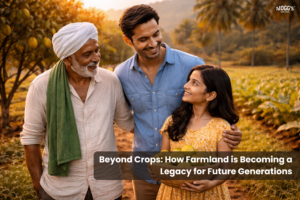
They visited the land during the holidays. At first, reluctantly. Then with curiosity. Then with pride. They learned that this piece of earth belonged to them. That it had been chosen for them long before they were born.
This is how intergenerational wealth often works. Not through grand gestures. Through foresight.
In India, we often talk about inheritance as something passed directly from parent to child. Homes. Jewellery. Savings. But the most substantial legacy investments usually skip one generation entirely.
Because the middle generation is usually too close to consumption, they build lives. They spend. They upgrade. They respond to pressure.
The generation before them thinks in decades. The generation after them benefits from that patience.
This is why farmland legacy investment has quietly survived centuries.
Land does not age the way buildings do. It does not follow fashion. It does not demand reinvention. It simply exists and grows in relevance as the population increases and resources become scarce.
Raghav understood this intuitively.
He had seen houses renovated and demolished. Gold sold and repurchased. Money moved and was forgotten. Land stayed.
Today, discussions around generational wealth in India are changing. Families are realising that legacy is not about passing assets that require management, maintenance and constant decision making.
It is about passing assets that give future generations a choice. The grandchildren did not feel burdened by the land. They felt anchored by it.
They did not have to sell it. They did not have to live on it. They simply had the option. That option is wealth.
Managed farmland makes this even more relevant for modern families.
Projects developed and maintained by professionals, like those by Mogg’s Estates, remove the traditional friction associated with land ownership. No operational complexity. No daily involvement. No dependence on one family member to manage everything.
The land is cared for. The value grows. The family stays connected without stress.
This is what makes farmland an ideal intergenerational asset. It does not demand presence but rewards patience.
For the middle generation, this kind of asset often goes unnoticed. It does not contribute to lifestyle. It does not show returns immediately. It does not impress peers.
But for the generation after, it becomes a foundation. In a world where wealth increasingly exists on screens, land remains tangible. It can be visited. Touched. Understood.
This matters more than we realise.
Children who grow up knowing they own land grow up differently. They understand ownership beyond consumption. They learn that wealth is built slowly. That time is a partner, not an enemy.
The farmland Raghav bought became a family reference point. Conversations returned to it. Decisions were measured against it. It became the quiet constant in a family that had changed in every other way.
This is the power of foresight. Not everything valuable needs to be visible.
At Moggs Estates, this philosophy is central. Their managed farmland projects are designed with long-term ownership in mind. Soil quality, water sustainability, plantation cycles and legal clarity are prioritized so that land can be held across generations without complications.
This is not about quick exits. It is about continuity. Families today are increasingly looking for investments that do not complicate inheritance. Assets that do not create disputes. Assets that remain relevant regardless of economic cycles.
Farmland fits this need naturally.
It does not divide easily. It encourages discussion. It creates shared responsibility and shared pride.
Most importantly, it carries a story. The grandchildren know why the land exists. They know who chose it and why. That story becomes part of their identity.
This is something no financial instrument can replicate. When we talk about legacy, we often imagine something grand. In reality, legacy is usually quiet. It is built through decisions that do not seek validation.
Raghav never spoke about his investment. He never explained it in detail. He trusted time to do that work. And time did.
Today, the land stands as proof that wealth is not just about accumulation. It is about intention.
Passing on money is easy. Passing on perspective is rare. Farmland does both.
If you are thinking about generational wealth, think beyond what feels urgent. Think about what will still matter when you are no longer part of the conversation.
At Mogg’s Estates, we believe legacy is not about control. It is about continuity. Managed farmland offers families a way to pass on stability, choice and connection without burden.
Because the most substantial inheritance is not the one that is used immediately, it is the one that waits.