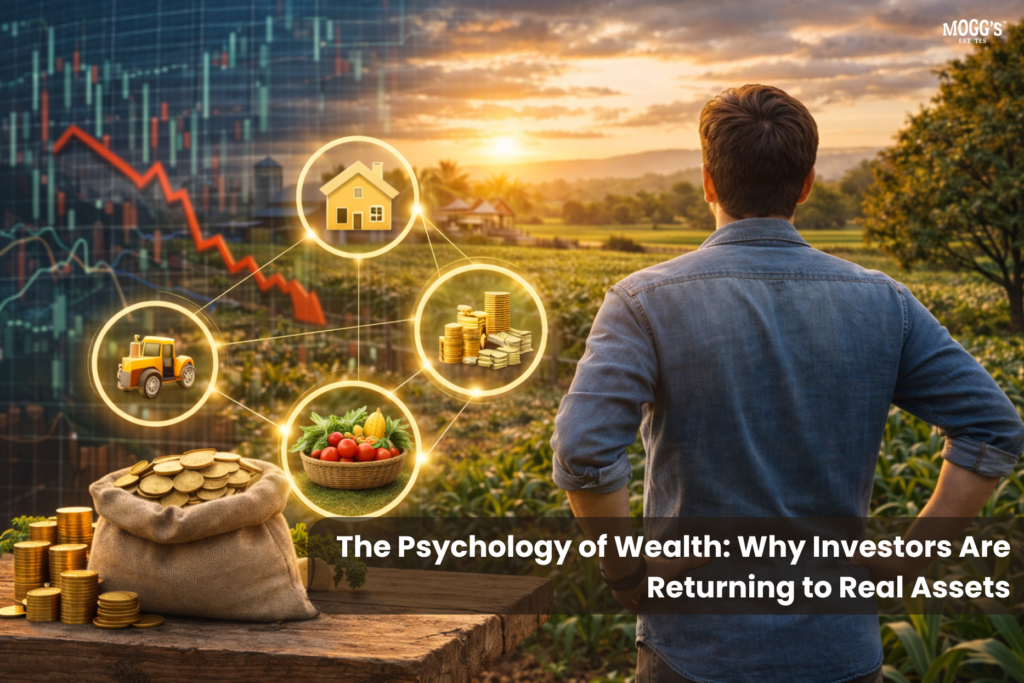
In an age of instant transactions, digital dashboards, and app based investing, wealth has never felt more abstract. Numbers move on screens, portfolios fluctuate by the hour, and ownership often feels temporary. Yet quietly, a shift is underway. Investors are returning to real assets. Not because they are outdated, but because they answer a deeper psychological need that digital wealth often fails to satisfy.
Across India, tangible assets like land and farmland are regaining attention. This is not a rejection of technology or markets. It is a recalibration. A return to assets that feel stable, understandable, and enduring. To understand why this shift is happening, we need to look beyond returns and into the psychology of wealth itself.
The Emotional Side of Investing
Every investment decision is emotional before it is rational. Fear, excitement, anxiety, and reassurance all shape how people allocate their money. Digital assets and stock markets move fast. That speed creates stimulation, but it also creates stress.
Daily market volatility triggers constant decision making. Buy. Sell. Hold. Check again. Over time, this mental load becomes exhausting. Even when portfolios grow, peace of mind often does not.
Real assets like land operate differently. They do not demand daily attention. Their value does not flash red or green every hour. This slower rhythm aligns better with how humans naturally process security and ownership.
This is one of the core reasons why tangible assets are regaining relevance in modern wealth planning.
Why Digital Wealth Feels Fragile
Digital investments are efficient, liquid, and scalable. They are also invisible. You cannot see them. You cannot touch them. You cannot walk on them.
From a psychological perspective, this matters more than most investors realize. Studies in behavioral finance show that people feel more secure when wealth is tied to something physical. Tangibility creates a sense of control and permanence.
When markets crash, digital wealth can feel like it disappears overnight. Even if losses are temporary, the emotional impact is immediate. This sense of fragility pushes investors to seek balance through assets that feel grounded.
Land, especially agricultural land, offers that grounding. It exists independent of market sentiment. It continues to serve a purpose regardless of economic cycles.
Tangible Assets and the Human Need for Certainty
Humans are wired to seek certainty in uncertain environments. Investing is inherently uncertain, but some assets soften that uncertainty better than others.
Tangible assets provide three psychological anchors:
First, visibility. You know what you own. Second, utility. The asset serves a real world function. Third, continuity. The asset exists across generations.
Farmland checks all three. It is visible. It produces food. It remains relevant decade after decade.
This is why farmland investment in India has always been part of generational wealth creation, even before it became a formal asset class.
The Shift From Speculation to Stability
Over the last decade, investors have been exposed to increasingly speculative opportunities. Cryptocurrencies, short term trading, and high risk instruments promise fast returns. Some succeed. Many do not.
What often follows is fatigue. Investors realize that excitement does not equal security. Fast money is mentally expensive.
As a result, there is a growing preference for assets that grow slowly but predictably. This shift is not about avoiding returns. It is about choosing returns that come with emotional stability.
Managed farmland fits into this mindset perfectly.
How Managed Farmland Reduces Investor Stress
Traditional farmland ownership came with challenges. Location constraints, lack of agricultural knowledge, and operational complexity made it impractical for urban investors.
Managed farmland models, such as those offered by Mogg’s Estates, change this equation.
By professionalising farm management, investors gain the benefits of land ownership without the daily involvement. Plantation, maintenance, harvesting, and monetisation are handled by experts. Ownership remains with the investor.
This separation of ownership and operations is powerful psychologically. Investors enjoy the reassurance of owning a real asset without the stress of managing it.
Real Assets and Long Term Thinking
Digital investing often encourages short term behavior. Notifications, alerts, and constant updates push investors toward frequent action.
Real assets encourage patience.
Farmland does not reward impulsive decisions. Its value unfolds over years through appreciation, crop cycles, and increasing demand for agricultural land.
This naturally aligns investors with long term thinking. When timelines extend, anxiety reduces. Expectations become realistic. Wealth feels intentional rather than reactive.
This is why farmland is increasingly being viewed as a long term investment in India rather than an alternative one.
The Role of Trust in Wealth Decisions
Trust is central to investing. Investors need to trust the asset, the system, and themselves.
Physical assets are easier to trust because their value proposition is simple. Land grows food. Food demand rises. Land becomes more valuable.
Managed farmland adds another layer of trust through transparency and structure. With clear documentation, defined management practices, and visible outcomes, investors feel informed rather than exposed.
Mogg’s Estates focuses on this clarity, allowing investors to understand exactly what they own and how value is created over time.
Tangibility and Legacy
Another psychological factor driving the return to real assets is legacy.
Many investors are no longer focused solely on personal wealth. They are thinking about what they leave behind. Digital assets can be inherited, but they often lack emotional weight.
Land carries stories. It becomes part of family identity. It represents foresight.
Farmland ownership allows investors to pass down not just value, but purpose. This is a powerful motivator, especially in the Indian context where generational planning is deeply ingrained.
Why Farmland Aligns With Modern Values
Today’s investors care about sustainability, impact, and responsibility. Farmland aligns naturally with these values.
Productive agricultural land supports food security, rural employment, and environmental stewardship. When managed responsibly, it contributes positively to society.
This creates alignment between financial goals and personal values. Wealth feels cleaner when it is connected to something meaningful.
Managed farmland projects by Mogg’s Estates are designed with long term sustainability in mind, reinforcing this sense of purpose driven ownership.
Portfolio Balance and Emotional Resilience
A well structured portfolio is not just financially diversified. It is emotionally diversified.
When all assets move together, stress multiplies. When one asset remains stable while others fluctuate, confidence improves.
Farmland provides this emotional ballast. It behaves differently from stocks and bonds. It is not influenced by daily market movements.
This makes it an effective portfolio stabiliser, reducing overall volatility and helping investors stay committed to their long term plans.
The Return to What Feels Real:
The renewed interest in tangible assets is not a step backward. It is an evolution.
As investing becomes more complex, investors crave simplicity. As wealth becomes more digital, they seek something real. As life becomes faster, they value assets that move at a human pace.
Farmland represents all of this.
Through managed farmland investment, platforms like Mogg’s Estates make it possible for modern investors to reconnect with real assets without compromising on convenience or professionalism.
Wealth is not just about accumulation. It is about how secure, calm, and confident you feel while building it.
The psychology of wealth is shifting. Investors are no longer chasing constant excitement. They are choosing assets that support long term stability, emotional ease, and lasting value.
In that shift, real assets are not just returning. They are reclaiming their place at the core of intelligent wealth creation in India.
And for many, farmland is where that journey now begins.