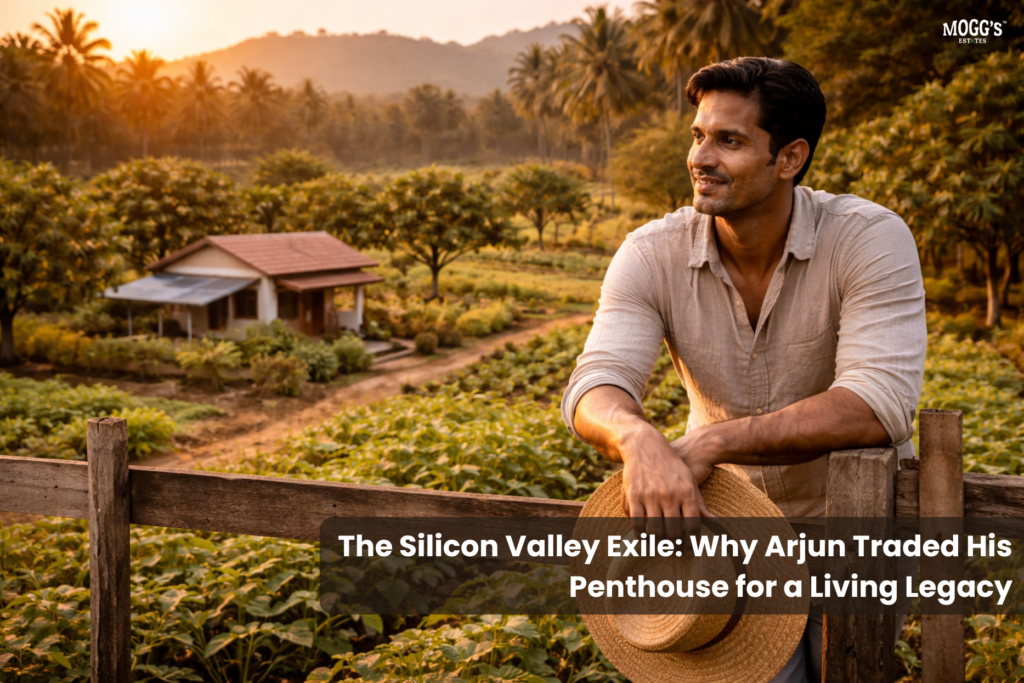
For Arjun, the “Bengaluru Dream” had started to feel like a very comfortable and very expensive cage. As a Senior Architect at a Tier-1 tech firm, his life was a masterclass in modern efficiency. He lived in a glass-walled penthouse in Whitefield. He drove an electric sedan that practically steered itself through the Silk Board crawl. He managed a team of developers across three time zones. His wealth was sophisticated. It was diversified across SIPs, crypto-assets, and ESOPs that flickered on his dashboard in shades of neon green. But one humid Tuesday evening, the power grid flickered. For three minutes, the high-speed Wi-Fi died. The air conditioning groaned to a halt. The ambient hum of the city vanished. In that sudden and heavy silence, Arjun looked at his hands. They were soft. They hadn’t touched anything that wasn’t made of brushed aluminum or Gorilla Glass in years. He realized that if the digital world paused, he owned nothing “real.” His wealth was high-velocity, but it had no roots. That night, he didn’t browse the stock markets. He searched for something older and something permanent. He started looking for the best-managed farmland in Karnataka.
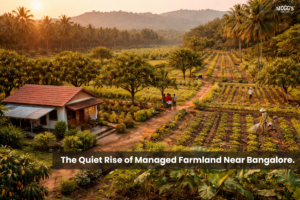
Arjun’s journey began with a realization that many of his peers were hitting simultaneously. The traditional real estate market in Bengaluru had hit a ceiling of “sameness.” He had looked at various luxury apartments near Sarjapur that promised “vertical gardens.” These were potted palms on a balcony overlooking a noisy construction site. He began researching farmlands near Bangalore, but the horror stories of the early 2000s haunted him. He worried about squatters and murky Legal titles. He feared the nightmare of local encroachment and the sheer impossibility of maintaining a farm while working a 60-hour week. He wanted the soil, but he didn’t have the time to be a full-time tiller. That’s when he discovered the concept of managed farmland. It wasn’t just a plot of land. It was an outsourced ecosystem. At the forefront of this movement was Mogg’s Estates. This was a company that didn’t just sell property. They offered a partnership with nature.
His scouting mission took him across the four corners of the city’s periphery to find the perfect fit. His first stop was the industrial-meets-agrarian belt of managed farmland near Hoskote. This area appealed to his logical side. The expansion of the Satellite Town Ring Road (STRR) meant that capital appreciation was a mathematical certainty. However, Mogg’s Estates showed him more than just a map. They showed him a vision of “Agri-tech” integration. The land was being prepared for high-value timber and fruit yields. Next, he drove down the “Green Corridor” to see managed farmland near Kanakapura. The air there felt thinner and cooler. It smelled of wet earth and eucalyptus. This wasn’t just an investment. It was a sanctuary where the focus was on sustainable farmlands. These projects were designed to recharge the water table rather than deplete it. A weekend trip even led him further south to managed farmland near Mysore. This area offered a connection to the Kaveri basin’s legendary fertility. It provided a slower pace of life that felt as steady and rhythmic as the seasons themselves.
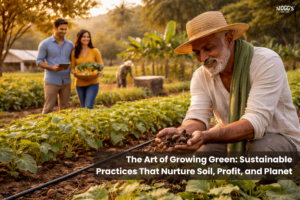
What finally stopped Arjun’s restless searching wasn’t a specific coordinate on a GPS. It was the Mogg’s Estates philosophy. Most developers were selling “Land 1.0,” which is just a fence and a prayer. Mogg’s Estates was offering “Land as a Service.” He sat down with the Mogg’s team and expected a sales pitch. Instead, he got a masterclass in Sustainability farmlands. They explained how they do not just sell the earth. They manage the biology of that earth through professional agronomy, security, and tech-monitoring. For a man who lived in the world of Service Level Agreements, this was music to his ears. Expert farmers and botanists would know exactly when to prune and nourish the trees. CCTV and digital updates would let Arjun check his sapling growth from his office in Indiranagar. This was a managed farmland model where the Legal due diligence was as deep as the borewells. This ensured that his investment was truly passive and secure.
One of Arjun’s biggest hurdles was the complexity of land laws in Karnataka. He had heard of “7/11 extracts” and “RTCs” but didn’t know his way through them. The Mogg’s team didn’t shy away from the Legal scrutiny. They provided a transparent 30-year trace of titles. They offered converted permissions where necessary and a clear roadmap of ownership. They emphasized that in the world of managed farmland near Bangalore, a clear title is as important as fertile soil. One without the other is a liability. For the first time in his investment history, Arjun felt he wasn’t buying into a scheme. He was securing a deed that would stand the test of time and government scrutiny.
Six months after his first visit to a Mogg’s Estates project, Arjun stood on his own acre. The sandalwood saplings were already a foot high. The organic vegetable patch at the corner of his plot was yielding tomatoes that actually tasted like sunlight. This patch was managed entirely by the on-site Mogg’s Estates staff. His “wealth” had changed. When his colleagues talked about the volatility of the tech sector, Arjun just smiled. He knew his managed farmland was quietly and stoically growing. It wasn’t subject to a CEO’s tweet or a sudden algorithm change. It followed the laws of biology and the steady rise of land scarcity. He realized that this was the ultimate hedge against inflation and urban burnout.
Last weekend, Arjun didn’t take his daughter Riya to a mall. They didn’t go to a sanitized plastic play-zone. They drove out to their farm. Riya spent three hours chasing a dragonfly. She learned that carrots come from the ground and not a grocery app. She watched the Mogg’s agronomists explain how mulch protects soil moisture. This was a lesson in Sustainability farmlands that no school textbook could replicate. As they drove back into the glowing orange haze of the Bengaluru skyline, Arjun felt a profound sense of relief. He had secured the best-managed farmland available. More importantly, he had bridged the gap between his digital success and his human needs. He was no longer just a Senior Architect of software. He was a steward of the earth. He held a legacy that would only grow stronger with every passing monsoon.
Are you still holding your wealth in pixels? Are you ready to plant it in the soil? The city is expanding, but the earth isn’t growing any more land. The window to own managed farmland near Bangalore is narrowing. You need a partner with clear Legal backing and a commitment to sustainable farmlands. Don’t just invest in a property.
Invest in a lifestyle that breathes and an asset that matures with grace.